Economy
Fix Bureaucracy to Attract More Investors—Elumelu Tasks FG

**Proposes ‘shared purpose’ to create economic, social wealth for citizens
By Dipo Olowookere
Federal Government has been charged to, as a matter of urgency, fix the bureaucracy in its parastatals, which frustrates the ease of doing business in Nigeria, so as to promote, attract and retain investors willing to do genuine business in the country.
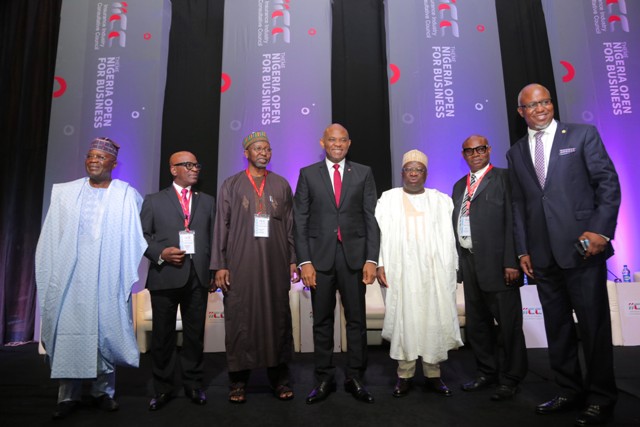
This charge was made by Chairman of Heirs Holdings, Mr Tony Elumelu, during an event held in Abuja on Monday.
Mr Elumelu, who delivered a speech on ‘Nigeria Open for Business’ at the 2017 National Insurance Conference organised by the Insurance Industry Consultative Council (IICC), pointed out that bureaucracy was a major challenge that needed to be tackled with a sense of urgency to curb excessive losses.
At the forum which took place at the Transcorp Hilton, the former banker cited a personal example, when the delays in the public sector led to a negative return on investment that forced his proprietary investment company, Heirs Holdings, to suspend the pursuit of its insurance license despite meeting the eligibility requirement and capitalisation benchmark.
“This bureaucracy is a cause for concern and if not tackled, will discourage otherwise willing investors from within and outside the country,” he said.
“Heirs Insurance Limited is an example where despite focused attempts to finalise a licence, the delay in processing has cost our company significantly in terms of resources and return on investment,” he added.
Though the business mogul applauded the present administration for its efforts so far in stabilising the Nigerian economy, he said much more still needed to be done to transform Nigeria into a country capable of attracting the right investments.
Mr Elumelu proposed that Nigeria’s transformation can only be achieved when the government and private sector work together in “shared purpose,” to create the economic and social wealth for the people.
He defined shared purpose as an alignment and commitment to 3Es – employment, empowerment and economic opportunity, where the government partners with the private sector to, not only design a business climate that creates job opportunities for the youths as in the case of the Tony Elumelu Foundation, but prioritises small and medium businesses.
Mr Elumelu ended his speech by calling on the government to define policies that ease the process of doing business in Nigeria.
“Predictability and consistency of policies must be embraced by our policy makers. We need the public sector to be willing partners in establishing the right, investment-worthy business environment we need in Nigeria. This is the only way Nigeria can be truly open for business,” he concluded.
In response to the speech, representative of the Deputy Governor of the Central Bank of Nigeria (CBN), Dr Joseph Nnanna, commended Mr Elumelu on the points raised, stating that the sector would proactively address the issues raised.
Other guests present at the event included the Commissioner for Insurance, National Insurance Commission (NAICOM), Mr Mohammed Kari, and Dr Okechukwu Enelamah, Minister of Industry, Trade and Investment (MITI).
Economy
NECA DG Warns of Growing Pressure on Businesses, Households
By Aduragbemi Omiyale
The Director General of the Nigeria Employers’ Consultative Association (NECA), Mr Adewale-Smatt Oyerinde, has run to the rooftop to warn of the negative impact of rising crude oil prices on businesses and households in the country.
In a statement on Monday, he said the Middle East crisis was pushing up domestic energy costs, placing pressure on businesses and eroding the purchasing power of citizens, warning that without urgent intervention, the situation could escalate.
According to him, fuel prices have risen sharply in recent days, with petrol exceeding N1,300 per litre in some locations and diesel approaching N1,800 per litre, reflecting the impact of global oil price movements.
He stressed that energy costs sit at the heart of Nigeria’s economy, and energy is the engine of production and distribution, noting that businesses, particularly in manufacturing, agriculture, and logistics, are already under significant pressure. “What we are witnessing is Nigeria’s oil paradox. Rising crude oil prices are pushing up domestic energy costs, squeezing businesses and worsening the cost of living for citizens.
“Once fuel prices rise, the effects are immediate and widespread: transport costs increase, food prices rise, and the overall cost of doing business escalates.
“For many firms that rely on diesel for operations, current price levels are becoming increasingly difficult to sustain. Profit margins are shrinking, and businesses are being forced to either pass on costs or scale down operations,” Mr Oyerinde stated.
The NECA DG further noted that global oil prices have surged amid geopolitical tensions, with Brent crude rising above $110 per barrel, intensifying cost pressures across energy markets.
He clarified that while the Middle East conflict has contributed to the rise in oil prices, the impact is exposing deeper structural weaknesses, underinvestment, weak infrastructure, and inefficiencies in Nigeria’s energy value chain.
“This situation is not only driven by external factors, but it is also reflecting ongoing constraints within the energy value chain, including supply inefficiencies and infrastructure limitations,” he disclosed.
“The government must act swiftly to ease supply constraints, stabilise prices, and provide targeted relief to critical sectors, he declared, emphasising that, “If this trend continues unchecked, we risk business closures, job losses, and a deeper cost-of-living crisis.”
On the long-term outlook, Mr Oyerinde emphasised the need for structural reforms. Nigeria’s resilience will not be determined by oil prices, but by how effectively we manage them. This is a moment to strengthen institutions, improve transparency, and invest in sustainable energy solutions.
He concluded with a caution that if properly managed, “this could strengthen our economy. If not, the gains from rising oil prices will be completely eroded by inflation and economic hardship.”
Economy
NAICOM Rules Out Extension of July 31 Recapitalisation Deadline
By Adedapo Adesanya
The National Insurance Commission (NAICOM) has stressed that it has no intention of extending the deadline of the ongoing insurance recapitalisation exercise fixed for July 31, 2026.
The Commissioner for Insurance, Mr Olusegun Omosehin, at a high-level media briefing in Lagos, emphasised that “The 31 July deadline is sacrosanct.”
Mr Omosehin rationalised that NAICOM said it was not worried by the sluggishness of some underwriting companies towards the exercise.
“It is embedded in the law, and as a regulator, we do not have the powers to alter a date set by an Act of the National Assembly,” he explained, noting that the timeline is a statutory requirement under the Nigeria Insurance Industry Reform Act of 2025.
“We would not be drawn into a last-minute rush or entertain pleas for extensions,” Mr Omosehin warned, adding that any adjustment to the schedule would require a formal amendment of the Act by the National Assembly and subsequent presidential assent, a path he stated the commission is not prepared to take.
He further noted that while 20 insurance companies have officially stepped forward to begin their capital verification process, the level of urgency across the board does not match the requirements of the law.
“We want a stronger, more resilient industry that can support Nigeria’s target of a $1tn economy,” the Commissioner added, stressing that the ultimate goal is not just capital but the capability to underwrite large risks and protect policyholders.
“Capital alone is not the goal; it is about the capability to underwrite large risks,” he reiterated, while urging operators who may lack the “stand-alone stamina” to meet the new requirements to consider mergers and acquisitions immediately rather than waiting.
“We warn against ‘emergency marriages’ concluded at the eleventh hour, as such ad hoc arrangements often lead to lingering liabilities and post-merger integration crises,” Mr Omosehin said.
The NAICOM chief also confirmed that the regulator is currently scanning all operating firms and will soon make the results of this regulatory assessment public.
While re-emphasising the July 31 deadline, he warned that all funds raised must be deposited in designated escrow accounts.
Economy
BudgIT Raises Alarm Over Poor Transparency in Nigeria’s Local Government Budgets
By Adedapo Adesanya
Governance transparency platform, BudgIT, has expressed worry that only 10 states provided publicly accessible budget information for their Local Government Areas (LGAs).
The report, titled The Missing Tier: Mapping Local Government Budget Transparency in Nigeria, found that while six states offer partial or outdated disclosures, as many as 18 states do not publish any LGA budget data at all.
Despite the existence of these budgets at council secretariats nationwide, BudgIT noted that access remains largely restricted, particularly online.
“For most of Nigeria’s 774 local governments, those budgets are not publicly accessible online,” the report stated.
Among the states assessed, Ekiti emerged as the top performer, with a comprehensive system that includes detailed, up-to-date budget documentation for its councils.
Other states identified as making LGA budget information available include Ebonyi, Osun, Kebbi, Kogi, Enugu, Kaduna and Yobe.
However, the report cautioned that even among these states, data quality remains inconsistent, with several budgets either incomplete, outdated, or poorly structured.
BudgIT highlighted notable examples of improved accountability practices.
Ekiti State, for instance, publishes individual 2026 budgets for all its LGAs and LCDAs, accompanied by signed documents, consultation records, and standardised financial templates.
Cross River State also stood out for releasing individual council budgets, audited accounts, and quarterly performance reports.
Similarly, Borno State was commended for maintaining a consolidated 2025 budget alongside supporting financial documents, suggesting a structured and functional reporting system.
The report identified six states with limited transparency, providing only fragmented or outdated information.
Kano State, for example, publishes quarterly performance reports but lacks full-year approved budgets.
In Imo State, no LGA budgets were found, although a financial statement from the Accountant-General was available.
Ondo State reportedly released documents for only a portion of its LGAs, while Anambra published an appropriation law without detailed breakdowns. Ogun State, meanwhile, only provided data for 2024.
BudgIT further disclosed that a large number of states fail entirely to make LGA budgets public.
These include Abia, Adamawa, Akwa Ibom, Bauchi, Bayelsa, Benue, Delta, Edo, Gombe, Jigawa, Katsina, Lagos, Nasarawa, Niger, Oyo, Plateau, Rivers, Sokoto, Taraba, and Zamfara.
According to the organisation, the issue is not the absence of budget documents but the lack of public access to them.
“Yet for most of Nigeria’s 774 local governments, those budgets are not publicly accessible online,” the civic tech firm said.
BudgIT stressed that improving transparency at the local government level does not require complex reforms but rather a deliberate policy decision.
“Since state governments already publish their own budgets online, extending the same standard to local councils is neither complex nor costly; it is a matter of institutional choice,” the organisation said.
It added, “This choice is a critical one; Nigeria’s post-1999 experience with democracy has not had Local Governments with significant autonomy. Be that as it may, LGAs still have the opportunity to make public what they budget, what they spend and what they earn.”
Highlighting the benefits of openness, the report noted that transparency enables citizens to track public spending and hold officials accountable.
“Where they are withheld, accountability stops at the state level, leaving the tier closest to citizens financially opaque,” BudgIT said.
-
Feature/OPED6 years agoDavos was Different this year
-
Travel/Tourism10 years ago
Lagos Seals Western Lodge Hotel In Ikorodu
-
Showbiz3 years agoEstranged Lover Releases Videos of Empress Njamah Bathing
-
Banking8 years agoSort Codes of GTBank Branches in Nigeria
-
Economy3 years agoSubsidy Removal: CNG at N130 Per Litre Cheaper Than Petrol—IPMAN
-
Banking3 years agoSort Codes of UBA Branches in Nigeria
-
Banking3 years agoFirst Bank Announces Planned Downtime
-
Sports3 years agoHighest Paid Nigerian Footballer – How Much Do Nigerian Footballers Earn