

Education
Robert E. Hall, Michael Woodford Win 2026 Nobel Economics Prize

By Adedapo Adesanya
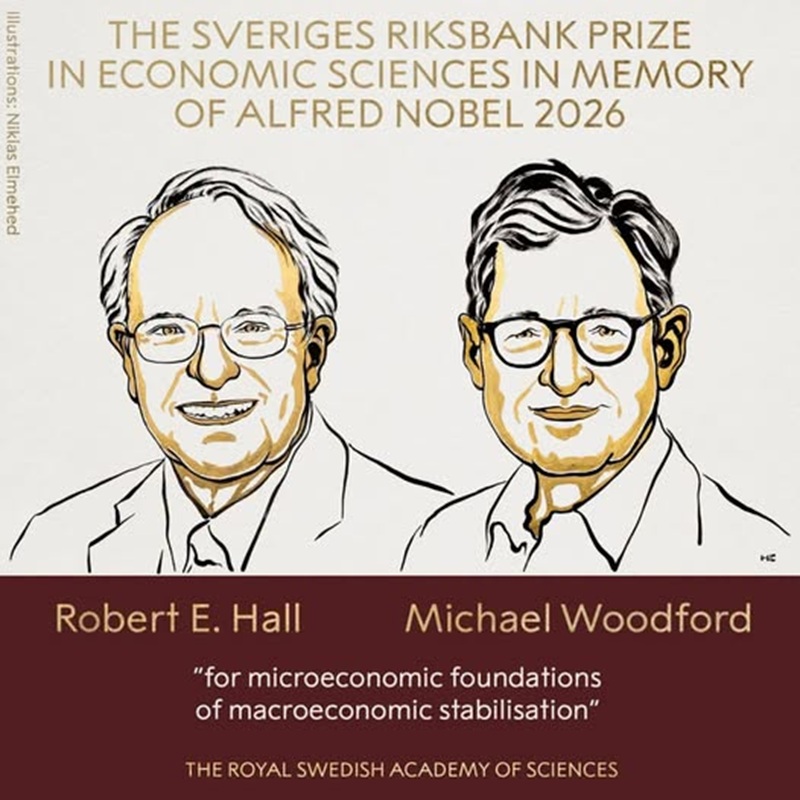
The Royal Swedish Academy of Sciences has awarded the 2026 Sveriges Riksbank Prize in Economic Sciences in Memory of Alfred Nobel to Robert E. Hall and Michael Woodford for their work on the microeconomic foundations of macroeconomic stabilisation.
Hall, a professor at Stanford University in the United States, and Woodford, a professor at Columbia University in New York, were recognised for developing economic models that have improved governments’ and central banks’ ability to manage economic fluctuations through fiscal and monetary policies.
According to the academy, their work has provided a stronger theoretical foundation for designing policies that can reduce the severity of economic downturns and prevent economies from overheating.
The academy said the laureates’ models enable policymakers to better understand how households and businesses make decisions about savings, consumption and prices, and how these decisions influence the wider economy.
Their approach moved away from relying primarily on statistical relationships between macroeconomic variables, such as inflation, output and consumption, towards models built on the economic decisions of individuals and businesses.
The academy explained that households and businesses make forward-looking decisions, meaning their expectations about future economic conditions influence their present behaviour. By communicating their policy plans, governments and central banks can shape these expectations and help steer economic activity in the desired direction.
The work is particularly relevant to stabilisation policies, which typically involve lowering interest rates and increasing government spending or budget deficits during recessions, while tightening monetary and fiscal conditions when economic activity becomes excessive.
The academy noted that the effectiveness of earlier Keynesian economic models came under scrutiny during the oil crises of the 1970s, when many Western economies experienced slow growth, high unemployment and rising inflation.
Hall and Woodford’s work helped reconstruct the theoretical basis of stabilisation policy, providing policymakers with improved tools to respond to economic shocks, including energy crises and sudden changes in household consumption.
“The laureates’ work has provided us with a stable theoretical foundation for the models that are now used by central banks and governments around the world,” said John Hassler, chair of the Committee for the Prize in Economic Sciences.
“With them, we are better equipped to deal with shocks in the economy, such as energy crises or sudden changes in how much households consume,” he added.
The prize carries an award of 12 million Swedish Kronor ($1.2 million), to be shared equally between the two laureates.
Hall was born in 1943 in Palo Alto, California, and obtained his doctorate from the Massachusetts Institute of Technology in 1967. Woodford was born in 1955 in Chicopee, Massachusetts, and earned his doctorate from the same institution in 1983.