

World
Russia’s Media Diplomacy Focusing on African Information Space and Frontiers

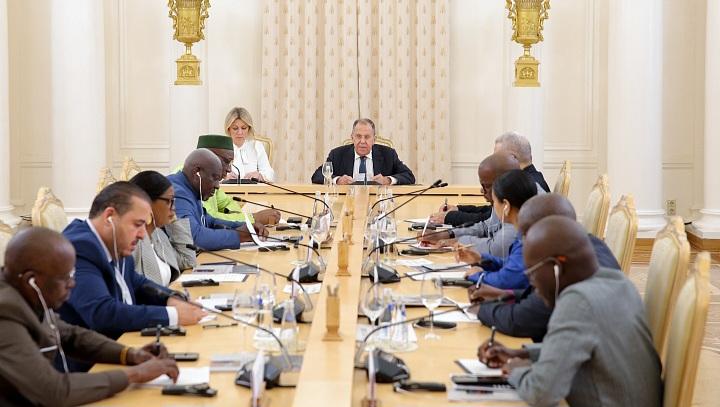
By Kestér Kenn Klomegâh
At the Russia-Africa summit, Foreign Minister Sergey Lavrov pledged expanded Russian media support across Africa, citing RT’s near-billion audience, Sputnik bureaus in Addis Ababa and Johannesburg, and the new African Initiative agency. Without reservation, Lavrov highlighted media-cooperation clauses in the 2023 and 2027–2029 Russia-Africa action plans, plus joint fact-checking efforts, as tools to counter Western dominance and disinformation.
On the other hand, African media representatives stressed the need for African-produced content for African audiences rather than one-way Russian narratives, noting the continent’s 1.5 billion people and roughly 380-million middle class, which constitutes an information-consuming market, while taking note that Russian media outlets provide objective information, and therefore their presence in Africa offers an opportunity to balance Western news reports. Admittedly, Western media plays an important recognisable role, including training African media practitioners and, at the same time, providing necessary financial support across Africa.
Foreign Minister Lavrov, with heads of leading African media outlets, offered the assurance, as a concrete diplomatic blitz, that Russia, after the Russia-Africa summit, expands and supports media operations across Africa. And African media representatives, captured the opportune moment outlined the landscape, emphasising the dominance of Western media in Africa, and urged Russian authorities to consider seriously the opening of media outlets also in the Russian Federation.
Bilateral media collaboration has been rising, but African media representatives prefer their own operatives rather than reproducing Russia’s one-way reports and narratives. Psychologically impactful Africans reading reports largely written by Africans. While Lavrov describes “the African continent as a unique civilisation and one of the key pillars of the multipolar world that is now actively taking shape on the international stage as an objective historical process,” the African media directors, at the meeting, also expressed commitment to build media content by Africans, to some degree with an African focus, for an African audience.
With an estimated 1.5 billion people, and approximately 380 million forming the middle class, Africa’s information-consuming market is twice Russia’s population. Lavrov maintains that Russian media could do the media job by exchanging Russian-written content for reproduction and distribution by African media channels. That’s enough to simply do the trick, news-feeding Africa. That would counteract Western narratives. “There are representatives of the Western elites – and it is they who are constantly flashing up on screens and on social media, and it is they who determine the “face” of the West in the modern world. These representatives do not care about the interests of their peoples and states,” Lavrov explained at the meeting.
Lavrov further mentioned, Russia Today (RT) television channel, operates in many languages: English, French, Spanish, German, Arabic, Serbian. The total audience of RT, by estimates, is almost a billion people. Its material is accessible in more than a hundred countries, including Africa. In addition, there are traditional news agencies, such as TASS and RIA Novosti. With their long-standing historical traditions, they are now mastering new methods of information work–and, by and large, with success.
As for Africa, the Sputnik news agency has already created editorial centres in Addis Ababa and Johannesburg, and is also setting up similar structures in Tanzania. Finally, the African Initiative news agency is the latest media project that focuses entirely on Africa by opening its bureaus in many African countries. Lavrov also stressed that the Ministry of Foreign Affairs supports foreign journalists, who are accredited in the Russian Federation to learn more truthful information about the country.
By the way, bilateral cooperation is necessary to balance media operations in Russia and across Africa, with more than 1.5 billion people. The bilateral argument can resolve the current growing geopolitical problems, fake reports allegedly spread by Western media. There are so many unresolved questions, but Lavrov was direct with one more question relating to the media during the meeting in late October 2026.
When asked how countries of the Global South join forces to strengthen their information sovereignty, combat disinformation and ensure fair coverage of the African perspective in international news, while upholding the principles of professional journalism, he said, “I touched on this subject when answering one of the earlier questions. The task of upholding one’s equal place in the international media space requires a wide variety of daily efforts–both individually and at the corporate level, as well as at the interstate level, when governments seek access for their media outlets to the markets of other countries.
When it comes to contemporary working methods, given the development of digital technologies and artificial intelligence, new opportunities have emerged. Admittedly, as the saying goes, it is a double-edged sword, because artificial intelligence can also be used–and is being used most actively–to produce fake news. This is not good for the media landscape and, above all, for audiences everywhere.
“We are in favour of developing cooperation by exchanging expertise in the use of modern technologies, artificial intelligence and other information and communications technologies. Incidentally, the relevant sections on interaction in the media sphere are contained in the joint action plan that was adopted in 2023 at the Russia-Africa Summit in St. Petersburg. A relevant section has also been included in the new plan for 2027–2029, at the 3rd Russia-Africa Summit in Moscow.
“In fact, Russian media outlets provide objective information, and therefore their presence in Africa offers an opportunity to provide balance to the news and assessments that come from other parts of the globe.
“Russian media operate in 44 African countries, including broadcasts in Swahili and Amharic. Take Sputnik and RT, for example. Speaking of the Confederation of Sahel States, the RT television channel was the first foreign partner to sign a cooperation agreement with Tafouk TV, the television channel of the Confederation of Sahel States. This took place in Niamey in July 2026. We actively promote a new international movement–the Global Fact-Checking Network. This is an organisation that brings together around 150 journalists, political scientists and specialists from 55 countries and holds annual events on combating disinformation.
“In addition to the above, more than 130 experts from 55 countries are members of an association which uses artificial intelligence, among other things, to identify unreliable materials at the early stages of their distribution. Its specialists also strive to identify the source of a fake, trace the chain of its distribution and find out how it was launched into the information space. Sergey Lavrov has, convincingly, invited African media directors, practising journalists, and independent experts to join the Global Fact-Checking Network (GFCN).”