

Media OutReach
World-Leading Computing, AI and Robotics Technologies Converge at China Hi-Tech Fair as 10,000 Overseas Buyers Drive Global Procurement

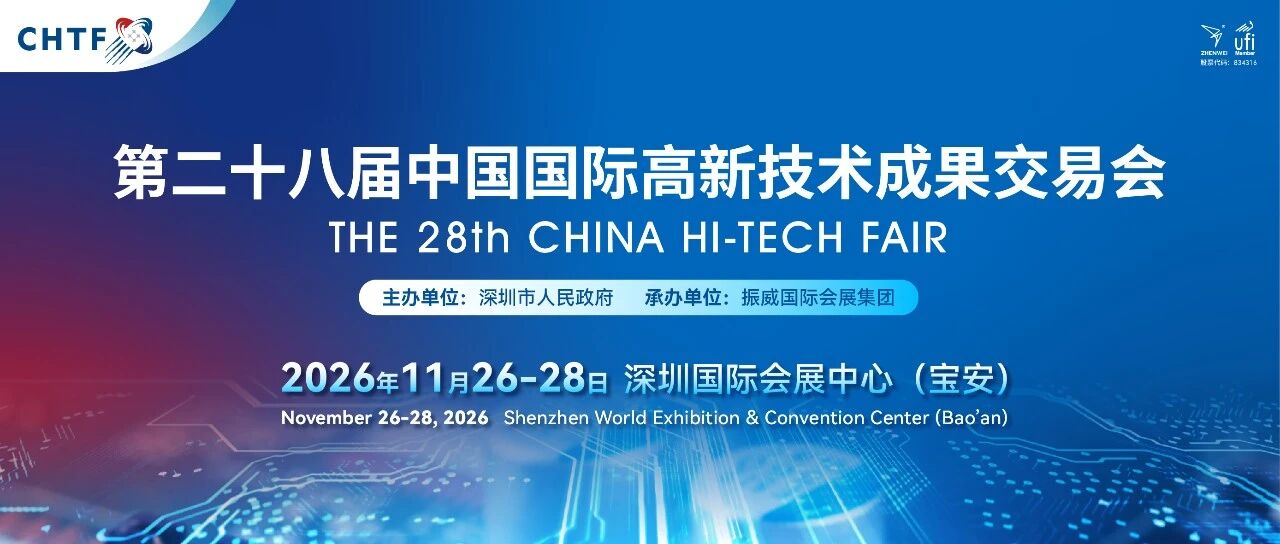
The 28th China Hi-Tech Fair (CHTF) will take place from November 26 to 28, 2026, at the Shenzhen World Exhibition & Convention Center in Bao’an. This year’s exhibition will bring together world-leading computing, artificial intelligence and robotics technologies. Unitree Robotics, Spirit AI, DEEP Robotics, Noetix Robotics, Booster Robotics, Luming Robotics, Inspire Robots and LinkerBot will join other innovators across the embodied AI ecosystem and its industrial value chain. Meanwhile, 10,000 overseas buyers will gather in Shenzhen, creating new opportunities for global procurement and business partnerships.
From computing infrastructure to intelligent robot brains, from system integration to dexterous manipulation, and from technology demonstrations to international trade, CHTF will present an annual showcase of China’s technological capabilities, bringing cutting-edge innovation together with global buyers.
1. Powered by Computing, Driven by AI: World-Leading Technologies Converge at CHTF
Competition in the intelligent era begins with foundational technological capabilities. Computing power provides the infrastructure for the advancement of artificial intelligence and embodied AI.
From large-model training and inference to real-time robotic perception and decision-making, advanced computing power is essential. CHTF has long served as a major platform for showcasing cutting-edge computing technologies. From chips and servers to AI computing centers and edge computing, and from general-purpose computing to AI computing, the fair brings together world-leading technologies and products that drive innovation in AI and robotics.
While computing power provides the foundation, artificial intelligence enables robots to become genuinely intelligent. By integrating large AI models with physical systems, robots are evolving beyond executing predefined instructions to understanding tasks, coordinating movements and adapting to changing conditions. The integration of computing power and AI is redefining robotic capabilities and opening new possibilities for the large-scale deployment of embodied AI.
At this year’s CHTF, advanced computing and AI technologies will be showcased alongside complete robotic systems, core components and practical applications, presenting a comprehensive technological landscape from foundational infrastructure to end-user applications.
2. Robotic Systems and Core Components: An Annual Showcase of Embodied AI Capabilities
The participation of Unitree Robotics, DEEP Robotics, Noetix Robotics, Booster Robotics and Luming Robotics highlights the technological breadth of this year’s robotics exhibition. The significance of this gathering becomes even clearer when examining the different technological approaches pursued by these companies.
Unitree Robotics develops humanoid and quadruped robots, while Noetix Robotics focuses on humanoid robotics and embodied AI. Booster Robotics provides humanoid robotic platforms and development tools for developers. Their distinct product strategies address different industry challenges: improving robotic mobility, simplifying development and supporting a wider range of tasks and applications.
Competitive advantages in robotics often lie in technical details. Stable locomotion requires coordination between mechanical structures, joint performance and control algorithms. Continuous movements depend on balance, responsiveness and execution. Developer-oriented products must translate hardware capabilities into accessible and extensible development platforms. Bringing leading companies together provides a valuable opportunity for visitors to compare product designs, developers to identify suitable technology platforms, and industry partners to explore potential collaborations.
3. From the Brain to the Fingertips: Innovation Lies in the Details
Once a robot has a physical body, understanding tasks, coordinating movements and adapting to changing conditions become fundamental challenges for embodied AI.
Spirit AI focuses on developing a general-purpose robotic brain that connects perception, decision-making and execution. Its research explores how robots understand their surroundings, select appropriate actions and adjust based on execution outcomes. When an object’s position, shape or orientation changes, the robot must reassess its approach. When a single grasping action becomes a sequence of operations, movements must be coordinated accordingly. Even a seemingly simple action requires multiple capabilities working together.
This coordination becomes more tangible when attention shifts from the brain to the hands. Inspire Robots focuses on miniature precision motion components, servo control and dexterous robotic hands, while LinkerBot develops dexterous hands, data collection systems and related software. Their respective technologies support robotic manipulation through precision actuation, operational capabilities and data. Grasping objects made of different materials requires precise force control; adjusting an object’s orientation requires coordinated finger movements; and completing continuous tasks requires real-time coordination between perception and execution. These details define the challenges of dexterous manipulation.
Evaluating embodied AI therefore requires looking beyond a robot’s physical appearance. Advances in joints, actuators, dexterous hands, perception and control can fundamentally expand the range of tasks robots can perform. Complete robotic systems demonstrate these capabilities, core components enable them, and algorithms and data drive their continued evolution.
4. Real-World Applications Define Commercial Value
The capabilities of embodied AI must be evaluated in specific operating environments. Flat surfaces and complex terrain present different challenges, while one-time demonstrations and continuous operations impose different requirements for stability and reliability. In real-world applications, deployment, maintenance, safety and cost become critical considerations.
DEEP Robotics offers a practical example through its applications in power infrastructure inspections, emergency response, utility corridors and tunnels. In these environments, robotic mobility must be integrated with task-specific payloads, sensing equipment and operational workflows. The ability to reach designated locations, collect meaningful data and adapt to on-site conditions directly determines practical value. For customers, technical specifications ultimately come down to one question: whether the robot can perform the job effectively.
Competition among embodied AI companies is therefore increasingly defined by system-level capabilities. Hardware, algorithms and application scenarios require continuous adaptation, product performance must be balanced against operating costs, and capabilities demonstrated under laboratory conditions must be validated in real-world tasks.
5. 10,000 Overseas Buyers Gather in Shenzhen, Driving Global Procurement
Cutting-edge technologies and innovative products must ultimately prove their value in the marketplace. As a major platform for China’s international engagement and high-tech trade, CHTF has long been a preferred destination for global buyers seeking insights into China’s technological developments and access to quality suppliers.
This year’s CHTF will bring together 10,000 overseas buyers in Shenzhen with specific procurement needs and investment interests. International buyers will gain access to world-leading computing and AI technologies, alongside a comprehensive robotics ecosystem spanning complete systems, core components and solutions. From exploring technology trends and evaluating products to testing samples and placing bulk orders, the exhibition provides an integrated procurement experience.
The convergence of technology and commerce extends the exhibition’s value beyond product discovery to commercialization. Product demonstrations can lead to discussions about deployment requirements and operational workflows, while technical exchanges can develop into joint development, system integration and application validation. End users seek products that address specific operational needs, robot manufacturers identify component suppliers and technology partners, and international buyers connect with Chinese innovators. Direct engagement between suppliers and buyers helps transform technology demonstrations into business opportunities and commercial orders.
6. An Annual Gathering Showcasing the Complete Industrial Value Chain
The significance of this annual gathering lies in its ability to bring innovations from across the industrial value chain into focus. Robot manufacturers demonstrate system integration and product capabilities, core component suppliers showcase the technologies underpinning robotic performance, and algorithm developers and application teams connect robotic capabilities with specific tasks. Industry collaboration creates broader opportunities for these innovations. For buyers, this comprehensive showcase supports more informed product and solution evaluations. For industry partners, it facilitates collaboration across the value chain. For exhibitors, it provides an opportunity to demonstrate technological strengths and establish industry recognition.
The companies sharing the exhibition floor reflect the industry’s competitive landscape, while the technologies they present demonstrate their capabilities. A company’s industry standing is built through sustained advances in products, technologies and applications. Platforms such as CHTF allow these achievements to gain recognition among customers, business partners and the wider industry.
From advanced computing and artificial intelligence to coordinated robotic movements, precision manipulation, real-world task execution and global procurement, the next stage of China’s technological advancement is being driven by companies across the industrial value chain. This annual showcase will highlight the innovators advancing critical technologies, enabling practical applications and connecting with global markets.
Hashtag: #ChinaHi-TechFair
The issuer is solely responsible for the content of this announcement.