Connect with us

Economy

Asian Stocks Close Broadly Higher Despite Selling Pressure on Japanese Shares

Published

on

By Investors Hub

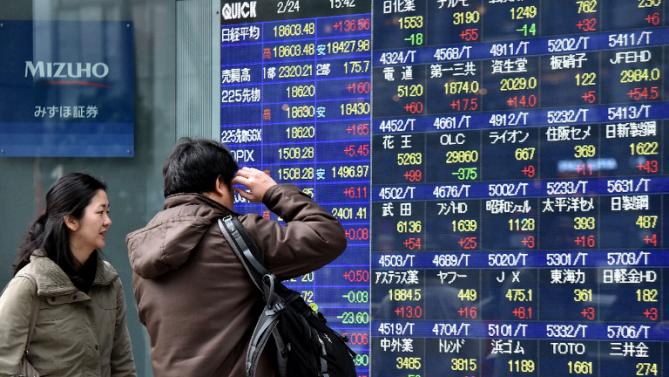
Asian stocks closed broadly higher on Monday, although concerns over a rising yen kept Japanese shares under selling pressure.

While upbeat Japanese GDP data, deteriorating Fed rate expectations and easing geopolitical concerns helped spur some bargain hunting after last week’s steep losses, lower oil prices and disappointing Chinese data kept a lid on overall gains in the region.

China’s industrial production growth eased at a faster-than-expected pace in July, official data from the National Bureau of Statistics showed.

Industrial production climbed 6.4 percent year-over-year in July, slower than the 7.6 percent spike in June. Economists had expected the growth to moderate to 7.1 percent.

Retail sales advanced 10.4 percent annually in July, following a 11.0 percent surge in the prior month. The expected rate of growth for the month was 10.8 percent.

Fixed asset investment grew at a slightly slower pace of 8.3 percent in July from a year ago, after a 8.6 percent hike in June.

China’s Shanghai Composite index jumped 28,82 points or 0.90 percent to 3,237.36 while Hong Kong’s Hang Seng index was up nearly 1.4 percent at 27,250 in late trade.

Japanese shares fell sharply to hit a 3-1/2-month low as trading resumed after a long holiday weekend.

The Nikkei average fell 192.64 points or 0.98 percent to 19,537.10, the lowest level since May 2, as concerns over a rising yen offset data that showed the Japanese economy grew at the fastest pace in more than two years in the second quarter.

The broader Topix index closed 1.12 percent lower at 1,599.06, dragged down by exporters and financials.

Japan’s GDP surged an annualized 4.0 percent in April-June – topping expectations for 2.5 percent and up from the upwardly revised 1.5 percent jump in the first quarter, official data showed.

Australian shares advanced, led by material and financial stocks as London copper and aluminum prices held near recent two-year highs on a weaker dollar following Friday’s weak U.S. inflation data.

The benchmark S&P/ASX 200 rose 37.30 points or 0.66 percent to 5,730.40 while the broader All Ordinaries index ended up 35.10 points or 0.61 percent at 5,778.60.

Bendigo and Adelaide Bank soared 7.5 percent on reporting a 4.2 percent increase in its full-year cash profit. Commonwealth Bank of Australia rose 1 percent after the bank announced the departure of its chief executive Ian Narev by the end of the 2018 financial year.

Mining giants BHP Billiton and Rio Tinto gained about 1 percent each while smaller rival Fortescue Metals Group advanced 1.1 percent. Gloves and protective clothing maker Ansell tumbled 3.1 percent after its full-year profit missed forecasts.


Modupe Gbadeyanka is a fast-rising journalist with Business Post Nigeria. Her passion for journalism is amazing. She is willing to learn more with a view to becoming one of the best pen-pushers in Nigeria. Her role models are the duo of CNN's Richard Quest and Christiane Amanpour.

Advertisement
Click to comment

Leave a Reply

Your email address will not be published. Required fields are marked *

Economy

Five Price Gainers Lift NASD Index by 0.22% as Market Cap Adds N5.6bn

Published

on

NASD Unlisted Securities Index

By Adedapo Adesanya

The NASD Over-the-Counter (OTC) Securities Exchange went up by 0.22 per cent on Friday, March 6, as a result of the rise in the share prices of five securities on the platform.

During the session, the market capitalisation of the bourse added N5.60 billion to close at N2.519 trillion versus the preceding session’s N2.513 trillion, and the NASD Unlisted Security Index (NSI) appreciated by 9.35 points to 4,256.41 points from 4,256.41 points.

The five price gainers were led by 11 Plc, which gained N29.02 to close at N319.25 per unit versus Thursday’s closing value of N290.23 per unit, Central Securities Clearing System (CSCS) Plc appreciated by N1.19 to N81.35 per share from N80.16 per share, Nipco Plc increased by N1.00 to N285.00 per unit from N284.00 per unit, FrieslandCampina Wamco Nigeria Plc rose by 72 Kobo to N125.20 per share from N124.48 per share, and UBN Property Plc improved by 19 Kobo to N2.17 per unit from N1.98 per unit.

On the flip side, Okitipupa Plc lost N20.00 to settle at N230.00 per share compared with the previous day’s N250.00 per share, NASD Plc declined by N5.21 to N51.00 per unit from N56.21 per unit, and First Trust Mortgage Bank Plc declined by 21 Kobo to N1.90 per share from N2.11 per share.

The volume of securities traded by market participants went down by 10.6 per cent yesterday to 3.4 million units from 3.8 million units, and the value of securities dropped 85.3 per cent to close at N62.4 million versus N423.3 million, while the number of deals jumped 4.8 per cent to 44 deals from 42 deals.

CSCS Plc remained the most traded stock by value (year-to-date) with 37.2 million units valued at N2.3 billion, followed by Okitipupa Plc with 6.3 million units worth N1.1 billion, and MRS Oil Plc with 3.4 million units sold for N506.8 million.

Resourcery Plc was the most traded stock by volume (year-to-date) with 1.05 billion units traded for N408.7 million, followed by Geo-Fluids Plc with 123.1 million units transacted for N481.6 million, and CSCS Plc with 37.2 million units worth N2.3 billion.

Continue Reading

Economy

Naira Loses N5.82 at NAFEX to Sell N1,393/$1

Published

on

currency in circulation eNaira

By Adedapo Adesanya

For another week, the Naira closed without recording a gain against the United States Dollar at the Nigerian Autonomous Foreign Exchange Market (NAFEX), as FX demand pressure continues to mount.

On Friday, the country’s legal tender further depreciated against the greenback by N5.82 or 0.42 per cent to trade at N1,393.26/$1 compared with the preceding day’s N1,387.45/$1.

Also, the local currency tumbled against the Pound Sterling in the official market segment yesterday by N7.61 to close at N1,859.99/£1 versus Thursday’s closing price of N1,852.38/£1, and crashed against the Euro by N1.58 to settle at N1,611.49/€1, in contrast to the N1,609.86/€1 it was traded a day earlier.

In the same vein, the Naira declined against the Dollar at the GTBank forex desk by N12 during the session to quote at N1,410/$1 versus the previous session’s rate of N1,398/$1, and at the parallel market, it lost N10 to sell for N1,415/$1 compared with the preceding day’s N1,405/$1.

The domestic currency continued its decline despite $300 million in FX intervention sales to banks by the Central Bank of Nigeria (CBN), indicating that the rising demand for foreign payments is outpacing supply. However, worries have heightened as the Naira is entering a threshold that has not previously created panic.

In the international market, the US Dollar held broadly steady and saw its steepest weekly gain in more than a year as the escalating conflict in the Middle East drove demand for safe-haven assets. This creates pressure on other currencies.

This also affected the cryptocurrency market. As tensions escalated in the Middle East last week, investors moved quickly to the safety of the US Dollar, which strengthened as markets began pricing in higher energy prices and reignited inflation fears, potentially delaying Federal Reserve rate cuts.

Ethereum (ETH) dipped by 4.9 per cent to $1,975.54, Solana (SOL) depreciated by 4.8 per cent to $84.08, Bitcoin (BTC) lost 4.3 per cent to sell for $67,725.27, Cardano (ADA) slumped 4.2 per cent to $0.2527, and Litecoin (LTC) shrank by 3.4 per cent to $53.55.

Further, Dogecoin (DOGE) declined by 3.2 per cent to $0.0906, Binance Coin (BNB) slipped 2.9 per cent to $626.32, and Ripple (XRP) went down by 2.6 per cent to $1.36, while the US Dollar Tether (USDT) and the US Dollar Coin (USDC) closed flat at $1.00 each.

Continue Reading

Economy

Brent Hits $92, WTI $90 as War Raise Prices

Published

on

brent crude oil

By Adedapo Adesanya

Crude futures climbed 12 per cent on Friday due to disruptions to global oil supplies because of the expanding ‌US-Israel war with Iran.

During the session, Brent crude futures settled at $92.69 a barrel after gaining $7.28 or 8.52 per cent, and the US West Texas Intermediate (WTI) crude futures finished at $90.90 a barrel, up $9.89 or 12.21 per cent.

In one week, WTI rose 35.63 per cent, and Brent climbed 27 per cent, the biggest weekly gains since the COVID-19 pandemic in 2020.

Disruptions to the Middle East supply and tanker traffic through the Strait of Hormuz continue to rattle global energy markets.

The strait is a narrow waterway which handles roughly a fifth of the world’s traded crude, making it one of the most critical chokepoints in the global oil system. Even partial disruptions or perceived risks to tanker traffic can trigger rapid price moves as traders scramble to price in supply uncertainty.

With the Strait now effectively closed for seven days, that means about 140 million barrels of oil have been unable to reach the market. Vessel traffic has effectively dropped from an average of 138 ships a day to around 1 or 2.

The conflict has spread across the Middle East’s key energy-producing areas, disrupting output and forcing ​shutdowns of refineries and liquefied natural ​gas plants.

Qatar’s energy minister told the Financial Times he expects all Gulf energy producers to shut down exports within weeks, a move he said could drive oil to $150 a barrel. Kuwait is also discussing cutting production even further, and refining operations as well, to levels that would match what would be needed domestically.

US President Donald Trump, ​in an interview, said he was not concerned about rising petrol prices linked to the conflict after he said the US government would step in to provide insurance coverage have yet to have an effect.

President Trump also said the US Navy would escort tankers in the strait earlier this week, but soon after, took it back, after the Navy itself said there was “no chance” of such escorts.

Continue Reading

Trending