Economy
Talks Ongoing to “Successfully” List MTN on NSE—SEC
By Modupe Gbadeyanka
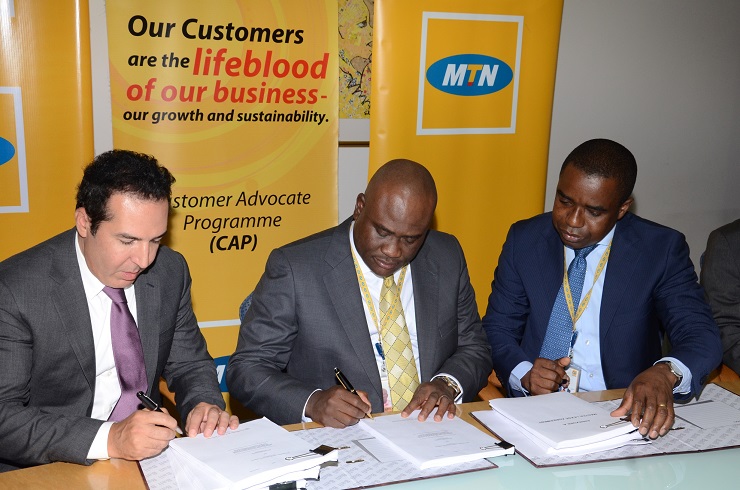
Director-General of the Securities and Exchange Commission (SEC), Mr Mounir Gwarzo, has confirmed that discussions were ongoing with leading GSM service provider, MTN Nigeria, on its planned listing on the Nigerian Stock Exchange (NSE).
Addressing journalists on Wednesday in Lagos after the second Capital Market Committee (CMC) meeting, the SEC boss said outcome of the talks would be known to the public when finalised.
The Nigerian government had said telecommunication firms operating in the country should list on the local bourse, though nothing concrete was yet to be realised.
Last year, the Federal Government, through the Nigerian Communications Commission (NCC) fined MTN Nigeria N330 billion for failing to disconnect unregistered SIM cards on its network and this had a negative effect on its earnings for the year.
But speaking today, Mr Gwarzo said his agency has met with MTN Nigeria and has suggested ways to the firm on how to successfully list its shares on the NSE trading platform.
“Concerning listing of MTN (Nigeria) on the Nigerian Stock Exchange, we have started discussions with them and also given them ideas on how to make it possible.
“We hope very soon, when the discussions are over, the company will announce its listing to investing public.
“I believe it (the listing) will boost our economy and showcase Nigeria as a good place to invest,” the SEC chief told newsmen.
Recall that late last year, officials of MTN Nigeria held a meeting with the capital market regulator on the sale of its Nigerian unit.
During the meeting, SEC emphatically told MTN that it was ready to support the company on its share sale as long as it was within local laws. It advised the telecom firm to ensure retail investors were protected.
MTN Nigeria had also stressed that it was ready to list its Nigerian unit on the NSE in 2017, subject to market conditions, part of an agreement with the Nigerian government after agreeing to pay a reduced fine of $1.7 billion in a settlement over unregistered SIM cards.
On June 30, 2017, General Manager of MTN, Mr Nikiwe Tsaagane, further assured the Federal Government that the leading telecommunications firm in the country will list its shares on NSE.
At a meeting with the Minister of Science and Technology, Mr Ogbonnaya Onu, in Abuja, the General Manager of MTN had noted that the company would still go ahead with the listing.
He had explained that plans were underway to make shareholders apply for the listing digitally.
“To achieve this, we are working with the Nigeria Stock Exchange to develop an application platform to enable our customers apply online. It would be the first time such is happening in the country,” Mr Tsaagane had informed the Minister during the meeting about two months ago.
The MTN top shot had also boasted that the listing of MTN Nigeria on the NSE would showcase Africa’s second biggest economy in the global economy.
“It is going to offer important role in the capital market as it will be one of the largest transactions in Africa,” he had bragged.
“The transaction is structured by ensuring that it is data based and inclusive as we ensure that our Nigerian customers are able to participate,” Mr Tsaagane had added.
The South African company boasts of over 60 million subscribers in Nigeria.
Economy
Uzoka-Anite Warns Against Inflation Risks from Oil, Gas Earnings Surge
By Adedapo Adesanya
The Minister of State for Finance and chairman of the Federation Account Allocation Committee (FAAC), Mrs Doris Uzoka-Anite, has cautioned that a projected surge in oil and gas revenues following President Bola Tinubu’s latest executive order could trigger inflationary pressures and exchange rate volatility if not carefully managed.
She said that the recent executive order mandating the direct remittance of certain oil sector revenues to the federation account would provide regulatory clarity and significantly strengthen revenues accruing to the federation account, but warned that sudden liquidity injections into the economy may complicate monetary policy coordination with the Central Bank of Nigeria and erode the real value of allocations to federal, state and local governments.
While addressing members of FAAC in Abuja, Mrs Uzoka-Anite commended President Tinubu on the order, describing the development as a structural fiscal correction aimed at restoring constitutional discipline to petroleum revenue management and enhancing distributable income across the three tiers of government.
She said that the revenue outlook was improving due to ongoing structural reforms introduced by the Federal Government.
According to her, the newly implemented tax reform measures are broadening the tax base, improving compliance and enhancing administrative efficiency.
“Also, the executive order signed by Mr President on February 13 is reinforcing revenue discipline in the oil and gas sector and reducing leakages,” she said.
The minister said that the order suspends the 30 per cent allocation to the Frontier Exploration Fund (FEF) and suspends the 30 per cent management fee on oil and gas profit payable to NNPC Limited.
She said that the order also directed that gas flare penalties be paid into the federation account, and mandated full remittance of petroleum revenues without unconstitutional deductions.
Mrs Uzoka-Anite said that the reform marks a shift from a retention-based oil revenue model to a gross remittance, federation-first model.
“The implications for FAAC are very significant; more oil and gas profit will now flow directly into the federation account.
“Gas flare penalties will become distributable revenue, and previously retained management fees will no longer reduce remittable inflows,” she said.
She said that the reforms were expected to result in higher monthly gross inflows into the federation account, and increased allocations to federal, state and local governments.
The minister said that a retrospective audit of the FFF, the Midstream and Downstream Gas Infrastructure, was due, and NNPC management fee deductions could lead to recoveries that may provide a one-off fiscal boost.
She welcomed the improved revenue outlook and cautioned against the risks associated with sudden liquidity injections.
“Experience shows that when revenues rise sharply and are distributed fully and immediately, large liquidity injections can increase inflationary pressures, complicate monetary management and reduce the real purchasing power of allocations,” she said.
She said that excess aggregate demand, exchange rate pressure, asset price distortions and inflationary risks could arise if increased inflows were not carefully managed.
Mrs Uzoka-Anite said that to mitigate such risks, she proposed phased disbursement of one-off recoveries.
She suggested that retrospective recoveries be staggered rather than injected into the economy in bulk, with a portion temporarily warehoused in a stabilisation buffer.
She also recommended strengthening the excess crude and stabilisation buffer mechanism to channel part of incremental inflows into a fiscal stabilisation window.
“This could offset revenue shortfalls in weaker months and reduce procyclicality in spending.
According to her, enhanced coordination with the CBN would be pursued to align fiscal injections with liquidity management tools and support open market operations where necessary.
Mrs Uzoka-Anite urged states and federal Ministries, Departments and Agencies (MDAs) to prioritise capital expenditure over recurrent expenditure.
She called for investment in infrastructure, agriculture, energy and other productive sectors, and avoid unsustainable wage or consumption spikes.
“Productive spending expands supply capacity and mitigates inflation,” she said.
She also announced plans to introduce monthly revenue transparency dashboards, production-to-remittance reconciliation reporting, and clear reporting of incremental inflows arising from tax reforms and the executive order.
The junior finance minister said that the reforms presented an opportunity to deepen fiscal federalism, enhance distributable revenue, restore constitutional clarity and strengthen trust among tiers of government.
She also advised that increased revenue must not translate into fiscal complacency.
“We must resist the temptation to treat incremental inflows as permanent windfalls. We should reduce debt burdens, clear arrears responsibly, build buffers and invest in growth-enhancing sectors,” she said.
Economy
Dangote Refinery Shares to be Available to Public in Five Months
By Adedapo Adesanya
The chairman of Dangote Group, Mr Aliko Dangote, has said that within the next five months, Nigerians should be able to purchase shares of Dangote Petroleum and Refinery.
Mr Dangote made this revelation on Sunday during a tour of the facility by the chief executive of the Nigerian National Petroleum Company (NNPC) Limited, Mr Bayo Ojulari, alongside members of the company’s executive management.
The $20 billion refinery is the largest single-train refinery in the world with 650,000 barrels per day refining capacity. There are efforts to boost the capacity to 1.4 million barrels per day soon.
Speaking with journalists, Mr Dangote said, “And the other issue is that they (NNPC) are holding 7.25 per cent of the shares that we have here, which is more than the shares Elon Musk has in Tesla. And they are holding that on behalf of Nigerians,” he said.
“So individually, Nigerians too will have an opportunity in the next, maybe a maximum of four to five months. There will actually be an opportunity to buy the shares.”
He added that shareholders will have the option to receive their dividends in either naira or dollars, as the refinery also earns in dollars.
Commenting on Mr Ojulari’s visit, the billionaire businessman said the NNPC, represented by Mr Ojulari and its management team, was not just a guest but a shareholder.
“Today is really our best day ever” at the facility. I know NNPC invested in us when we were not really sure whether the refinery would be successful.
“So that’s the kind of level of confidence. But right now, the relationship with the new set of people that we have at NNPC, I think the sky is the limit, and we will cooperate and also make sure that we work together to make sure that we make Nigerians proud.”
Speaking on prospects of partnership with NNPC in the upstream sector, he said, “We have block 71, 72, but we’re going to look much deeper”.
“Most likely, depending on our own discussions with them, we will partner with them, maybe in some of the upstream. They, too, will partner with us here because here is not just a refinery, it’s an industrial hub.
“And that’s why we’re doing linear alkaline benzene, which is a raw material for detergents, ” he added.
Economy
NGX Investigates Zichis Stocks After 859% Rise in One Month
By Aduragbemi Omiyale
The Nigerian Exchange (NGX) Limited has launched an investigation into trading activities on the shares of Zichis Agro-Allied Industries Plc.
A notice from Customs Street on Monday disclosed that this has led to the suspension of the company for now.
This development comes about a month after Zichis was listed on the domestic bourse and placed in the growth board of the NGX.
In the circular, it was disclosed that the suspension may be lifted after the conclusion of the findings, but for now, investors will not be able to trade the organisation’s securities on the NGX platform.
“The suspension of trading in Zichis shares shall be lifted upon the conclusion of an investigation into the trading activities on the company’s shares,” a part of the disclosure stated.
The bourse explained that it wielded the big stick on Zichis in compliance with Rule 7.0, Rules on Suspension of Trading in Listed Securities, Rulebook of The Exchange (Issuers’ Rules).
This part of the law states that, “Notwithstanding any of the foregoing provisions, the exchange may, in accordance with any of its rules, place the trading of any security on suspension.
“It may also do so if it is of the view that such suspension will be in the interest of the investing public and in accordance with the SEC Rules.”
In announcing the action on the firm, the NGX declared that, “The shares of Zichis Agro-Allied Industries Plc have been suspended from trading on the facilities of Nigerian Exchange Limited (NGX), effective today, Monday, February 23, 2026.”
Business Post reports that last week, shares of Zichis appreciated by 60.74 per cent to N17.36. It joined the stock exchange at N1.81, indicating it has gained N15.55 or 859.12 per cent in one month.
-
Feature/OPED6 years agoDavos was Different this year
-
Travel/Tourism10 years ago
Lagos Seals Western Lodge Hotel In Ikorodu
-
Showbiz3 years agoEstranged Lover Releases Videos of Empress Njamah Bathing
-
Banking8 years agoSort Codes of GTBank Branches in Nigeria
-
Economy3 years agoSubsidy Removal: CNG at N130 Per Litre Cheaper Than Petrol—IPMAN
-
Banking3 years agoSort Codes of UBA Branches in Nigeria
-
Banking3 years agoFirst Bank Announces Planned Downtime
-
Sports3 years agoHighest Paid Nigerian Footballer – How Much Do Nigerian Footballers Earn