Connect with us

Economy

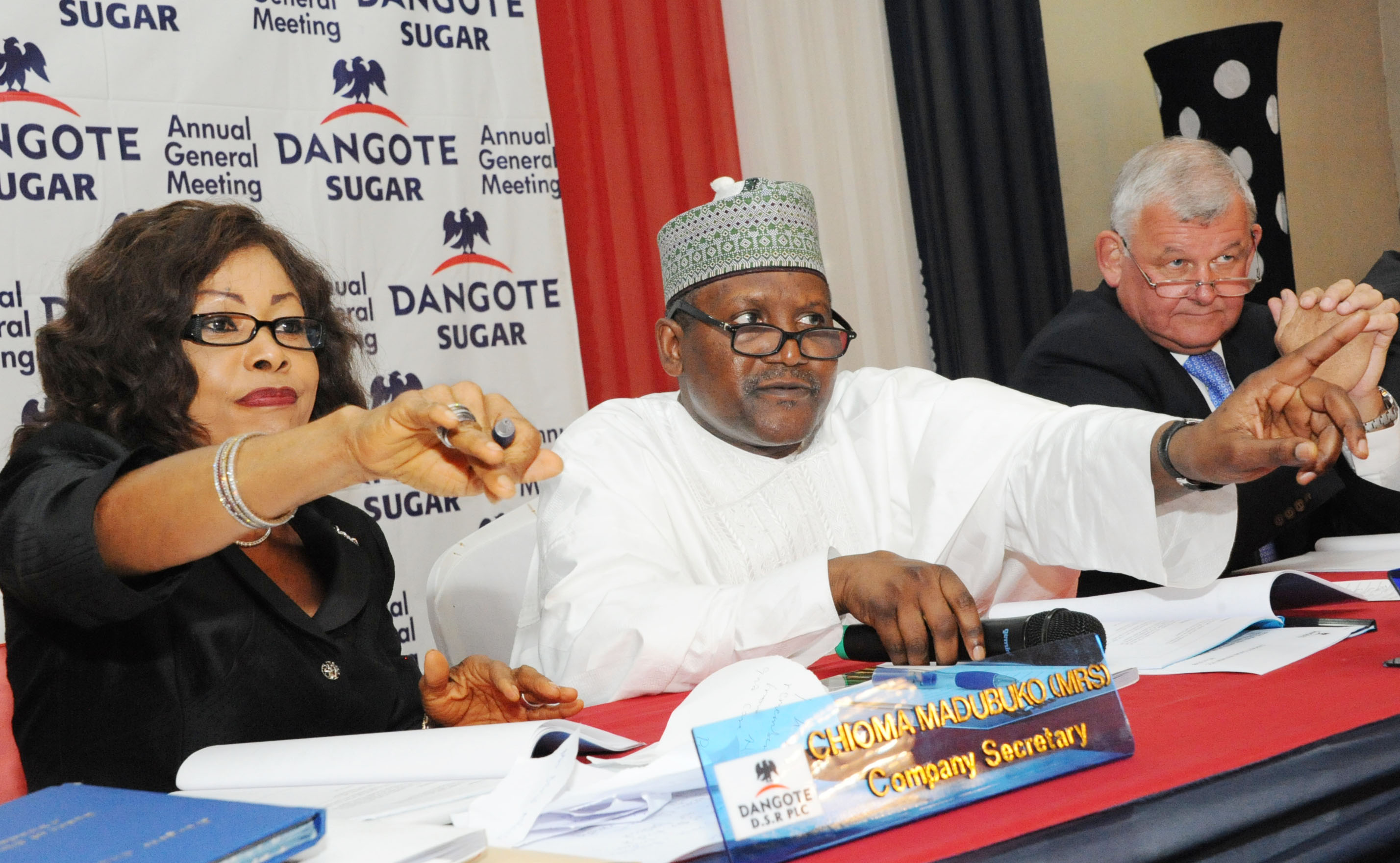
Dangote to Build $450m Sugar Production Factory in Niger

Published

on

Dangote Sugar

By Modupe Gbadeyanka

A sugar production factory capable of creating over 15,000 jobs is to be situated on a 16,000-hectare of land at Lavun Local Government Area of Niger State.

On Wednesday, August 23, 2017, President of Dangote Group, Mr Aliko Dangote, signed a Memorandum of Understanding (MoU) with the state government for the $450million state-of–art and fully integrated sugar complex.

Mr Dangote noted that his decision to start the factory was part of his desire to achieve self-sufficiency in sugar production through the government’s backward integration policy.

At the signing today in Minna, Mr Dangote said when the project is completed, it would bring about a complete economic turn-around for the state.

Dangote Group is currently operating out-grower scheme in rice production in a number of states and also has Africa’s largest sugar refinery in Lagos and a sugar cane plantation in Numan, Adamawa State.

Mr Dangote said his investment was informed by his company’s firm belief in the potentials of the Nigerian economy, adding that the new outlay will add value and create jobs for Nigerians.

He commended the Niger State Governor, Mr Abubakar Sani Bello for his foresight and efforts to woo investors to the state, noting that “the Dangote’s Integrated Sugar Project in Niger State will also include the establishment of integrated sugar mills, generate power, produce molasses, ethanol fuel, biomass and produce animal feeds.”

In his remarks, Governor Bello said the deal will revolutionize agriculture in his state and Nigeria. Expressing joy that the MoU was signed during his own administration, he described Mr Dangote as the liberator of the Nigerian economy and a dependable partner.

The Governor then urged Dangote Group to explore other investment opportunities available in the state, just as he announced that the state was opened for multi-sectoral investments.

Representative of the Minister of Industry, Trade and Investment, Mr Aminu Bisala, described Mr Dangote as the biggest private sector supporter of the Nigerian economy, and Federal Government policies.

He said the Federal Government was comfortable with the numerous investments efforts of the Dangote Group.

Also speaking, Chairman of the Niger State Traditional Council Etsu Nupe, Mr Abubakar Yahyah said he was elated about the huge investment coming to the state, while praying God to bless the Dangote Group more.

Just last week, the conglomerate had sponsored an investment summit in the state, which was attended by former Presidents Abdulsalami Abubakar, Olusegun Obasanjo and the then Acting President, Yemi Osinbajo, who described the private sector as key to the country’s economic development.

Group Managing Director of Dangote Sugar Plc, Engr. Abdullahi Sule, stated that the MoU would be a game changer for Niger State economy and Nigeria as a whole.

He said the integrated sugar mills will have the capacity to produce 160,000MT of raw sugar, pointing out that has been in the fore front of support for government industrialization programmes through backward integration policy in agriculture.

According to him, the Dangote Sugar Refinery is developing a sugar backward integration plan through the production of 1.5MT/PA in ten years in: Nasarawa, Adamawa, Kogi, Kwara, Taraba and Niger states respectively.

The Group’s Executive Director Stakeholders’ Management and Corporate Communication, Mr Ahmed Mansur, had also announced that the Group was investing over $1billion in the agricultural sector in the country, specifically in rice, sugar, tomato and dairy productions.

Niger State Commissioner for Investment, Commerce and Industry, Rahmatu Muhammad Yar’Adua said that the deal with Dangote Group will help grow the agricultural sector and create direct and indirect jobs in the state.

It would be recalled that the Group’s foray into sugar business began in 1981. It has injected over $104million into the Savannah Sugar Company Limited it acquired from government in 2003. Savannah Sugar this year alone, produced 20,000MT of raw sugar from its plantation.


Modupe Gbadeyanka is a fast-rising journalist with Business Post Nigeria. Her passion for journalism is amazing. She is willing to learn more with a view to becoming one of the best pen-pushers in Nigeria. Her role models are the duo of CNN's Richard Quest and Christiane Amanpour.

Economy

NGX Seeks Suspension of New Capital Gains Tax

Published

on

capital gains tax

By Adedapo Adesanya

The Nigerian Exchange (NGX) Limited is seeking review of the controversial Capital Gains Tax increase, fearing it will chase away foreign investors from the country’s capital market.

Nigeria’s new tax regime, which takes effect from January 1, 2026, represents one of the most significant changes to Nigeria’s tax system in recent years.

Under the new rules, the flat 10 per cent Capital Gains Tax rate has been replaced by progressive income tax rates ranging from zero to 30 per cent, depending on an investor’s overall income or profit level while large corporate investors will see the top rate reduced to 25 per cent as part of a wider corporate tax reform.

The chief executive of NGX, Mr Jude Chiemeka, said in a Bloomberg interview in Kigali, Rwanda that there should be a “removal of the capital gains tax completely, or perhaps deferring it for five years.”

According to him, Nigeria, having a higher Capital Gains Tax, will make investors redirect asset allocation to frontier markets and “countries that have less tax.”

“From a capital flow perspective, we should be concerned because all these international portfolio managers that invest across frontier markets will certainly go to where the cost of investing is not so burdensome,” the CEO said, as per Bloomberg. “That is really the angle one will look at it from.”

Meanwhile, the policy has been defended by the chairman of the Presidential Fiscal Policy and Tax Reforms Committee, Mr Taiwo Oyedele, who noted that the new tax will make investing in the capital market more attractive by reducing risks, promoting fairness, and simplifying compliance.

He noted that the framework allows investors to deduct legitimate costs such as brokerage fees, regulatory charges, realised capital losses, margin interest, and foreign exchange losses directly tied to investments, thereby ensuring that they are not taxed when operating at a loss.

Mr Oyedele  also said the reforms introduced a more inclusive approach to taxation by exempting several categories of investors and transactions.

Continue Reading

Economy

Food Concepts Return NASD OTC Exchange to Danger Zone

Published

on

NASD OTC exchange

By Adedapo Adesanya

Food Concepts Plc neutralized the gains recorded by three securities, returning the NASD Over-the-Counter (OTC) Securities Exchange into the negative territory with a 0.27 per cent loss on Thursday, December 4.

Yesterday, the share price of the parent company of Chicken Republic and PieXpress declined by 34 Kobo to sell at N3.15 per unit compared with the previous day’s N3.49 per unit.

This shrank the market capitalisation of the OTC bourse by N5.72 billion to N2.136 billion from N2.142 trillion and weakened the NASD Unlisted Security Index (NSI) by 9.57 points to 3,571.53 points from 3,581.10 points.

Business Post reports that Central Securities Clearing System (CSCS) Plc went down by 50 Kobo to N38.50 per share from N38.00 per share, FrieslandCampina Wamco Nigeria Plc gained 29 Kobo to sell at N55.79 per unit versus N55.50 per unit, and Geo-Fluids Plc added 5 Kobo to close at N4.60 per share compared with Wednesday’s closing price of N4.55 per share.

Trading data indicated that the volume of securities recorded at the session surged by 6,885.3 per cent to 4.3 million units from the 61,570 units posted a day earlier, the value of securities increased by 10,301.7 per cent to N947.2 million from N3.3 million, and the number of deals went up by 146.7 per cent to 37 deals from the 15 deals achieved in the previous trading session.

At the close of business, Infrastructure Credit Guarantee Company (InfraCredit) Plc was the most traded stock by value on a year-to-date basis with the sale of 5.8 billion units for N16.4 billion, trailed by Okitipupa Plc with 170.4 million units worth N8.0 billion, and Air Liquide Plc with 507.5 million units valued at N4.2 billion.

InfraCredit Plc also finished the session as the most traded stock by volume on a year-to-date basis with 5.8 billion units transacted for N16.4 billion, followed by Industrial and General Insurance (IGI) Plc with 1.2 billion units sold for N420.2 million, and Impresit Bakolori Plc with 536.9 million units traded for N524.9 million.

Continue Reading

Economy

Investors Gain N97bn from Local Equity Market

Published

on

Nigerian equity market

By Dipo Olowookere

The upward trend witnessed at the Nigerian Exchange (NGX) Limited in recent sessions continued on Thursday as it further improved by 0.10 per cent.

This was despite investor sentiment turning bearish after the local equity market ended with 23 price gainers and 28 price gainers, indicating a negative market breadth index.

UAC Nigeria gained 10.00 per cent to finish at N88.00, Morison Industries appreciated by 9.94 per cent to N3.54, Ecobank rose by 8.53 per cent to N36.90, and Coronation Insurance grew by 8.47 per cent to N2.56.

On the flip side, Ellah Lakes depreciated by 10.00 per cent to N13.14, Eunisell Nigeria also shed 10.00 per cent to finish at N72.90, Transcorp Hotels slipped by 9.95 per cent to N157.50, Omatek shrank by 9.23 per cent to N1.18, and Guinea Insurance dipped by 8.46 per cent to N1.19.

Yesterday, the All-Share Index (ASI) went up by 152.28 points to 145,476.15 points from 145,323.87 points and the market capitalisation chalked up N97 billion to finish at N92.726 trillion compared with the previous day’s N92.629 trillion.

Customs Street was bubbling with activities on Thursday, though the trading volume and value slightly went down, according to data.

A total of 1.9 billion stocks worth N19.2 billion exchanged hands in 23,369 deals during the session versus the N2.3 billion valued at N21.0 billion traded in 21,513 deals a day earlier.

This showed that the number of deals increased by 8.63 per cent, the volume of transactions depleted by 17.39 per cent, and the value of trades decreased by 8.57 per cent.

For another trading day, eTranzact led the activity chart with 1.6 billion units sold for N6.4 billion, Fidelity Bank traded 31.0 million units worth N589.3 million, GTCO exchanged 28.3 million units valued at N2.5 billion, Zenith Bank transacted 27.1 million units for N1.6 billion, and Ecobank traded 21.9 million units worth N744.3 million.

Continue Reading

Trending