Banking
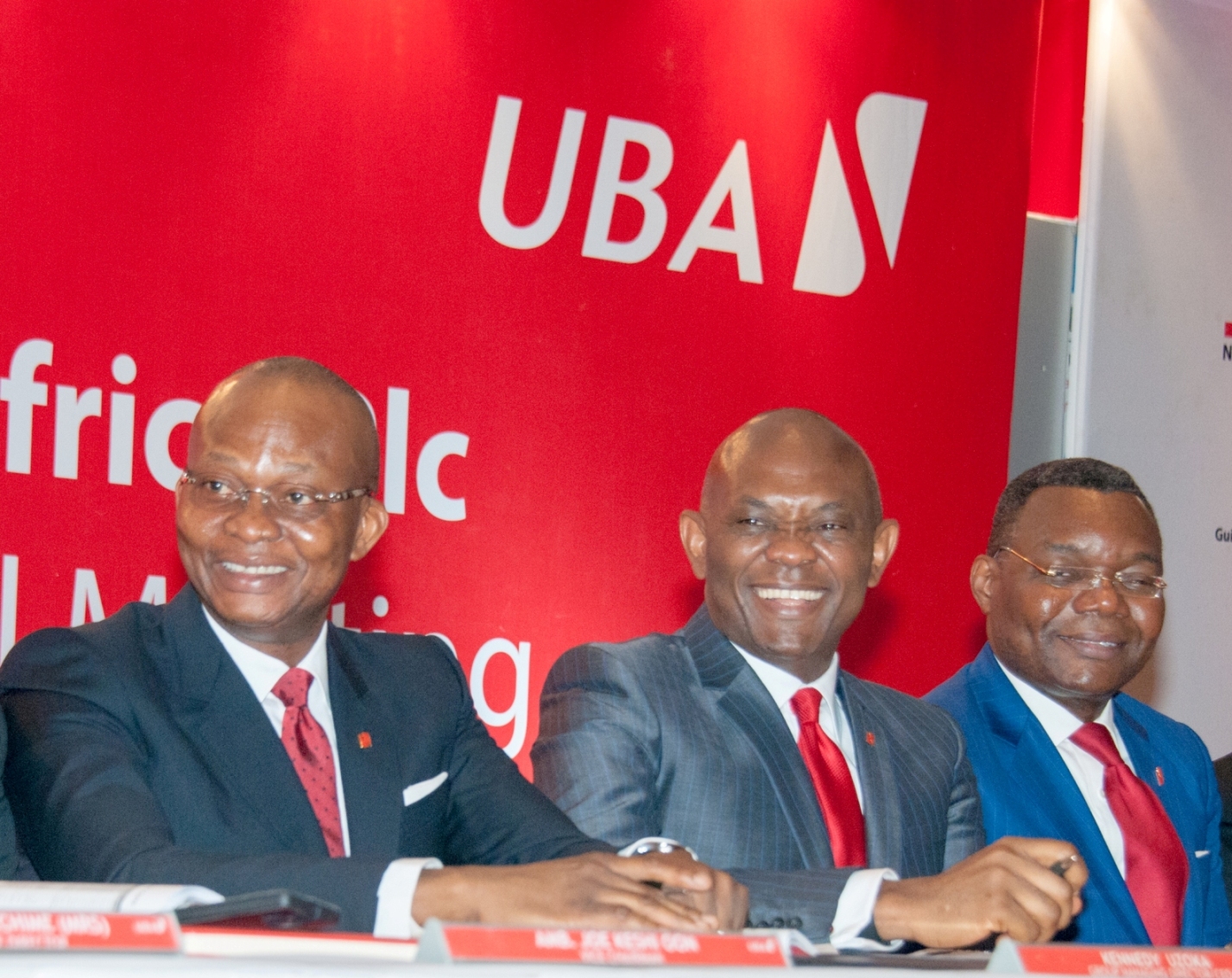
UBA Grows HY Earnings by 34.5%, Shareholders’ Fund by 8%
By Modupe Gbadeyanka
One of the top lenders in Nigeria, the United Bank for Africa (UBA) Plc has announced its audited half year financial results ended June 30, 2017, showing remarkable performance across major metrics.
UBA grew its gross earnings for the period by 34.5 percent to N222.7 billion, as against N165.6 billion reported in June 2016.
This impressive performance, which reflects the strong momentum of UBA’s business and its increasing share of customers’ wallet, was driven by the 44.3 percent and 16 percent growth in interest income and non-funded income respectively.
The group’s operating income stood at N161.8 billion, compared to N116.2 billion recorded in the corresponding period of 2016, representing a 39.2 percent growth.
Notwithstanding the impact of Naira devaluation and double digit inflation in Nigeria and a number of other African countries where UBA operates, the group managed through its cost lines to deliver a sterling profit before tax (PBT) of N57.5 billion, representing a significant growth of 65.5 percent over N34.8 billion recorded in the corresponding period of June 2016.
In same vein, the group recorded an unprecedented Profit After Tax (PAT) of N42.3 billion, translating to a 56.2 percent growth over the N27.1 billion recorded in the half-year of 2016. This profitability further reflects the earnings capacity of the group and its capability to progressively deliver superior returns to shareholders.
While the group closed the half year with Total Assets of N3.69 trillion, a growth of 5.3 percent, it prudently grew gross loans to N1.6 trillion, a 4 percent growth when compared to the group loan book as at 31 December 2016.
Reflecting a strong capacity for internal capital generation, the group’s Shareholders’ Fund grew by 8 percent to N483.1 billion, whilst it delivered an annualized 18.2 percent return on average equity (RoAE) and an interim dividend of N0.20 per share.
Commenting on the result, Mr Kennedy Uzoka, the Group Managing Director/CEO, said that “the results again demonstrate the strong momentum of the bank, as we deliver continuous improvement across our businesses and key performance metrics.”
He further stated that the bank’s “unwavering focus on customer service excellence is translating to strong operational and financial efficiency gains.
“We have achieved better pricing on assets and liabilities, leading to continued improvement in the net interest margin to 7.3 percent.
“Leveraging our service-focused strategy and treasury management, we grew non-interest income by 17 percent year-on-year, reinforcing our transaction-banking-led approach towards deepening financial inclusion in Sub-Saharan Africa.”
According to him, UBA has made considerable progress in its retail banking penetration, gaining market share in deposits, at a time when a sizeable percentage of households are challenged due to inflationary pressures on disposable income.
The bank grew its retail savings and current account deposits by 23 percent and 5 percent YTD respectively.
Also speaking on UBA’s financial performance and position, the Group CFO, Mr Ugo Nwaghodoh, said that the bank had “a strong start in the year, despite protracted recession in Nigeria, our largest market.
“Our profit after tax of N42 billion translates to 18.2 percent return on average equity, broadly in line with our 2017 FY guidance.”
He further said that the Bank’s African subsidiaries (ex-Nigeria) contributed 32 percent of the group’s earnings, leveraging on digital offerings to gain market share across the different markets.
“We maintain our discipline of banking only quality and profitable assets, a conservative stance which reflects on our asset quality.
“Notwithstanding consistent liquidity mop-up by the CBN, we maintained an average balance sheet liquidity ratio of 42 percent.
“Further reinforcing the bank’s capacity is the strong BASEL II capital adequacy ratio of 20 percent, which underpins our ability to grow, as the macro risks decline,” he said.
United Bank for Africa Plc is a leading pan-African financial services group, with presence in 19 African countries, as well as the United Kingdom, the United States of America and France.
UBA was incorporated in Nigeria as a limited liability company after taking over the assets of the British and French Bank Limited who had been operating in Nigeria since 1949.
The United Bank for Africa merged with Standard Trust Bank in 2005 and from a single country operation founded in 1949 in Nigeria – Africa’s largest economy – UBA has become one of the leading providers of banking and other financial services on the African continent.
The lender provides services to over14 million customers globally, through one of the most diverse service channels in sub-Saharan Africa, with over 1,000 branches and customer touch points and robust online and mobile banking platforms.
UBA was the first Nigerian bank to make an Initial Public Offering, following its listing on the NSE in1970. It was also the first Nigerian bank to issue Global Depository Receipts. The shares of UBA are publicly traded on the Nigerian Stock Exchange and the Bank has a well-diversified shareholder base, which includes foreign and local institutional investors, as well as individual shareholders.
Banking
Senate Seeks CBN’s Full Disclosure on Unremitted N1.44trn Surplus
By Adedapo Adesanya
The Senate has demanded detailed explanation from the Central Bank of Nigeria (CBN) over the alleged non-remittance of N1.44 trillion in operating surplus.
The Senate Committee on Banking, Insurance and Other Financial Institutions, chaired by Mr Tokunbo Abiru, opened its statutory briefing with a firm call for transparency at the apex bank, noting that the Auditor-General’s query on the unremitted funds required a full, clear and documented response, insisting that public trust in monetary governance depended on strict accountability.
While acknowledging the CBN’s achievements in stabilising the foreign exchange market and reducing inflation, Mr Abiru underscored that such progress must be accompanied by institutional responsibility.
He stated the Senate expected the CBN to explain the circumstances surrounding the query, outline corrective steps taken and reveal safeguards against future lapses.
This came as the Governor of the central bank, Mr Yemi Cardoso, appeared before the senate committee and offered an extensive review of economic conditions, asserting that Nigeria was experiencing renewed macroeconomic stability across major indicators.
Mr Cardoso attributed the progress to bold monetary reforms, foreign-exchange liberalisation and disciplined liquidity management implemented since mid-2025.
According to him, headline inflation had declined for seven consecutive months, from 34.6 per cent in November 2024 to 16.05 per cent in October 2025, marking the steepest and longest disinflation trend in over a decade.
Food inflation accruing to him also slowed to 13.12 per cent, supported by improved supply conditions and exchange-rate predictability.
The CBN governor described the foreign-exchange market as fundamentally transformed, adding that speculative attacks and arbitrage opportunities had largely disappeared.
According to him, the premium between the official and parallel markets had fallen to below two per cent, compared to over 60 per cent a year earlier. As of November 26, the naira traded at N1,442.92 per dollar at the Nigerian Foreign Exchange Market, stronger than the N1,551 average recorded in the first half of 2025.
He also announced a sharp rise in external reserves to $46.7 billion, the highest in nearly seven years and sufficient to cover over ten months of imports.
Diaspora remittances, he noted, had tripled to about $600 million monthly, while foreign capital inflows reached $20.98 billion in the first ten months of 2025, 70 per cent higher than in 2024 and more than four times the 2023 figure.
Cardoso further confirmed that the CBN had fully cleared the $7 billion verified FX backlog, restoring investor confidence and strengthening Nigeria’s balance-of-payments position.
On banking-sector stability, he reported that recapitalisation efforts were progressing smoothly. Twenty-seven banks had already raised new capital, with sixteen meeting or surpassing the new regulatory thresholds ahead of the March 31, 2026 deadline, highlighting improvements in ATM cash availability, digital-payments oversight and cybersecurity compliance.
Despite the positive indicators, the Senate sought clarity on several policy decisions.
Mr Abiru pressed for explanations on the sustained 45 per cent Cash Reserve Ratio (CRR), the 75 per cent CRR applied to non-Treasury Single Account public-sector deposits, FX forward settlements, mutilated naira notes in circulation, excessive bank charges, failed electronic transactions and the compliance of CBN subsidiaries with parliamentary oversight.
He also requested an update on the activities of the Financial Services Regulatory Coordinating Committee, arguing that stronger inter-agency cooperation was necessary to maintain public confidence.
The session later moved into a closed-door meeting.
Banking
Toxic Bank Assets: AMCON Repays CBN N3.6trn, Still Owes N3trn
By Modupe Gbadeyanka
About N3.6 trillion has been repaid to the Central Bank of Nigeria (CBN) by the Asset Management Corporation of Nigeria (AMCON) since its inception in 2010.
This information was revealed by the chief executive of AMCON, Mr Gbenga Alade, during a media parley to update the press on the activities of the agency.
Mr Alade said at the moment, the organisation still owes the central bank about N3 trillion for toxic assets of banks in the country.
He praised the organisation for its asset recovery drive, stressing that when compared with others across the world, Nigeria has done well.
“It is important to stress that the corporation has done tremendously well, especially when compared to other notable government-owned Asset Management Corporations around the world.
“Based on the balance at purchase, AMCON outperformed other Asset Management Corporations all over the world by achieving over 87 per cent in recoveries despite the unique challenges associated with debt recovery in Nigeria.
“The Malaysian Danaharta, which is adjudged one of the best performing Asset Management Corporation’s, only achieved 58 per cent. The Chinese Asset Management Corporation, despite its stricter laws, achieved just 33 per cent.
“Only the Korean Asset Management Corporation (KAMCO), South Korea, has achieved more recoveries than AMCON, with about 100 per cent. This was due to their brute force with which they chased the obligors.
“Despite KAMCO’s recovery records, the agency is still operational to date with slight realignments in its mandate.
“Other noted Asset Management Corporations that have transitioned into a perpetual institution of the various governments include, China Asset Management Company, Federal Deposit Insurance Corporation (FDIC) USA, and KFW Germany.
“So, gentlemen, without sounding immodest, AMCON has done well, and we will not relent until all the outstanding debts are fully realized,” Mr Alade stated.
On the financial performance of AMCON, he said last year, the firm posted a revenue of N156.25 billion and operating expenses of N29.04 billion, while for the 2025 fiscal year should be a revenue of N215.15 billion and operating expenses of N29.06 billion.
Banking
The Alternative Bank Opens Effurun Branch in Delta
By Modupe Gbadeyanka
One of the non-interest banks in Nigeria, The Alternative Bank (AltBank), has opened a new branch in Effurun, Delta State.
The new office will serve the Edo-Delta region and provide purposeful banking and real financial empowerment for individuals, entrepreneurs, and businesses, a statement from the firm stated.
The lender disclosed that the Effurun branch is a bold move in its mission to reshape banking in Nigeria.
The launch was graced by key dignitaries, including the Ovie of Uvwie Kingdom, Emmanuel Ekemejewa Sideso Abe I; the Chairman of Uvwie Local Government, Anthony O. Ofoni, represented his vice, Andrew Agagbo; and the Special Adviser to the Governor of Delta State on Community Development, Mr Ernest Airoboyi; amongst others.
The Divisional Head for South at The Alternative Bank, Mr Chukwuemeka Agada, emphasised the institution’s commitment to Warri and its surrounding communities.
“By establishing a presence here, we are initiating a transformation in the way banking serves the people of Delta. Our purpose-driven approach ensures that customers’ financial goals are not just met but exceeded,” he stated.
“This branch represents our pledge to empower Warri’s dynamic businesses and families, providing them with the tools to grow without compromise,” Mr Agada added.
“We understand the heartbeat of this community, and we are excited to integrate our bank into the fabric of this dynamic region,” he stated further.
On his part, the representative of the Ovie, Mr Samuel Eshenake, challenged the bank to facilitate development and employment within the Effurun community.
The Regional Head for Edo/Delta at The Alternative Bank, Mr Akanni Owolabi, embraced this challenge, pledging that the bank will work sustainably to drive local commerce.
“At The Alternative Bank, we are committed to being an active partner in the development of Effurun. We see this branch as a catalyst for creating opportunities, driving employment, and supporting the growth of local businesses.
“Our mission is to empower this community, ensuring that every step forward is one of progress, prosperity, and shared success.”
-
Feature/OPED6 years agoDavos was Different this year
-
Travel/Tourism9 years ago
Lagos Seals Western Lodge Hotel In Ikorodu
-
Showbiz3 years agoEstranged Lover Releases Videos of Empress Njamah Bathing
-
Banking7 years agoSort Codes of GTBank Branches in Nigeria
-
Economy2 years agoSubsidy Removal: CNG at N130 Per Litre Cheaper Than Petrol—IPMAN
-
Banking3 years agoFirst Bank Announces Planned Downtime
-
Banking3 years agoSort Codes of UBA Branches in Nigeria
-
Sports3 years agoHighest Paid Nigerian Footballer – How Much Do Nigerian Footballers Earn