

Economy
Embattled Baru Breaks Silence on $25b NNPC Contracts Mess

By Modupe Gbadeyanka
Group Managing Director (GMD) of the Nigerian National Petroleum Corporation (NNPC), Mr Maikanti Baru, has reacted to the letter written to President Muhammadu Buhari in August 2017 by the Minister of State for Petroleum Resources, Mr Ibe Kachikwu, alleging the award of contracts by the GMD without due process as well as insubordination.
In a statement released on Monday in Abuja by the Group General Manager, Group Public Affairs Division of the NNPC, Mr Ndu Ughamadu, the GMD said he was responding to the issues following a directive by the President to him to do so.
Below is the statement released today by the NNPC, which was obtained by Business Post.
Following the publication of alleged lack of adherence to due process in the award of NNPC contracts, the President ordered the Group Managing Director (GMD) and Management of the Nigerian National Petroleum Corporation (NNPC) to consider and respond expeditiously to the allegations.
The substance of the allegations made by the Minister of State for Petroleum Resources, in a letter to the President dated 30th of August 2017, is that a number of “major contracts were never reviewed or discussed with me (sic) the NNPC Board.”
It is important to note from the outset that the law and the rules do not require a review or discussion with the Minister of State or the NNPC Board on contractual matters. What is required is the processing and approval of contracts by the NNPC Tenders Board, the President in his executive capacity or as Minister of Petroleum, or the Federal Executive Council (FEC), as the case may be. There are therefore situations where all that is required is the approval of the NNPC Tenders Board while, in other cases, based on the threshold, the award must be submitted for presidential approval. Likewise, in some instances it is FEC approval that is required.
It should be noted that for both the Crude Term Contract and the Direct Sale and Direct Purchase (DSDP) agreements, there are no specific values attached to each transaction to warrant the values of $10billion and $5billion respectively placed on them in the claim of Dr. Kachikwu. It is therefore inappropriate to attach arbitrary values to the shortlists with the aim of classifying the transactions as contracts above NNPC Tenders Board limit. They are merely the shortlisting of prospective off-takers of crude oil and suppliers of petroleum products under agreed terms. These transactions were not required to be presented as contracts to the Board of NNPC and, of course, the monetary value of any crude oil eventually lifted by any of the companies goes straight into the federation account and not to the company.
Furthermore, contrary to the assertion of Dr. Kachikwu that he was never involved in the 2017/2018 contracting process for the Crude Oil Term Contracts, Dr. Kachikwu was in fact expressly consulted by the GMD and his recommendations were taken into account in following through the laid down procedure. Thus, for him to turn around and claim that “…these major contracts were never reviewed or discussed with me…” is most unfortunate to say the least.
THE NNPC CONTRACTING PROCESS
The contracting process in NNPC is governed by the following:
- Provisions of the NNPC Act
- The Public Procurement Act, 2007 (PPA)
iii. Procurement method and thresholds of application and the composition of Tenders Board as provided by the Secretary to the Government of the Federation (SGF) Circular reference no. SGF/OP/1/S.3/VIII/57, dated 11th March, 2009.
- NNPC Delegation of Authority Guide
- Supply Chain Management Policy & Procedure documents
- NNPC Ethics Guide
Approving Authority for Contracts
The SGF Circular (iii above) on procurement threshold provided the following authority limits for NNPC transactions as well as the composition of the NNPC Tenders Board:
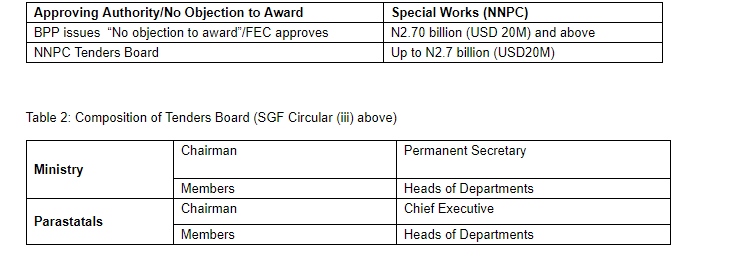
NNPC had cause to clarify severally from Bureau of Public Procurement (BPP) as to the composition of NNPC Tenders Board and the role of NNPC Board appointed by Government. The following clarifications were made.
- The BPP expressly clarified that NNPC Tenders Board (NTB) is NOT the same as NNPC Board. The governing board (NNPC Board) is responsible for approval of work programmes, corporate plans and budgets, while the NTB is responsible for approval of day-to-day procurement implementation.
- BPP referred to the SGF circular for the composition of the NTB to compose of the Accounting Officer (GMD NNPC) as the Chairman, with Heads of Department (GEDs) as members with the Head of procurement (GGM SCM) serving as the Secretary of the NNPC Tenders Board.
The above clarifications of the provisions of the procurement process show that approvals reside within the NTB and where thresholds are exceeded, the NNPC refers to FEC for approval. Therefore, the NNPC Board has no role in contracts approval process as advised by BPP.
As can be seen, all these clarifications were sought and obtained prior to August, 2015 and were implemented by Dr. Kachikwu as the GMD of NNPC. Dr. Kachikwu also constituted the first NNPC Tenders Board on 8th September, 2015 and continued to chair it until his exit in June, 2016.
Typical NNPC Contracting Process
- Approval of project proposal and contracting strategy by NTB.
- Placement of adverts for expression of interest in electronic and print media.
- Soliciting for tender (Technical and Commercial)
- Tender evaluation
- Tender approval by NTB for contracts within its threshold; otherwise
- Obtain BPP certificate of no objection before presentation to FEC.
- Present to FEC for approval.
All Contracts in NNPC follow the above procedure.
SPECIFIC CONTRACTS MENTIONED IN THE HONOURABLE MINISTER OF STATE FOR PETROLEUM RESOURCES’ (HMSPR) LETTER TO MR. PRESIDENT
- Crude Oil Term Contract (COTC)- valued at over $10bn
It is important to state that the COTC is not a contract for procurement of goods, works or services; rather it is simply a list of approved off-takers of Nigerian crude oil of all grades. This list does not carry any value, but simply state the terms and conditions for the lifting. It is therefore inappropriate to attach a value to it with the aim of classifying it as contract above Management limit.
In arriving at the off-takers list for 2017/2018 COTC, the following steps were followed:
- Adverts were placed in National and International print media on Monday, 17th October, 2016.
- The bids were publicly opened in the presence of all stakeholders (NIETI, DPR, BPP, Civil Society Organisations, NNPC SCM Division and the press as well as live broadcasts by the NTA and other TV stations).
- Detailed evaluation was carried out and the short list of the successful off-takers was presented to the approving authority (Mr. President) for consideration and approval.
- Thereafter, NNPC published the list of the successful off-takers in newspapers and NNPC’s official website.
This has been the standard procedure and it is the same process adopted during the 2016/2017 COTC when the HMSPR was the GMD.
In conclusion, due process has been fully followed in the shortlisting of the off-takers of the Nigerian crude oil for the current term 2017/2018.
- The Direct Sale Direct Purchase (DSDP) Contract- valued at over $5bn
Like the COTC, the DSDP is not a contract for any procurement of goods, works or services, rather it is simply a list of off-takers of crude oil and suppliers of petroleum products of equivalent value.
This list does not carry any value, but simply state the terms and conditions for the lifting and supply of petroleum products. It is therefore mischievous to classify it as contract and attach a value to it that is above Management’s limit.
In arriving at the off-takers list for 2017/2018 DSDP, the following steps were followed:
- Work plans and execution strategy for the DSDP was granted by the approving authority (Mr. President).
- Adverts were placed in National and International print media and NNPC website on Thursday, 22nd December, 2016.
- The bids were publicly opened in the presence of all stakeholders (NIETI, DPR, BPP, Civil Society Organisations, NNPC’s SCM Division and the press as well as live broadcast by the NTA and some TV stations).
- Detailed evaluation was carried out and the short list of the successful off-takers was presented to the approving authority (Mr. President) for consideration and approval.
This has been the standard procedure and it is the same process adopted during the 2016/2017 DSDP when the HMSPR was the GMD.
In conclusion, it has been confirmed that due process has been followed in arriving at the shortlist of the DSDP partners for the 2017/2018 cycle.
- The Ajaokuta-Kaduna-Kano (AKK) Gas Pipeline Contract
The AKK Gas pipeline project is a contractor financed contract. The process adopted for this contract is as follows:
- Approval of project proposal and contracting strategy was given by NTB.
- Placement of adverts for expression of interest in some National and International print media and NNPC’s website.
- Expression of interest for pre-qualification received and evaluated.
- Technical and Commercial tenders issued and evaluated
- NTB considered and endorsed tender evaluation result for FEC approval since this contract is above NTB’s threshold subject to obtaining the following certificates of no objections:
- BPP certificate of no objection (obtained).
- Certificate of no objection from Infrastructure Concession and Regulatory Commission (ICRC) (obtained).
- Certificate of no objection from Nigerian Content Monitoring & Development Board (NCMDB) (being awaited)
BPP and ICRC certificates have been obtained, while that of NCDMB is being awaited after which the contract will be presented to FEC for consideration and approval.
Thus, due process is being followed in the processing of this contract.
- Various Financing Arrangements Considered with IOCs;
The financing arrangements reported as contracts are part of the process of exiting Cash Call approved by the FEC. It entails negotiations with JV Partners on alternative funding of some selected projects through third party financing to bridge the funding gap associated with Federal Government’s inability to meet its cash call contributions.
The third party financing option emanates from the appropriation act provisions that allow sourcing of financing outside regular cash call contributions. Upon approval of the calendar year’s operating budget, the NNPC in conjunction with its JV partners commence the necessary process for accessing financing to bridge the funding gap.
Section 8 sub-sections (1) and (4) of the NNPC Act CAP N123 requires that all NNPC borrowings must be approved by Mr. President. Specifically, it provides that:
(1) Subject to the other provisions of this section, the Corporation may, from time to time, borrow by overdraft or otherwise howsoever such sums as it may require in the exercise of its functions under this Act.
(4) Where any sum required aforesaid –
- a) Is to be in currency other than Naira; and
- b) Is to be borrowed by the Corporation otherwise than temporarily,
- c) The Corporation shall not borrow the sum without the prior approval of the President.
Due Process:
- NAPIMS and JV partner identify bankable projects that require financing and sends to NNPC Corporate Finance to assist in procuring financing.
- Constitution of Joint Financing Team (JFT) between NNPC and the JV Partner.
- JFT NNPC invites Request For Proposals (RFPs) from Financial Institutions.
- Submitted RFPs are evaluated and beauty parade conducted to determine most cost-efficient proposal.
- Negotiated Financing Strategy, Term-sheets, Structures and pricing are presented for NNPC Management’s (NTB) approvals.
- NNPC presents the renegotiated terms for approval of Mr. President.
- NNPC executes the resultant Agreement.
Financings taken under this Administration: Approx. $3bn are as follows:
All established due process as enumerated above has been observed leading to the securing of financing for the following projects in 2016/2017:
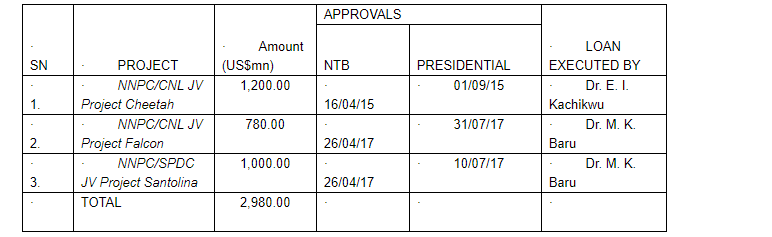
These are not procurement projects as described by the PPA, 2007. However, all established due processes as enumerated above were followed.
The NPDC Integrity Upgrade and Development Projects
All the NPDC procurement contracts were subjected to the approved procurement procedures as described in respect of the AKK Gas Pipeline project above. There were no breaches of any extant procurement processes. For the benefit of doubt, it is confirmed that there is no single NPDC contract that has been approved by the relevant Tenders Board beyond its limit of financial authority and there is no single contract that is in the $3Bn to $4Bn range claimed in the write-up.
Conclusions
From the foregoing, the allegations were baseless and due process has been followed in the various activities.
Furthermore, it is established that apart from the AKK project and NPDC production service contracts, all the other transactions mentioned were not procurement contracts. The NPDC production service contracts have undergone due process, while the AKK contract that requires FEC approval has not reached the stage of contract award.
Ndu Ughamadu
Group General Manager
Group Public Affairs Division,
NNPC, Abuja.
October 9, 2017.


