Connect with us

Economy

BoI Gets $200m from NCDMB to Assist Local Oil Firms

Published

on

NCDMB NCI Fund

By Modupe Gbadeyanka

The sum of $200 million has been released by Nigerian Content Development and Monitoring Board (NCDMB) to the Bank of Industry (BoI) for the support of indigenous oil and gas service providers in the country.

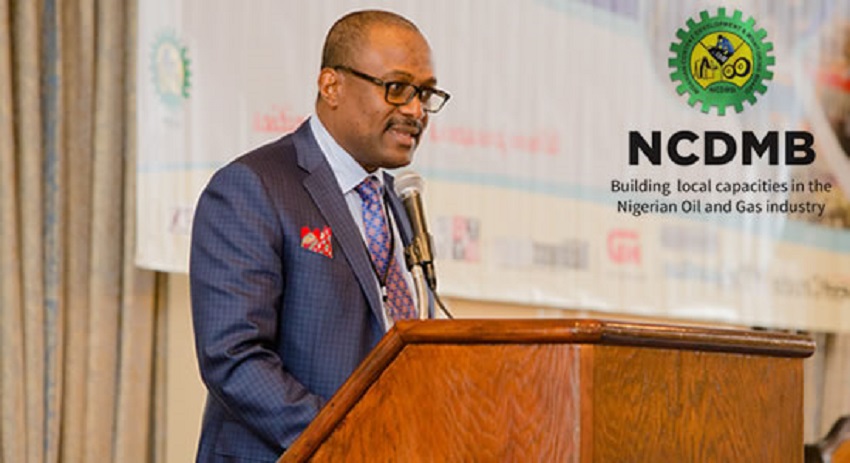
Executive Secretary of NCDMB, Mr Simbi Wabote, speaking on Tuesday at the 7th Practical Nigerian Content Forum in Uyo, Akwa Ibom, stated that the funding package will assist local oil firms create more jobs in the country.

He said his agency would ensure that about eight indigenous oil and gas service providers access the fund every six months to boost job creation in the sector.

“With respect to the Nigerian Content Intervention Fund, in the last one year, we have launched the $200 million intervention fund for our Nigerian oil and gas service providers who are contributors to the Nigerian Content Development Fund.

“It may interest you to know that we have released the $200 million intervention fund to the Bank of Industry for adequate disbursement.

“The intervention fund has all-in single digit interest rate of eight percent for loans extended to Nigerian oil and gas service providers and all-in single digit interest rate of five percent for loans extended to community contractors.

“We will also ensure that the NCIF becomes fully operational and provide statistics of service providers and community contractors who have benefited,” the board chief said.

Mr Wabote further stated that third party outfits were being engaged to monitor compliance with respect to local content implementation in the upstream, midstream and downstream arms of the oil and gas industry.

“We will put in place third-party outfits to enhance compliance monitoring in the upstream, midstream and downstream sectors of the industry, as well as sharpen intervention monitoring based on complaints and whistle-blower alerts,” he said.


Modupe Gbadeyanka is a fast-rising journalist with Business Post Nigeria. Her passion for journalism is amazing. She is willing to learn more with a view to becoming one of the best pen-pushers in Nigeria. Her role models are the duo of CNN's Richard Quest and Christiane Amanpour.

Advertisement
Click to comment

Leave a Reply

Your email address will not be published. Required fields are marked *

Economy

Oil Leaps Nearly 5% as Middle East Conflict Escalates, Supply Risks Mount

Published

on

crude oil market

By Adedapo Adesanya

Oil gained almost 5 per cent on Tuesday as the United States and Israel’s ​battle with Iran intensified, disrupting energy shipments from the Middle East and stoking fears of a longer conflict.

Brent futures chalked up $3.66 ‌or up 4.7 per cent to trade at $81.40 a barrel, its highest settlement since January 2025, while the US West Texas Intermediate (WTI) futures appreciated by $3.33 or 4.7 per cent to at $74.56 per barrel.

Israeli and US forces attacked targets across Iran on Tuesday, prompting Iranian retaliatory strikes around the Gulf as the conflict spread to Lebanon.

Iran has responded with strikes against regional energy infrastructure and tankers in the Strait of Hormuz, through which a fifth of the world’s ​oil and liquefied natural gas typically passes.

Also, Iraq, which is the second largest crude producer ​in the Organisation of the Petroleum Exporting Countries (OPEC) behind Saudi Arabia, cut production by nearly 1.5 million barrels a day.

The Iraqi government said that disrupted navigation and a shortage of available tankers have pushed storage tanks in southern export terminals toward critical levels, forcing production reductions.

The cuts could ​more than double within days as the country runs out of storage space for crude it cannot export due ⁠to the crisis.

Separately, a drone attack targeted the port of Fujairah in the United Arab Emirates (UAE), the country’s largest oil export hub outside the Strait of Hormuz. The incident adds to mounting security risks for Gulf energy infrastructure.

​Concerns increased after Iranian media reported on Monday that Iran will fire on any ship trying to pass through the Strait.

Now, tankers and container ships are avoiding the Strait, with insurers cancelling coverage for vessels and global oil and gas shipping rates soared. Any sustained disruption materially tightens the seaborne crude market, particularly for Middle Eastern barrels bound for Asia.

US President Donald Trump said US and Israeli air attacks ​were projected to last four to five weeks, but could go on longer.

Analysts warn that beyond roughly three weeks of disruption, producers may have no choice but to curb output.

The market is debating how long the supply risk will last, and whether $100 oil is a floor rather than a ceiling if Hormuz does not normalise.

The American Petroleum Institute (API) estimated that crude oil inventories in the United States rose by 5.6 million barrels in the week ending February 27, after adding 11.4 million barrels in the week prior. Official data from the US Energy Information Administration (EIA) will be released later on Wednesday.

Continue Reading

Economy

Nigeria in Talks with China to Expand Yuan–Naira Swap Deal to $10bn

Published

on

yuan-naira $10bn

By Adedapo Adesanya

The federal government is in advanced talks with China to expand its existing Yuan–Naira currency swap to as much as $10 billion, a move aimed at easing pressure on the US dollar and narrowing the trade imbalance that heavily favours the Asian country.

The director general and Global Liaison for the Nigeria–China Strategic Partnership (NSCP), Mr Joseph Tegbe, said in Abuja that the government was seeking to renew and scale up the current $2.5 billion swap arrangement to allow businesses transact directly in yuan, reducing reliance on the dollar for bilateral trade.

According to him, the existing swap line, though initially underutilised, is being renewed and expanded, with proposals to increase it to $10 billion.

Mr Tegbe said Nigeria was also fast-tracking export protocols to take full advantage of China’s zero-tariff policy for African countries, set to take effect in May 2026.

“Products like hides, skins, cashew, and aquatic products such as crabs and shrimps, which are often exported informally, will now enter China legally under zero duty,” he stated.

The DG highlighted that beyond trade, Nigeria is pursuing equity-based partnerships with Chinese firms. Notable initiatives. These include China Harbour Engineering Company’s $1 billion investment in the Lekki Deep Sea Port and large-scale developmental projects in agriculture, steel, and poultry.

Nigerian businesses to transact directly in Yuan, avoiding the current need to convert Naira to dollars and then to Yuan, which places additional strain on dollar demand.

“We are in discussions with China to establish a truly workable Yuan–Naira swap arrangement. We already have about a $2.5 billion swap line, and although progress slowed toward the end of last year, we are now looking to renew and expand it.

“What this means for the economy is simple: a Nigerian business should be able to pay in naira into his local bank account here and receive Yuan in China directly to do his/her business. Currently, traders convert Naira to Dollars, and then Dollars to Yuan, which increases demand for the US Dollar.

“But someone trading with China does not need Dollars — they need Yuan. If transactions move directly between naira and yuan, it will significantly reduce pressure on the Dollar–Naira exchange rate,” he said.

He noted that for the swap to be effective, Nigeria’s foreign exchange reserves must be at a comfortable level, a goal being addressed by the Central Bank of Nigeria (CBN) as part of broader efforts to stabilise the currency and facilitate smoother bilateral trade.

“Our foreign exchange reserves must also be at a comfortable level for the swap to function effectively. Without sufficient reserves, the arrangement cannot deliver its full benefits. That is why we are strengthening our FX position and renewing the agreement.

“Businesses have told us the current threshold is insufficient, so we are working to increase it to the equivalent of $10 billion,” Mr Tegbe said.

Continue Reading

Economy

Spike in Demand for Salt, Seasoning Products Raise NASCON Revenue by 27%

Published

on

NASCON Factory

By Aduragbemi Omiyale

One of the leading salt refiners in Nigeria, Nascon Allied Industries Plc, a subsidiary of Dangote Group, has recorded a 27 per cent spike in revenue for the 2025 financial year.

The financial statements of the company disclosed that earnings stood at N152.7 billion compared with the N120.4 billion achieved in 2024, driven by a robust demand for its salt and seasoning products and improved production stability.

This helped the firm to raise its gross profit by 33 per cent to N73.9 billion from N55.5 billion, as the profit after tax went up by 115 per cent to N33.5 billion from N15.6 billion, and the earnings per share grew by 115 per cent at N12.41, inspiring the board to jack up the dividend payout by 200 per cent at N6.00.

“It is a privilege to present the audited results of Nascon Allied Industries Plc for the year ended December 31, 2025,” the Managing Director, Mr Aderemi Saka, said.

“This year’s performance stands as a testament to our collective resilience and strategic discipline in navigating a demanding macroeconomic environment.

“Our commitment to operational excellence delivered the strongest bottom-line performance in our company’s recent history.

“Revenue grew by 27 per cent to N152.7 billion, reinforced by a robust demand for our salt and seasoning products and improved production stability, while gross profit rose by 33 per cent to N73.9 billion.

“Profit After Tax surged by 115 per cent to N33.5 billion, and this exceptional earnings growth translated into a 115 per cent increase in Earnings Per Share, now at N12.41.

“Reflecting this solid performance, the board is pleased to propose a dividend of N6.00 per share, representing a 200 per cent increase,” he added.

Mr Saka attributed the success of last year to “the 72 per cent expansion of our asset base to N135.3 billion, enabled largely by our strategic investment in new Compressed Natural Gas (CNG) trucks.

“This transition serves a dual purpose: protecting our operations from the volatility of diesel prices while significantly reducing our carbon footprint.

“By strengthening our logistics capabilities, we have enhanced operational independence and secured greater supply chain control, deepening the sustainability of our business model.”

“We concluded the year with a strong liquidity position, as cash and cash equivalents rose by 69 per cent to N41.6 billion, supported by operating cash flows of N43.9 billion.

“This financial strength gives us the capacity to continue investing in technology, infrastructure, and operational efficiency initiatives that will reinforce our market leadership,” he further stated.

“As we look ahead, we remain focused on increasing our market presence, strengthening operational resilience, and executing the long-term strategic initiatives that support sustainable growth.

“With a solid balance sheet and a committed workforce, we are well-positioned to continue delivering value to our shareholders and all stakeholders.

“I extend my sincere appreciation to our shareholders, customers, and employees for their unwavering support. As we move forward, I am optimistic about carrying this momentum into 2026 and beyond,” the MD disclosed.

Continue Reading

Trending