Economy
Core Gold Discovers High Grade Gold in Ecuador
By Dipo Olowookere
After its intensive trenching activities at the newly identified Linderos gold target within its emerging Dynasty District in Ecuador, Core Gold has announced high grade gold in the region.
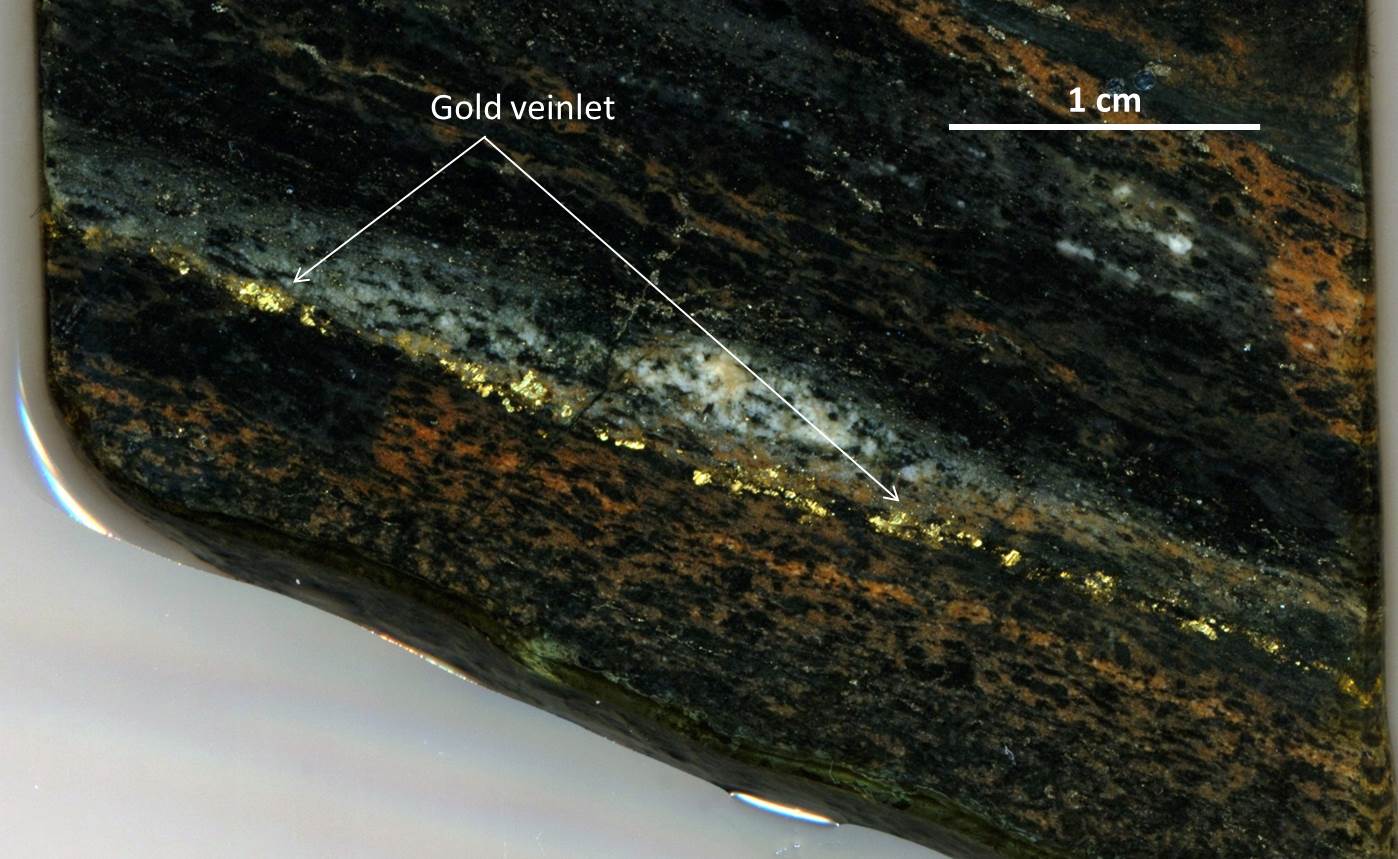
The first 29 trenches at the Linderos epithermal gold prospect within the Dynasty District have yielded encouraging initial results including 21.00m at 18.51 g/t Au, 19.95m at 14.31 g/t Au, 18.20m at 14.74 g/t Au, and 2.00 m at 326.8 g/t Au.
Rock geochemistry and geological detail mapping indicate that the mineralized zone extends for 1,000 meters to the southeast adjacent to the area of trenching. Further trenching is ongoing with additional results due in early 2018.
The company said it has applied for bulk sampling and drilling permits and is aiming to drill and bulk sample Linderos in Q1 2018.
These results are from the first 29 trenches of a planned 60 trench program.
The 29 trenches were sampled over an area of 100m x 150m located within a larger 120m x 1,000m long brecciated shear zone defined by pervasive rock gold geochemical anomalies that have been confirmed by this initial trenching sampling program.
The trenches, which were dug no more than 2.5m deep, were extracted according to industry protocols, sampling the basement rock in a continuous and systematic method. Trenches were designed perpendicular to the shear zone. Sampling (810 samples) was executed across the oxidized quartz veins/structures as well as in the porphyry wall rock.
The Linderos target is a new discovery identified by Core Gold during its 2017 exploration efforts and has not undergone any previous trenching or historical drill testing.
The firm’s four contiguous Linderos Project concessions total 14,317 hectares and are located approximately 45 kilometers southwest of Core Gold’s Dynasty Goldfield project. Further assays from subsequent trenches are now pending and Core Gold plans to start drill testing at Linderos as soon as all the necessary permits are in place.
Keith Piggott, Chief Executive Officer of Core Gold commented: “The initial trenching high-grade gold results at the Linderos target and the overall size of the anomalous shear zone suggest that we are just beginning to test and understand the potential of a major discovery at Linderos. It is precisely this type of potential that attracted us to this large and undeveloped district to begin with and these initial results reinforce our thesis”.
Economy
NASD Market Falls 1.18% to Extend Losing Streak
By Adedapo Adesanya
The NASD Over-the-Counter (OTC) Securities Exchange extended its stay in the south for the fourth consecutive session after it shed 1.18 per cent on Friday, March 13.
The unlisted securities market recorded a loss despite closing without a price decliner, and ending with two price gainers led by Geo Fluids Plc, which gained 1o Kobo to sell at N3.10 per share compared with the previous day’s N3.00 per share. Industrial and General Insurance (IGI) Plc appreciated during the session by 2 Kobo to trade at 54 Kobo per unit versus Thursday’s closing price of 52 Kobo per unit.
When the market closed for the day, the market capitalisation lost N29.83 billion to close at N2.489 trillion compared with the N2.519 trillion it finished a day earlier, and the NASD Unlisted Security Index (NSI) crashed by 49.84 points to 4,160.46 points from 4,210.31 points.
Market activity improved yesterday, as the volume of transactions rose 179.5 per cent to 10.4 million units from 3.7 million units, but the value of trades declined by 68.4 per cent to N29.9 million from N95.0 million, while the number of deals weakened by 11.5 per cent to 46 deals from 52 deals.
Central Securities Clearing Systems (CSCS) Plc remained the most active stock by value on a year-to-date basis with 38.4 million units worth N2.4 billion, Okitipupa Plc followed with 6.4 million units traded at N1.1 billion, and FrieslandCampina Wamco Nigeria Plc transacted 6.3 million units for N584.3 million.
Resourcery Plc ended the trading session as the most traded stock by volume on a year-to-date basis with 1.1 billion units valued at N415.6 million, trailed by Geo-Fluids Plc with 130.8 million units valued at N504.5 million, and CSCS Plc with 38.4 million units worth N2.4 billion.
Economy
Naira Trades N1,366/$1 at Official Market, N1,400/$1 at Black Market
By Adedapo Adesanya
The Naira continued to claw back some gains against the Dollar in the different segments of the foreign exchange (FX) market, as its value was strengthened on Friday.
In the black market, it gained N10 against the United States Dollar yesterday to close at N1,400/$1 compared with the preceding day’s rate of N1,410/$1, and at the GTBank forex counter, it chalked up N6 to close at N1,385/$1, in contrast to the N1,391/$1 it was traded a day earlier.
Similarly, in the Nigerian Autonomous Foreign Exchange Market (NAFEX), it appreciated against the greenback during the session by N5.28 or 0.38 per cent to quote at N1,366.23/$1 versus Thursday’s closing price of N1,371.51/$1.
It also improved its value against the Pound Sterling in the official market on Friday by N21.81 to settle at N1,812.99/£1 compared with the previous day’s N1,834.80/£1, and gained N13.86 against the Euro to sell at N1,568.03/€1 versus N1,581.89/€1.
Pressure eased further on the FX market as the Central Bank of Nigeria (CBN) continued interventionist operations this week, selling Dollars to banks to boost liquidity after a $500 million boost last week.
This was complemented by inflows from foreign investors, exporters and non-bank corporates, among others, while Nigeria’s gross external reserves remained above $50 billion, the highest since 2009.
The Governor of the apex bank, Mr Yemi Cardoso, also eased fears of a Naira devaluation, saying the country’s financial system has been strengthened by reforms.
Regardless, external pressure looms as the US Dollar strengthened globally due to its war with Iran, now ongoing for three weeks.
Meanwhile, the cryptocurrency market was largely down as traders and investors continue to align with current realities.
The market is adapting to the conflict in real time. Early in the war, every headline produced an outsized reaction because nobody could price the tail risk. Now, traders have a framework where strikes happen, oil spikes and bitcoin dips only to recover again.
Cardano (ADA) depreciated by 3.8 per cent to $0.2623, Dogecoin (DOGE) lost 1.7 per cent to finish at $0.0948, Ripple (XRP) slumped 1.5 per cent to $1.39, Solana (SOL) dropped 1.4 per cent to sell for $87.33, Binance Coin (BNB) went down by 1.3 per cent to $653.58, Bitcoin (BTC) declined by 1.1 per cent to $70,670.63, and Ethereum (ETH) decreased by 0.9 per cent to $2,078.78.
However, TRON (TRX) appreciated by 1.7 per cent to $0.2941, while the US Dollar Tether (USDT) and the US Dollar Coin (USDC) remained unchanged at $1.00 apiece.
Economy
Oil Stays Above $100 as Strait of Hormuz Traffic Stalls
By Adedapo Adesanya
The price of the major crude oil grade, Brent crude oil, closed above $100 on Friday for the second consecutive session, as the Iran war heads toward its third week, with oil tanker traffic through the Strait of Hormuz still effectively at a standstill.
It gained 2.67 per cent or $2.68 during the trading day to close at $103.14 per barrel, while the US West Texas Intermediate (WTI) crude oil grade appreciated by 3.11 per cent or $2.98 to settle at $98.71 per barrel.
Brent futures were up about 10 per cent for the week following the 27 per cent rise seen last week, which marked the biggest weekly gain in oil prices since the COVID-19 pandemic in 2020. WTI futures, which saw their best week since 1983 last week, ended the week more than 8 per cent higher.
US President Donald Trump said American forces launched a major bombing raid on Iran’s strategic Kharg Island, targeting military facilities on the key Persian Gulf outpost while warning Iran that its vital oil infrastructure could be destroyed if shipping in the Strait of Hormuz is disrupted.
The terminal accounts for roughly 90 per cent of Iranian crude shipments, loading millions of barrels per day onto tankers bound largely for Asian markets.
The US and Israel’s strikes in the conflict have largely targeted Iranian military and nuclear infrastructure. Oil facilities elsewhere in Iran have been hit, but Kharg’s massive storage tanks, jetties, and pipelines had remained untouched until the latest strike.
Iran’s new supreme leader, Mojtaba Khamenei, vowed to keep fighting in a message delivered via state television.
There have been a number of attacks on foreign ships in or near the Strait, feeding into concerns that a prolonged war could translate to a global economic shock.
Prices are rising despite the US and its allies rolling out some measures to keep a lid on energy costs.
The International Energy Agency (IEA) has agreed to release 400 million stockpiled barrels, the largest such action in history.
The US has issued a 30-day waiver for India to purchase sanctioned oil from Russia. President Donald Trump is considering loosening rules under the Jones Act that require American ships to transport goods between domestic ports, including oil and gas, in an effort to lower costs.
Traders are continuing to monitor developments in the Middle East.
-
Feature/OPED6 years agoDavos was Different this year
-
Travel/Tourism10 years ago
Lagos Seals Western Lodge Hotel In Ikorodu
-
Showbiz3 years agoEstranged Lover Releases Videos of Empress Njamah Bathing
-
Banking8 years agoSort Codes of GTBank Branches in Nigeria
-
Economy3 years agoSubsidy Removal: CNG at N130 Per Litre Cheaper Than Petrol—IPMAN
-
Banking3 years agoSort Codes of UBA Branches in Nigeria
-
Banking3 years agoFirst Bank Announces Planned Downtime
-
Sports3 years agoHighest Paid Nigerian Footballer – How Much Do Nigerian Footballers Earn