Connect with us

Economy

Dangote Begins Sale of Cement on Jumia

Published

on

By Dipo Olowookere

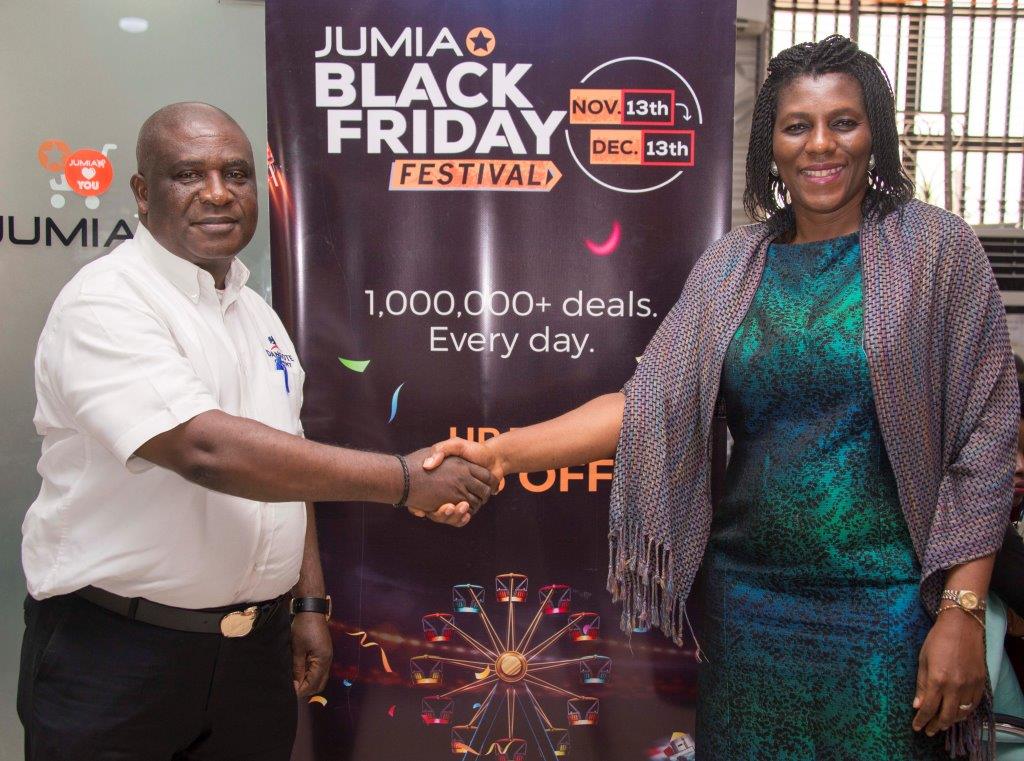
In a new move designed to reduce price and ease logistics inherent in the purchase of its products, the management of Dangote Cement Plc has signed a pact with the foremost e-commerce platform, Jumia Nigeria, to offer for sale its cement to customers online.

At the unveiling of the deal in Lagos, Dangote Cement, Key Account Director, Mr Chux Mogbolu said Dangote Cement was happy to partner with online shopping giant, in a bid to make Dangote cement available with ease to customers.

According to the deal, Nigerians and corporate bodies wishing to purchase a minimum of 300 bags of 50kg of Dangote Cement and above can now order on Jumia from the comfort of their rooms at a reasonable price of N2,500 per bag as opposed to how much is sold in the open market and see them delivered to any place of their choice without any extra cost for transportation.

Mr Mogbolu, however disclosed that the purchase would only be within Lagos, Port- Harcourt and Abuja for now.

He said, “Dangote Cement decided to work with Jumia Nigeria based on its credibility and excellent performance over the years in online shopping management”, adding that the new initiative would help arrest the scams perpetrated by online fraudsters who deceived the people by asking them to come and purchase Dangote Cement for N1000 per bag.

“For now, the pilot scheme is live in Lagos, Abuja and Port Harcourt, but we can extend to other cities depending on the level of demand and performance of the new deal,” he added.

“With the deal, Nigerians in need of seamless supply of cement from Dangote can now place order and pay online and wait for the delivery in record time from any of Dangote’s nearest cement plant to Lagos, Port Harcourt or Abuja.

“We are starting with Minimum Order Quantity (MOQ) of 300, 600 and 900. We may increase depending on demand surge as time goes on,” Mr Mogbolu explained.

Speaking on the deal too, Chief Executive Officer of Jumia Nigeria, Juliet Anammah said the deal with Dangote Cement is part of efforts to deepen service delivery on Jumia Nigeria online platform.

She said she was of the belief that the deal will be beneficial to all parties involved and deepen further online shopping in Nigeria as obtained all over the world.

The Jumia Nigeria boss reflected on the 2017 Black Friday Festival ran by her organization and said the Festival has attracted more than 14 million visits since the commencement of the campaign on November 13th.

According to her, “the annual sales event, which was initiated in Nigeria in 2013 by Jumia remains the busiest and largest shopping day of the year on both online and offline stores. This year’s explosive Black Friday numbers demonstrates the increasing capacity and flexibility of the online retail space in Nigeria.”

“We deliver to the 36 states across Nigeria, and are able to reach neighborhoods and shoppers who traditionally have not had access to a wide variety of products and deals. This year we also see the increasing interest in groceries and other FMCG products which reflect the increasing relevance of Black Friday to the average Nigerian.”

Some key highlights of the 2017 figures presented by Jumia Nigeria in Lagos on Thursday showed among other things more than 1.9 million visits on Black Friday Big Bang. 14.4 million visits since the start of the sales event; Overall, 85% of all visits were made on a mobile device, compared to 72% in 2016; and 86,000 smartphones and counting have been sold in the past two weeks.


Dipo Olowookere is a journalist based in Nigeria that has passion for reporting business news stories. At his leisure time, he watches football and supports 3SC of Ibadan. Mr Olowookere can be reached via [email protected]

1 Comment

1 Comment

Leave a Reply

Your email address will not be published. Required fields are marked *

Economy

Customs Street Bleeds 1.44% as Lafarge Africa Leads Losers’ Chart

Published

on

customs street

By Dipo Olowookere

Nigeria’s stock market further depleted by 1.44 per cent on Wednesday following panic sell-offs by investors, who are cutting down their exposure to local equities.

Business Post observed that profit-taking dominated Customs Street at midweek, with all the key sectors of the Nigerian Exchange (NGX) Limited closing in red.

The insurance space shed 2.76 per cent, the industrial goods index lost 1.55 per cent, the banking counter declined by 1.53 per cent, the consumer goods segment shrank by 0.28 per cent, and the energy sector weakened by 0.05 per cent.

As a result, the All-Share Index (ASI) contracted by 3,554.05 points to 243,132.61 points from 246,686.66 points, and the market capitalisation moderated by N2.279 trillion to N155.940 trillion from N158.219 trillion.

Lafarge Africa led the losers’ chart yesterday after it gave up 9.97 per cent to trade at N307.90, Zichis lost 9.82 per cent to close at N29.20, Learn Africa depreciated by 9.80 per cent to N11.50, John Holt crashed by 9.80 per cent to N13.80, and Consolidated Hallmark dipped by 8.84 per cent to N6.19.

On the flip side, Abbey Mortgage Bank topped the gainers’ log after it grew by 9.93 per cent to N7.75, International Energy Insurance appreciated by 9.89 per cent to N6.00, Tripple G gained 9.80 per cent to sell for N4.37, Universal Insurance expanded by 8.91 per cent to N1.10, and Royal Exchange improved by 7.14 per cent to N1.50.

A total of 17 stocks gained weight yesterday, while 43 stocks lost weight, indicating a negative market breadth index and weak investor sentiment. This has been the mood of the market since the beginning of this week.

Market participants transacted 923.0 million shares worth N42.3 billion in 69,332 deals on Wednesday, in contrast to the 718.8 million shares valued at N29.3 billion traded in 71,683 deals on Tuesday, representing a drop in the number of deals by 3.28 per cent, and a rise in the trading volume and value by 28.41 per cent and 44.37 per cent, respectively.

Sterling Holdings led the activity chart with 264.6 million units valued at N2.1 billion, Access Holdings traded 76.7 million units worth N1.8 billion, Linkage Assurance exchanged 55.1 million units for N99.2 million, VFD Group sold 35.5 million units worth N378.8 million, and Ellah Lakes transacted 33.1 million units valued at N334.3 million.

Continue Reading

Economy

Oil Prices Rise 2% as Middle East Hostilities Escalate

Published

on

Oil Prices fall

By Adedapo Adesanya

Oil prices ‌rose around 2 per cent on Wednesday as hostilities in the Middle East erupted anew and talks between Iran and the United States showed little progress.

Brent futures grew by $1.81 or 1.89 per cent to $97.81 per barrel, and the US West Texas Intermediate (WTI) crude climbed $2.26 or 2.41 per cent to $96.02 a barrel.

According to reports, Iran launched ballistic missiles toward regional neighbours Kuwait and ​Bahrain, killing one person and injuring dozens, while the US forces conducted strikes on Iran’s Qeshm ​Island.

Iranian drones and missiles struck Kuwait International Airport overnight, causing the country to immediately suspend air traffic, activate emergency procedures, and divert flights to alternative airports.

Iran’s Revolutionary Guard said the operation was retaliation for recent US military actions and warned that regional states supporting American operations could face further consequences. Kuwait hosts major US military facilities and serves as a key logistics hub for American operations across the Middle East, but until then had largely avoided becoming a direct target.

Following the overnight attack, the United Arab Emirates (UAE) called for a united Gulf stance.

Meanwhile, President Donald Trump said Iran had agreed not to have a nuclear weapon and that Supreme Leader ‌Ayatollah Mojtaba ⁠Khamenei was involved in negotiations. He has insisted this week that discussions remain active and said a broader agreement could emerge within days, while Iranian officials have delivered contradictory messages.

Iranian Foreign Minister Abbas Araqchi said contacts with American representatives have not been cut off, but no progress has been made in the negotiations.

The prolonged closure of the Strait of Hormuz continues to bottleneck global energy supplies, driving sustained upward pressure on oil markets.

The International Energy Agency (IEA) has warned that global ​oil inventories could hit critical ​levels ahead of peak summer ⁠demand if stock draws continue at their current pace.

Crude oil inventories in the US decreased by 8.0 million barrels during the week ending May 29, according to data from the Energy Information Administration (EIA) released on Wednesday. The EIA’s data release follows figures by the American Petroleum Institute (API) that were released a day earlier, which reported that crude oil inventories saw a draw of 6.75 million barrels in the period.

Continue Reading

Economy

CSCS Boss Shantali Says T+1 Settlement Targets Long-Term Capital Market Growth

Published

on

Shehu Yahaya Shantali

By Adedapo Adesanya

The chief executive of the Central Securities Clearing System (CSCS) Plc, Mr Shehu Yahaya Shantali, says Nigeria’s shift to a T+1 settlement cycle goes beyond faster transactions and is intended to deepen long-term growth in the capital market.

Speaking at a ceremony marking the commencement of T+1 settlement in Lagos, Mr Shantali described the development as a strategic milestone that goes beyond faster transaction timelines to reinforce the market’s structural strength and future readiness.

According to him, the shortened settlement cycle reflects years of investment in infrastructure, technology, and stakeholder collaboration aimed at transforming Nigeria into a globally competitive investment destination.

Nigeria recently became the first market in Africa to adopt the T+1 framework, reducing the settlement period for securities transactions from two days to one.

According to the boss of the securities depository firm, the shortened settlement cycle reflects years of investment in infrastructure, technology, and stakeholder collaboration aimed at transforming Nigeria into a globally competitive investment destination.

“These investments are not solely for T+1 settlement but to position Nigeria’s capital market for sustained growth and longterm competitiveness,” he said.

The migration from T+1 settlement is expected to enhance liquidity, improve capital efficiency, and reduce counterparty risk across the market.

Mr Shantali explained that the T+1 transition represents the culmination of a decades-long evolution from a manual, paper-based system to a fully automated, technology-driven post-trade environment.

He recalled that investors previously waited several months to complete transactions under the old system, but successive reforms, including transitions to T+5, T+3, and T+2, steadily improved efficiency and market integrity.

The latest upgrade, he said, builds on extensive preparations undertaken over the past three years, including system enhancements, process optimisation, and market-wide readiness assessments coordinated by the SEC and industry stakeholders.

On his part, the Director-General of the Securities and Exchange Commission (SEC), Mr Emomotimi Agama, said the reform signals Nigeria’s readiness to compete at the highest levels of global finance, noting that the country transitioned from T+2 to T+1 within six months.

“The era of T+1 has begun,” Mr Agama said, adding that shorter settlement cycles are critical to attracting global capital and strengthening investor confidence.

He noted that leading markets such as the United States, Canada, and India have already adopted T+1 settlement, while several European markets are preparing to migrate, making Nigeria’s transition a crucial step in maintaining international relevance.

Continue Reading

Trending