Economy
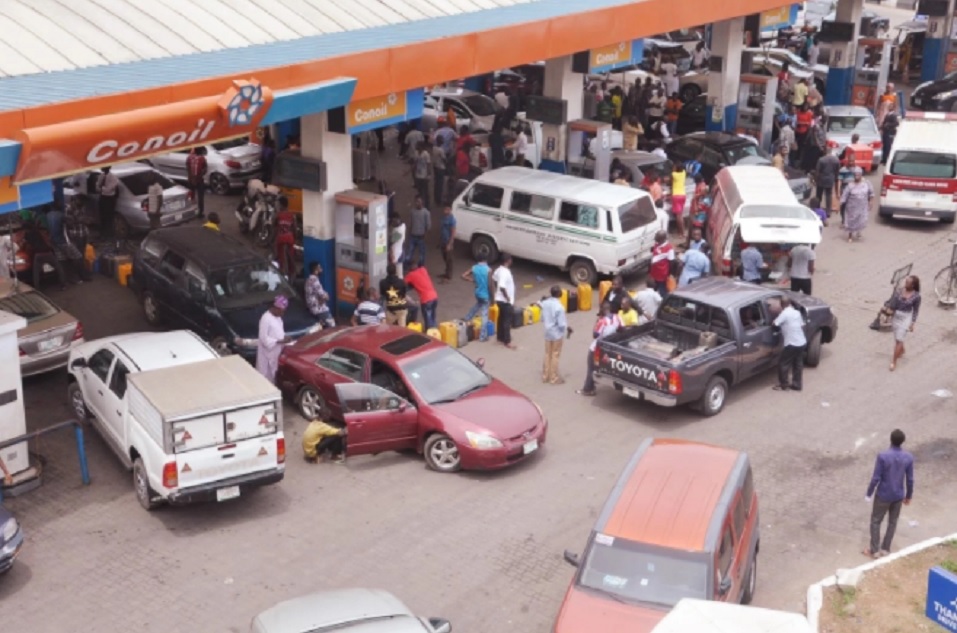
Fuel Scarcity Will Soon Become History in Nigeria—NNPC
By Dipo Olowookere
Group Managing Director of the Nigerian National Petroleum Corporation (NNPC), Mr Maikanti Baru, has assured citizens that the perennial fuel scarcity in the country would soon become “a thing of the past.”
Mr Baru gave this assurance while delivering a goodwill message during the ‘NNPC Day’ held at the 39th Kaduna International Trade Fair, in Kaduna on Wednesday.
He said the state-owned oil firm was committed to providing the necessary assistance for Nigeria to attain competitive edge in non-oil sectors of the economy.
“NNPC is suited to providing the enabling environment for the nation to optimise its commercial, industrial and agricultural potentials to attain competitive edge in these sectors. This is a commitment which we shall continue to abide by,” Mr Baru stated.
To further demonstrate NNPC’s commitment on this goal, Mr Baru explained that the corporation had set up the Renewable Energy Division which is focused on not only developing solar and other renewable energy sources but also on developing Biofuels that are heavily dependent on agricultural produce as feedstock.
According to him, the multiplayer effects of such ventures are enormous. These include reviving the nation’s agricultural sector, generating millions of jobs, contributing significantly to power generation, producing high volume of animal feed, starch and other by-products, in addition to the biofuels that will be blended to our Refineries’ petroleum products that will significantly reduce imports of petroleum products into the country.
Mr Baru, who spoke on the theme ‘NNPC and Promotion of Industry, Commerce and Agriculture for International Competitiveness,’ noted that to aid the course of focusing on industry, commerce and agriculture, Nigeria needed to begin with the end in mind by first undertaking a holistic policy actions towards rebuilding the nation’s infrastructure.
In this regard, the GMD observed that that key infrastructure sectors that were expected to be upgraded include electric power, transport, information and communication, roads, water and sanitation as well as rehabilitation of existing oil and gas pipeline facilities.
“It is my sincere belief that revitalising these critical infrastructures will emplace efficiency in the new focus areas of Commerce, Industry and Agriculture to buoy the national economy and enable the country’s entrepreneurs compete favourably with their peers across the globe,” he added.
The GMD also lauded President Muhammadu Buhari’s economic agenda which he said had saved the country from the vagaries of monoculture.
“Every Nigerian, individual or corporate, has the onerous responsibility to ensure this vision becomes a reality,” he maintained.
On the recent fuel supply issues witnessed in some cities across the country, Mr Baru said NNPC had, over the last few months, been engaging with relevant stakeholders to ensure the challenge remains “a thing of the past.”
Mr Baru, who insisted that fuel scarcity was caused by greedy marketers, explained that the corporation had been collaborating with sister agencies towards addressing products profiteering, diversion, hoarding and smuggling.
Above all, he said, the corporation was working hard to get the nation’s refineries back to their optimal levels.
He listed some of the key stakeholders engaged by the corporation to include the Department of Petroleum Resources (DPR), Federal Ministry of Power, Works and Housing, the Nigerian Security & Civil Defence Corps, the Nigerian Customs Service as well as Nigerian Ports Authority (NPA).
Earlier in his speech, President of the Kaduna State Chamber of Commerce, Mines & Agriculture (KADCCIMA), Dr Farida Dankaka, said this year’s theme was chosen to complement the efforts of the Federal Government in promoting economic growth through commerce and industry.
Dankaka, who was represented by Mr Tijjani Musa, also commended the Federal Government on its economic diversification which has led to sufficiency in rice production, stressing that such effort should also be extended to other cash crops like cotton, groundnut, wheat, rubber, palm oil etc.
The Kaduna International Trade Fair is one of the most important events in the business calendar of KADCCIMA.
Alongside Lagos and Enugu, it is one of the three local trade fairs attended by the corporation not only to enlighten the public on its various services, but also to educate them on the safest way of handling its products.
Economy
JTF Destroys 925 Illegal Refineries, Seizes 6.8 million Litres of Crude Oil
By Adedapo Adesanya
The Joint Task Force South-South, Operation Delta Safe (OPDS), demobilised no fewer than 925 illegal refining sites, dismantled 1,228 storage facilities and destroyed 297 large wooden boats in the last one year.
This was part of major operational successes recorded in the last twelve months, significantly degrading crude oil theft, illegal refining and sea robbery across the Niger Delta.
The Commander of OPDS, Rear Admiral Olugbenga Oladipo, disclosed this in Yenagoa during a Defence Media Operations tour and briefing on the activities of the task force.
The brief was presented by Asst. Commander A. Bako of the Nigeria Security and Civil Defence Corps (NSCDC), on his behalf.
He said sustained intelligence-driven kinetic and non-kinetic operations had strengthened the security of Nigeria’s critical oil and gas infrastructure, leading to improved crude oil production and export stability.
Reeling other milestones, he said “About 6.8 million litres of crude oil, 2.29 million litres of illegally refined diesel (AGO), as well as large quantities of PMS and DPK, were recovered or denied criminal elements,” he said.
The officer added that 136 tanker trucks conveying stolen petroleum products were intercepted, while 1,565 suspects linked to oil theft, illegal refining, kidnapping and other crimes were arrested and handed over to relevant prosecuting agencies.
He noted that the sustained operations helped achieve an average terminal factor of about 95 per cent on major pipelines, including the Trans Niger, Trans Ramos and Trans Escravos pipelines, particularly in the last quarter of 2025.
On maritime security, the OPDS commander said the task force conducted over 3,240 land and sea patrols, leading to the clearance and destruction of 14 militants’ and sea robbers’ camps.
He said the aggressive posture against sea robbery and piracy had resulted in zero piracy incidents in the Gulf of Guinea and the lowest incidence of sea robbery in Nigerian waters within the period.
In the area of arms control, the commander disclosed that 99 illicit weapons were recovered from criminal elements during intelligence-led raids across the joint operations area.
Beyond combat operations, he said OPDS intensified non-kinetic engagements, resolving about 282 Corporate Social Responsibility (CSR)-related disputes between oil companies and host communities.
“These mediation efforts involving companies such as Chevron, Aiteo, Oando and others helped prevent production shutdowns and fostered a more conducive operating environment,” he said.
He added that OPDS also carried out medical outreaches, educational support programmes and community development initiatives, while maintaining strong collaboration with pipeline surveillance contractors and regulatory agencies.
The officer commended the media for its role in public sensitisation and accurate reporting, describing it as a force multiplier in the campaign against crude oil theft and vandalism.
He assured that the task force would sustain operational pressure on criminal networks to further secure national economic assets and maintain peace in the Niger Delta.
In his remarks, the Director of Defence Media Operations, Major-General Michael Onoja, underscored the central role of information operations in modern warfare, describing effective communication as a critical line of operation in ongoing military campaigns across the country.
He said the Chief of Defence Staff (CDS), Gen. Christopher Musa, had placed renewed emphasis on strategic communication to strengthen public trust, improve perception management and enhance cooperation between the Armed Forces and the civil populace.
He described the media as a strategic partner and “heroes of democracy,” noting that the press remained the most effective bridge between the military and the public.
According to him, security communication is a two-way process in which information from citizens aided military operations, while accurate reporting helps promote transparency, accountability and national cohesion, in line with Section 22 of the 1999 Constitution.
He reaffirmed the Armed Forces of Nigeria’s commitment to transparency and accountability, stressing that oversight and responsible media engagement would strengthen professionalism and operational effectiveness.
The defence spokesman also commended troops and sister security agencies for their sacrifices in the fight against insecurity, adding that national security required a whole-of-nation approach and active citizen participation.
Economy
DMO to Sell N900bn FGN Bonds January 26
By Aduragbemi Omiyale
Bonds worth about N900 billion is to be offered to investors in January 2026 by the Debt Management Office (DMO).
The debt instrument would be sold by the agency on behalf of the Federal Government of Nigeria (FGN) as part of its borrowing plans.
The paper would be issued in three tenors, according to the debt office of the Nigerian government, and would be sold at N1,000 per unit.
Business Post reports that the minimum subscription for the bond is N50 million and in multiples of N1,000 thereafter, with the interest to be paid semi-annually, and the bullet repayment on the maturity date.
For re-openings of previously issued bonds, (where the coupon is already set), successful bidders will pay a price corresponding to the yield-to-maturity bid that clears the volume being auctioned, plus any accrued interest on the instrument, a circular from the DMO disclosed.
The auction date, the agency revealed, is Monday, January 26, 2026, with N300 billion of a 7-year reopening note offered at 18.50 per cent. The organisation will also auction N400 billion of 10-year re-opening 19.00% FGN FEB 2034, and another 10-year re-opening 22.60% FGN JAN 2035 note worth N200 billion.
The FGN bonds are backed by the full faith and credit of the Federal Government and are charged upon the general assets of Nigeria. They qualify as securities in which trustees can invest under the Trustees Investment Act and can be used as government securities within the meaning of Company Income Tax Act and Personal income Tax Act for tax exemption for pension funds amongst other investors.
After issuance, the debt instruments would be listed on the Nigerian Exchange (NGX) Limited and the FMDQ Securities Exchange.
Economy
Nigeria Attracts $5.3bn Upstream Investments in 2025
By Adedapo Adesanya
Nigeria has emerged as Sub-Saharan Africa’s leading upstream oil and gas investment destination in 2025, attracting $5.3 billion in capital, according to a report by industry intelligence firm, Wood Mackenzie.
The investment into the country happened despite an 18 per cent decline in upstream spending across the region, underscoring the impact of recent fiscal and regulatory reforms.
Wood Mackenzie disclosed that Nigeria retained the top spot for upstream capital inflows, even as investment activity slowed sharply across Africa.
Notably, only two Final Investment Decisions (FIDs) were recorded across Sub-Saharan Africa in 2025, with Nigeria securing one of them.
The FID was reached on the Shell–Sunlink HI Field (OML 144), a shallow-water non-associated gas project, following the introduction of Nigeria’s Non-Associated Gas (NAG) incentives in 2024.
The incentives restored the project’s commercial viability and unlocked critical gas feedstock for Nigeria LNG Limited (NLNG) which according to Wood Mackenzie signals a clear shift in investor confidence.
“Nigeria’s NAG incentives have materially improved gas economics, enabling projects that were previously marginal to reach FID,” the firm noted.
The latest investment milestone marks a sharp turnaround from previous years.
Between 2015 and 2023, Nigeria captured just 4 per cent of Africa’s sanctioned FIDs, securing $5 billion across six of 44 projects.
However, over the last two years, Nigeria has attracted 38 per cent of Africa’s sanctioned FIDs, accounting for $8 billion across five of eight projects continent-wide.
“This reversal highlights the impact of decisive reforms implemented over the past 24 months,” Wood Mackenzie said, adding that Nigeria now offers “among the most competitive deep-water fiscal terms globally and the most attractive gas terms in Africa,” it said.
Looking ahead, the firm expressed optimism that Nigeria will sustain the momentum into 2026. “With targeted incentives and a stable, investor-focused policy framework, we expect additional FIDs to be sanctioned,” it stated.
The resurgence positions Nigeria as a standout destination for upstream oil and gas investment at a time when capital discipline and policy uncertainty continue to weigh on much of Sub-Saharan Africa.
The Bola Tinubu administration has reiterated its commitment to boosting investment in the country’s energy sector, particularly in oil and gas. In May 2025, President Tinubu issued a new executive order (EO) to lower project costs, attract investment, and enhance revenues from oil and gas operations.
The new order builds on the administration’s 2024 presidential reform directives, which introduced enhanced fiscal terms, streamlined project timelines, and aligned local content policies with global best practices.
-
Feature/OPED6 years agoDavos was Different this year
-
Travel/Tourism9 years ago
Lagos Seals Western Lodge Hotel In Ikorodu
-
Showbiz3 years agoEstranged Lover Releases Videos of Empress Njamah Bathing
-
Banking8 years agoSort Codes of GTBank Branches in Nigeria
-
Economy3 years agoSubsidy Removal: CNG at N130 Per Litre Cheaper Than Petrol—IPMAN
-
Banking3 years agoFirst Bank Announces Planned Downtime
-
Banking3 years agoSort Codes of UBA Branches in Nigeria
-
Sports3 years agoHighest Paid Nigerian Footballer – How Much Do Nigerian Footballers Earn