Connect with us

Economy

Asian Equities Close Higher as White House Eyes Tariff Exemptions

Published

on

By Investors Hub

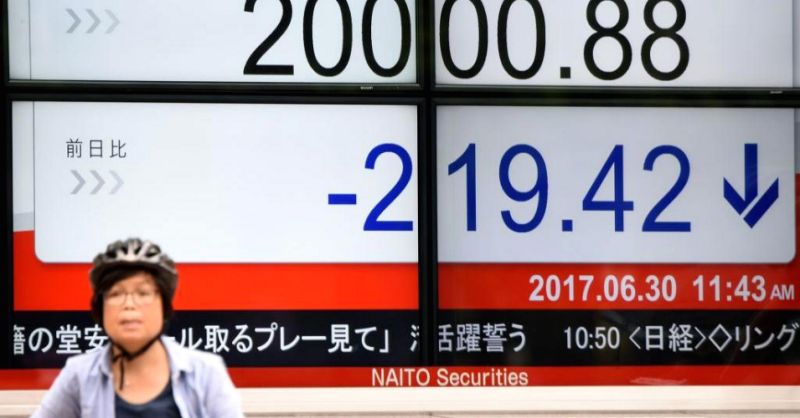
Asian stocks closed mostly higher on Thursday after the White House indicated that some countries could be exempt from President Donald Trump’s planned tariffs on steel and aluminum imports. Better than expected economic data from China and Japan also offered support.

Chinese stocks ended higher after official data showed China’s exports grew at a faster than expected pace in February.

The benchmark Shanghai Composite index rose 17.63 points or 0.5 percent to close at 3,289.29, while Hong Kong’s Hang Seng Index jumped 457.60 points or 1.5 percent to 30,654.52.

China’s exports jumped 44.5 percent year-over-year in February in dollar terms, much faster than the 11.0 percent rise economists had forecast.

Imports climbed 6.3 percent from a year ago, slower than the expected growth of 8.0 percent. The trade surplus totaled $33.74 billion, in contrast to the expected deficit of $5.7 billion.

Japanese stocks rebounded, although markets ended off their day’s highs ahead of the ECB and Bank of Japan meetings and Trump’s final announcement of tariffs on steel and aluminum imports.

The Nikkei 225 Index ended up 115.35 points or 0.5 percent at 21,368.07 after rising more than 1 percent earlier in the day. The broader Topix index closed 0.4 percent higher at 1,709.95.

Honda Motor and Sony rose about 1 percent on a weaker yen. Steelmaker Japan Steel Works jumped 3.2 percent and Kobe Steel rallied 3 percent as worries about a trade war eased. Nintendo, Tokyo Electron and Eisai soared 4-10 percent.

Japan’s GDP grew a seasonally adjusted 0.4 percent sequentially in the fourth quarter of 2017, the Cabinet Office said in Thursday’s revision. That exceeded expectations for an increase of 0.2 percent after last month’s preliminary reading suggested a gain of 0.1 percent.

Australian shares rose as trade war fears eased and trade surplus figures for January topped forecasts. The benchmark S&P/ASX 200 Index rose 40.90 points or 0.7 percent to finish at 5,942.90, while the broader All Ordinaries Index ended up 41.20 points or 0.7 percent at 6,046.60.

The big four banks rose between 0.4 percent and 1.4 percent after RBA Governor Philip Lowe sounded upbeat about domestic economic growth.

Mining stocks ended mixed, with Rio Tinto rising 0.6 percent and Fortescue Metals Group climbing 2.1 percent, while BHP Billiton dropped 2 percent.

Energy firms also turned in a mixed performance after oil prices fell more than 2 percent overnight on data showing an increase in U.S. crude inventories and output.

On the economic front, Australia posted a merchandise trade surplus of A$1.055 billion in January, the Australian Bureau of Statistics said. That blew away forecasts for a surplus of A$200 million following the upwardly revised A$1.146 billion deficit in December.


Modupe Gbadeyanka is a fast-rising journalist with Business Post Nigeria. Her passion for journalism is amazing. She is willing to learn more with a view to becoming one of the best pen-pushers in Nigeria. Her role models are the duo of CNN's Richard Quest and Christiane Amanpour.

Advertisement
Click to comment

Leave a Reply

Your email address will not be published. Required fields are marked *

Economy

Naira Down Again at NAFEX, Trades N1,359/$1

Published

on

Naira-Yuan Currency Swap Deal

By Adedapo Adesanya

The Naira further weakened against the Dollar in the Nigerian Autonomous Foreign Exchange Market (NAFEX) for the fourth straight session this week on Thursday, February 26.

At the official market yesterday, the Nigerian Naira lost N3.71 or 0.27 per cent to trade at N1,359.82/$1 compared with the previous session’s N1,356.11/$1.

In the same vein, the local currency depreciated against the Pound Sterling in the same market window on Thursday by N8.27 to close at N1,843.23/£1 versus Wednesday’s closing price of N1,834.96/£1, and against the Euro, it crashed by N8.30 to quote at N1,606.89/€1, in contrast to the midweek’s closing price of N1,598.59/€1.

But at the GTBank forex desk, the exchange rate of the Naira to the Dollar remained unchanged at N1,367/$1, and also at the parallel market, it maintained stability at N1,365/$1.

The continuation of the decline of the Nigerian currency is attributed to a surge in foreign payments that have outpaced the available Dollars in the FX market.

In a move to address the ongoing shortfall at the official window, the Central Bank of Nigeria (CBN) intervened by selling $100 million to banks and dealers on Tuesday.

However, the FX support failed to reverse the trend, though analysts see no cause for alarm, given that the authority recently mopped up foreign currency to achieve balance and it is still within the expected trading range of N1,350 and N1,450/$1.

As for the cryptocurrency market, major tokens posted losses over the last 24 hours as traders continued to de-risk alongside equities following Nvidia’s earnings-driven pullback, with Ripple (XRP) down by 2.7 per cent to $1.40, and Dogecoin (DOGE) down by 1.6 per cent to $0.0098.

Further, Litecoin (LTC) declined by 1.3 per cent to $55.87, Ethereum (ETH) slipped by 0.9 per cent to $2,036.89, Bitcoin (BTC) tumbled by 0.7 per cent to $67,708.21, Cardano (ADA) slumped by 0.6 per cent to $0.2924, and Solana (SOL) depreciated by 0.4 per cent to $87.22, while Binance Coin (BNB) gained 0.4 per cent to sell for $629.95, with the US Dollar Tether (USDT) and the US Dollar Coin (USDC) closing flat at $1.00 each.

Continue Reading

Economy

Crude Oil Falls as Geopolitical Risk Around Iran Clouds Supply Outlook

Published

on

Crude Oil Loan Facility

By Adedapo Adesanya

Crude oil settled lower on Thursday as investors tracked developments in talks between the United States and Iran over the latter’s nuclear programme, weighing potential supply concerns if hostilities escalate.

Brent crude futures lost 10 cents or 0.14 per cent to close at $70.75 a barrel, while the US West Texas Intermediate (WTI) crude futures depreciated by 21 cents or 0.32 per cent to $65.21 a barrel.

The US and Iran held indirect talks in Geneva on Thursday over their long-running nuclear dispute to avert a conflict after US President Donald Trump ordered a military build-up in the region.

Prices had gained earlier in the session after media reports indicated the talks had stalled over US insistence on zero enrichment of uranium by Iran, as well as a demand for the delivery of all 60 per cent-enriched uranium to the US.

However, prices then retreated after the two countries extended talks into next week, reducing the immediate strike potential.

Iran’s Foreign Minister, who confirmed talks will continue next week, said Thursday’s talks were the most serious exchanges with the US yet, saying Iran clearly laid out its demand for lifting sanctions and the process for relief.

His counterpart from Oman, who is handling the talks, said significant progress was made in Thursday’s talks. The Omani minister’s upbeat assessment followed indirect talks between Iranian Foreign Minister and US envoys Steve Witkoff and Jared Kushner in Geneva, with one session in the morning and the second in the afternoon.

He will also hold talks with US Vice President JD Vance and other US officials in Washington on Friday.

The Trump administration has insisted that Iran’s ballistic missile program and its support for armed groups in the region must be part of the negotiations.

The American President said on February 19 that Iran must make a deal in 10 to 15 days, warning that “really bad things” would otherwise happen.

On Tuesday, he briefly laid out his case for a possible attack on Iran in his State of the Union speech, underlining that while he preferred a diplomatic solution, he would not allow Iran to obtain a nuclear weapon.

Meanwhile, the US continues to amass forces in the Middle Eastern region, with the military saying it is prepared to execute orders given by the US President.

Continue Reading

Economy

Why Transparency Matters in Your Choice of a Financial Broker

Published

on

HFM financial broker

Choosing a Forex broker is essentially picking a partner to hold the wallet. In 2026, the market is flooded with flashy ads promising massive leverage and “zero fees,” but most of that is just noise. Real transparency is becoming a rare commodity. It isn’t just a corporate buzzword; it’s the only way a trader can be sure they aren’t playing against a stacked deck. If a broker’s operations are a black box, the trader is flying blind, which is a guaranteed way to blow an account.

The Scam of “Zero Commissions”

The first place transparency falls apart is in the pricing. Many brokers scream about “zero commissions” to get people through the door, but they aren’t running a charity. If they aren’t charging a flat fee, they are almost certainly hiding their profit in bloated spreads or “slippage.” A trader might hit buy at one price and get filled at a significantly worse one without any explanation. This acts as a silent tax on every trade. A transparent broker doesn’t hide the bill; they provide a live, auditable breakdown of costs so the trader can actually calculate their edge.

The Conflict of Market Making

It is vital to know who is on the other side of the screen. Many brokers act as “Market Makers,” which is a polite way of saying they win when the trader loses. This creates a massive conflict of interest. There is little incentive for a broker to provide fast execution if a client’s profit hurts their own bottom line. A broker with nothing to hide is open about using an ECN or STP model, simply passing orders to the big banks and taking a small, visible fee. If a broker refuses to disclose their execution model, they are likely betting against their own clients.

Regulation as a Safety Net

Transparency is worthless without an actual watchdog. A broker that values its reputation leads with its licenses from heavy-hitters like the FCA or ASIC. They don’t bury their regulatory status in the fine print or hide behind “offshore” jurisdictions with zero oversight. More importantly, they provide proof that client funds are kept in segregated accounts. This ensures that if the broker goes bust, the money doesn’t go to their creditors—it stays with the trader. Without this level of openness, capital is essentially unprotected.

The Withdrawal Litmus Test

The ultimate test of a broker’s transparency is how they handle the exit. There are countless horror stories of traders growing an account only to find that “technical errors” or vague “bonus terms” prevent them from withdrawing their money. A legitimate broker has clear, public rules for getting funds out and doesn’t hide behind a wall of unreturned emails. If a platform makes it difficult to see the exit strategy, it’s a sign that the front door should have stayed closed.

Conclusion

In 2026, honesty is the most valuable feature a broker can offer. It is the foundation that allows a trader to focus on the charts instead of worrying if their stops are being hunted. Finding a partner with clear pricing, honest execution, and real regulation is the first trade that has to be won. Flashy marketing is easy to find, but transparency is what actually keeps a trader in the game for the long haul.

Continue Reading

Trending