Economy
Mutual Fund Assets Cross N500b Mark
By Dipo Olowookere
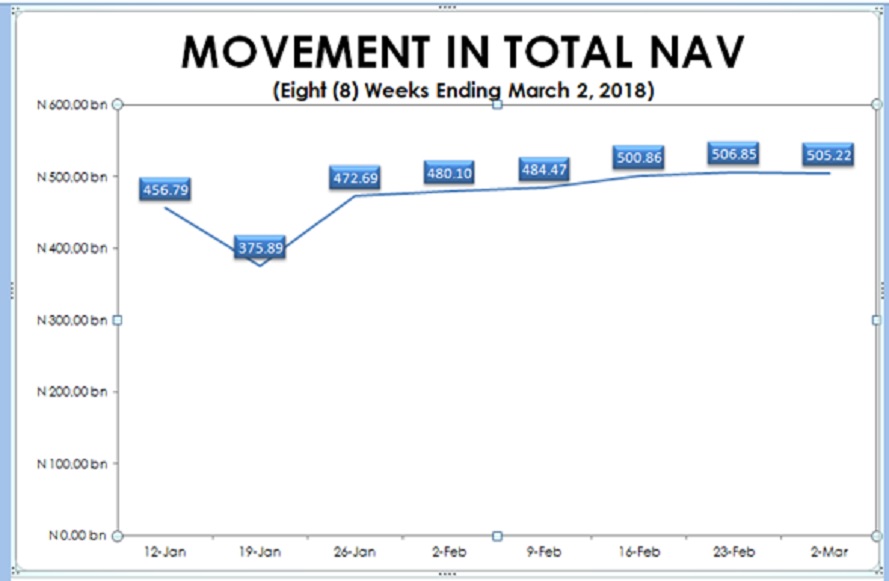
Nigeria’s mutual fund the industry has added N84 billion to end with total assets worth N0.513 trillion as at March 2, 2018.
This was helped by performance in equity market and net inflows, analysts at Quantitative Financial Analytics have revealed. It marks the sixth consecutive weekly rise in AUM for Mutual Fund industry since January 19, 2018.
Mutual fund AUM has been on the increase since 2006 and the increase has accelerated remarkably in recent times especially as investor sentiments and awareness improves.
According to Quantitative Financial Analytics, in 2017 alone, AUM surged by about 89 percent from N224.8 billion to N426 billion due to net inflow of about N186 billion as well as estimated aggregate profit of N16 billion recorded by the industry in 2017.
That the mutual fund industry has crossed the half trillion mark is quite a mile stone given the seemingly lack of transparency in the industry.
Though the AUM has continued to increase, the dynamics of the industry remains relatively the same as investors remained overweight on money market mutual funds despite ongoing trend in the yield curve.
Of the N512 billion total asset value as at March 2, 2018, N368.9 billion resides in money market funds, representing 72 percent of the industry AUM.
The industry is not only growing in terms of asset under management (AUM), it is also growing with regards to the number of funds.
In 2017, 16 new funds were added to the SEC NAV Summary report compared to the 10 funds added in 2016 and so far in 2018, 2 new funds have been added.
The fact that as at 2006, mutual funds were relatively unknown with total assets of less than N35 billion compared to its half a trillion Naira value today implies that mutual fund have come to stay.
Economy
Lokpobiri Begs Lawmakers to Reschedule Oil Revenue Executive Order Probe
By Adedapo Adesanya
A joint National Assembly probe into President Bola Tinubu’s new oil revenue executive order was stalled on Thursday following a request for more time by the Minister of Petroleum Resources, Mr Heineken Lokpobiri.
The hearing was convened to scrutinise the executive order directing that royalty oil, tax oil, profit oil, profit gas and other revenues due to the Federation under various petroleum contracts be paid directly into the Federation Account.
Mr Lokpobiri told lawmakers that although he attended out of respect for parliament, he had been notified of the hearing only a day earlier and had not obtained all the relevant documents needed to defend the policy adequately.
He appealed for the session to be rescheduled.
Co-chairman of the joint committee and Chairman of the Senate Committee on Gas, Mr Agom Jarigbe, put the request to a voice vote, and lawmakers approved the adjournment.
A new date is expected to be communicated to the minister.
The executive order signed last week also scrapped the 30 per cent Frontier Exploration Fund created under the Petroleum Industry Act (PIA) and discontinued the 30 per cent management fee on profit oil and profit gas previously retained by the Nigerian National Petroleum Company (NNPC) Limited.
Anchored on Sections 5 and 44(3) of the Constitution, the presidency said the directive was aimed at safeguarding oil and gas revenues, curbing excessive deductions and restoring the constitutional entitlements of federal, state and local governments to the
However, the order has sparked criticism within the industry, one of which was from the Petroleum and Natural Gas Senior Staff Association of Nigeria (PENGASSAN), whose president, Mr Festus Osifo, called for an immediate withdrawal of the order, warning that it could undermine the PIA and erode investor confidence.
Meanwhile, at another session, the Chairman of the Senate Committee on Finance, Senator Mohammed Sani Musa, disclosed that President Tinubu would soon transmit proposals to amend certain provisions of the PIA to align with current economic realities.
He noted that while many expect the executive order to boost revenue automatically, Nigeria has yet to achieve its desired income levels.
He did not specify which sections of the law would be targeted, but suggested that the drive to enhance revenue generation would necessitate legislative adjustments.
The PIA, signed into law in 2021 by the late ex-President Muhammadu Buhari, overhauled the governance, regulatory and fiscal framework of Nigeria’s oil and gas sector, commercialised the NNPC and restructured revenue-sharing arrangements.
Economy
NGX Group Declares N2 Final Dividend, 1-for-3 Bonus Issue for FY’25
By Aduragbemi Omiyale
Shareholders of Nigerian Exchange (NGX) Group Plc will receive one new share for every three held as of April 10, 2026, as a bonus, according to a proposal from the board.
This is in addition to a final dividend of N2.00 proposed by the board to shareholders for the 2025 fiscal year, which raised the total dividend for the year to N3.00, according to the financial statements of the company filed with NGX Limited.
Last year, NGX Group recorded a sterling performance, with its earnings growing by 36.0 per cent to N22.9 billion from N16.9 billion due to sustained growth across core business segments, improved customer penetration on the back of increased investor activity and rising investor confidence.
The operating profit in the year increased by 44.4 per cent to N11.8 billion, while pre-tax profit jumped to N15.6 billion from N13.6 billion in 2024, with the earnings per share (EPS) at N4.75.
As for its balance sheet, total assets increased to N71.0 billion from N68.0 billion, while shareholders’ equity strengthened to N55.2 billion
The improved debt-to-equity position reflects a conservative capital structure, enhanced solvency profile, and strong retained earnings growth.
“Our 2025 performance demonstrates the resilience of our business model and the effectiveness of disciplined strategic execution. Strong revenue growth, improved operating margins and a strengthened balance sheet reinforce our commitment to delivering sustainable long-term shareholder value.
“The increased dividend and bonus issue reflect the Board’s confidence in the sustainability of our earnings and the robustness of our capital position as we continue to deepen Nigeria’s capital markets.
“We are confident that the momentum that we have built in 2025 will be sustained, given investor confidence in the Nigerian capital market and a pipeline of exciting new listings that will broaden and deepen the market,” the chairman of NGX Group, Mr Umaru Kwairanga, said.
On his part, the chief executive of the organisation, Mr Temi Popoola, said, “We delivered strong top-line growth and enhanced profitability in 2025 despite macroeconomic headwinds.
“Our 36 per cent core revenue growth, improved operating efficiency and successful deleveraging have strengthened our capital base and financial flexibility, supporting the increased dividend and bonus issuance.
“As regulatory standards evolve, including the recent upward review of minimum capital requirements by the Securities and Exchange Commission (SEC), our robust balance sheet positions us to meet new thresholds seamlessly while continuing to invest in liquidity expansion, product innovation and market infrastructure to build a resilient, globally competitive exchange group.”
Economy
FG Targets Credit Access For 50% Workers By 2030
By Adedapo Adesanya
The Vice President, Mr Kashim Shettima, inaugurated the Board of the Nigerian Consumer Credit Corporation (CREDICORP) and gave a 50 per cent access target for workers, saying consumer credit was critical to Nigeria’s ambition of becoming a one-trillion-dollar economy by 2030.
According to him, President Bola Tinubu established the CREDICORP to build a trusted credit infrastructure, provide catalytic capital to lower borrowing costs, and help Nigerians overcome long-standing cultural resistance to credit.
Speaking on Thursday in Abuja when he inaugurated the board on behalf of the President, the Vice President, in a statement by his spokesman, Mr Stanley Nkwocha, said that the quality of life of Nigerians cannot improve without closing the gap between access to capital and human dignity.
“A civil servant who earns honestly does not have to chase sudden wealth just to buy a vehicle, or save for ten years to buy one. A young professional should not remain in darkness simply because solar power must be paid for all at once,” the Vice President said.
VP Shettima disclosed that in just one year of operations, CREDICORP has disbursed over ₦37 billion in consumer credit to more than 200,000 Nigerians, with over half of them accessing formal credit for the first time.
The Vice President said the organisation was specifically tasked with building credit infrastructure to bridge the trust gap between lenders and borrowers, providing wholesale capital and credit guarantees through its portfolio company.
“Ultimately, these critical jobs of CREDICORP will enable access to consumer credit to at least 50 per cent of working Nigerians by 2030,” he said.
The Vice President explained that the new board’s role was not ceremonial as they are custodians of the organisation’s mission, adding that the long-term strength of the institution would depend on their “vigilance, integrity, sacrifice, and commitment.”
He directed Board members to uphold Public Service Rules, the Board Charter, and all applicable governance frameworks, warning that accountability and stewardship of public resources were non-negotiable.
The Chairman of CREDICORP, Mr Aderemi Abdul, expressed appreciation to President Tinubu for his vision behind the formation of CREDICORP and for the confidence reposed in them, noting that the establishment of the corporation marked an important step towards strengthening the nation’s financial architecture.
He assured President Tinubu that the board understands its responsibility and will guide the institution to deliver meaningful benefits to Nigerians.
For his part, Mr Uzoma Nwagba, Managing Director/CEO of CREDICORP, recalled watching President Tinubu say 20 years ago that consumer credit is one of the major tools that will improve the lives of Nigerians.
He noted that over the past 18 months, the institution has benefited more than 200,000 Nigerians, including students.
He assured that the presidential vision behind CREDICORP would not be taken lightly, as the team considers their appointments a unique, once-in-a-lifetime opportunity.
Other members of the board inaugurated include Mrs Olanike Kolawole, Executive Director, Operations; Mrs Aisha Abdullahi, Executive Director, Credit and Portfolio Management; Mr Armstrong Ume-Takang (MD, MoFI), Representative of MoFI; Mrs Bisoye Coke-Odusote (DG, NIMC), Representative of NIMC; and Mr Mohammed Naziru Abbas, Representative of FMITI.
Others are Mr Marvin Nadah, Representative of FCCPC; Mrs Chinonyelum Ndidi, Representative of the Federal Ministry of Finance; Mr Mohammed Abbas Jega, Independent Director; and Mrs Toyin Adeniji, Independent Director.
-
Feature/OPED6 years agoDavos was Different this year
-
Travel/Tourism10 years ago
Lagos Seals Western Lodge Hotel In Ikorodu
-
Showbiz3 years agoEstranged Lover Releases Videos of Empress Njamah Bathing
-
Banking8 years agoSort Codes of GTBank Branches in Nigeria
-
Economy3 years agoSubsidy Removal: CNG at N130 Per Litre Cheaper Than Petrol—IPMAN
-
Banking3 years agoSort Codes of UBA Branches in Nigeria
-
Banking3 years agoFirst Bank Announces Planned Downtime
-
Sports3 years agoHighest Paid Nigerian Footballer – How Much Do Nigerian Footballers Earn