General
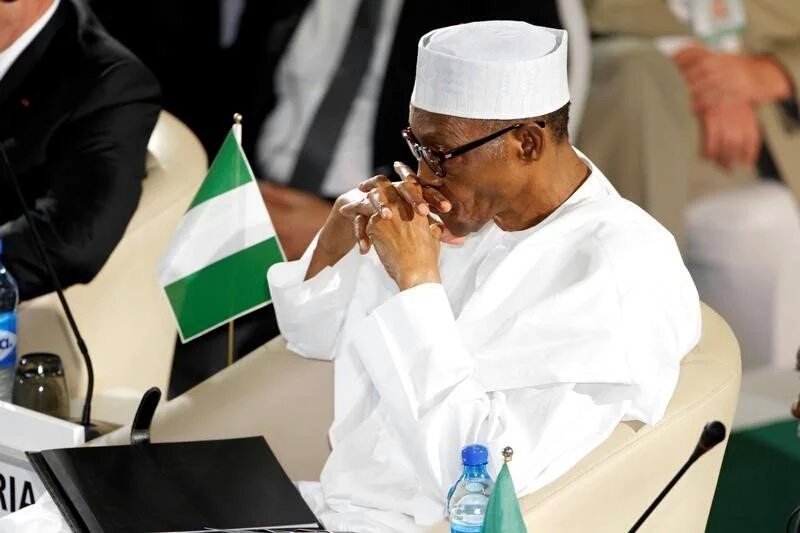
Martin Luther King Family Disowns Award Given to Buhari
By Dipo Olowookere
The family of late Martin Luther King Jnr has denied giving an award to President Muhammadu Buhari of Nigeria.
On Monday, the Presidency publicised a visit by purported members of the late American activist, who fought for rights of African-American.
During the meeting, President Buhari was conferred with the first Black History Month National Black Excellence and Exceptional African Leadership Award 2018.
Mr Buhari even announced this through his official and verified Twitter handle, saying, “President @MBuhari today at the State House received Martin Luther King Jnr’s family. He was also conferred with the 1st Black History Month National Black Excellence and Exceptional African Leadership Award 2018. #AsoVillaToday.”
But days after the said visit, the family of Mr King Jnr dissociated themselves from the visit and award, saying it never came from them.
The family, through The King Centre, tweeted yesterday that, “The award given to President Buhari of Nigeria was not given by The King Center, at the request of The King Center or by the children of #MLK and #CorettaScottKing. @MrFixNigeria.”
This Wednesday night tweet has caused uproar on social media with some asking how the Presidency allowed itself to be ‘duped.’
Others said this was very embarrassing to the country at large and called for authorities to fish out those behind this.
General
REA Expects Further $1.1bn Investment for New Mini Power Grids
By Adedapo Adesanya
The Managing Director of the Rural Electrification Agency, (REA), Mr Abba Aliyu, is poised to attract an estimated $1.1 billion in additional private-sector investment to further achieve the agency’s targets.
He said that the organisation has received a $750 million funding in 2024 through the World Bank funded Distributed Access through Renewable Energy Scale-up (DARES) project.
He added that this capital is specifically intended to act as a springboard to attract an estimated $1.1 billion in additional private-sector investment, with the ultimate goal of providing electricity access to roughly 17.5 million Nigerians through 1,350 new mini grids.
Mr Aliyu also said that the Nigeria Electrification Project (NEP) has already led to the electrification of 1.1 million households across more than 200 mini grids and the delivery of hybrid power solutions to 15 federal institutions.
According to a statement, this followed Mr Aliyu’s high-level inspection of Vsolaris facilities in Lagos, adding that the visit also served as a platform for the REA to highlight its decentralized electrification strategy, which relies on partnering with firms capable of managing local assembly and highefficiency project execution.
The federal government, through the REA, underscored the critical role the partnership with the private sector plays in achieving Nigeria’s ambitious off-grid energy targets and ending energy poverty.
Mr Aliyu emphasized that while public funds serve as a catalyst, the long-term sustainability of Nigeria’s power sector rests on credible private developers who are willing to invest their own resources.
He noted that public funds are intentionally deployed as catalytic grants to ensure that the private sector maintains skin in the game which he believes is the only way to guarantee true accountability and the survival of these projects over time.
General
FG Eyes Higher Allocation as Senate Moves to Amend Revenue Sharing Formula
By Adedapo Adesanya
The Senate has proposed a review of the current revenue-sharing formula among the three tiers of government, seeking to allocate more funds to the federal government.
The proposal is contained in a constitutional amendment bill titled Constitution of the Federal Republic of Nigeria, 1999 (Alteration) Bill, 2026, sponsored by Mr Karimi Sunday representing Kogi-West, which passed first reading during plenary on Tuesday.
Coming amid ongoing calls for a new revenue formula to favour states and local governments, the bill argues for an increased federal share from the existing formula.
Under the current revenue sharing formula designed during the President Olusegun Obasanjo administration, the federal government takes about 52.68 percent of the total revenue generation by the nation in a month, the 36 state governments including the Federal Capital Territory, Abuja get 26.72 per cent and the 774 local governments share 20.60 per cent. The oil producing states of the Niger Delta region receive 13 per cent revenue as derivation to compensate for ecological damage of oil production in the region.
Defending the bill, the senator in a media conference on Tuesday stated that the federal government is overburdened by responsibilities such as the rehabilitation of dilapidated Trunk A roads and rising security costs, adding that available funds are no longer sufficient.
Ahead of its second reading, the lawmaker alleged that some states have little to show for funds received from the federation account.
The battle to change the sharing formula has been ongoing for more than 12 years. In 2013, the Revenue Mobilisation Allocation and Fiscal Commission (RMAFC) resolved to undertake a review to achieve a balanced development of the country.
To achieve that objective, the commission embarked on a nationwide consultation to the 36 states and also met with notable persons, including traditional rulers on the issue.
In December 2014, the commission came out with a proposed new revenue formula, which was submitted to the government. However, the report was not implemented.
Proponents have argued that the review of the revenue allocation among the federal, states and local governments of the federation has become necessary due to the current economic realities the country is facing.
General
African Energy Bank Plans to Raise $15bn in Three Years
By Adedapo Adesanya
The African Energy Bank (AEB) plans to raise $15 billion in its first three years of operations to fund strategic energy projects.
The Secretary General of the African Petroleum Producers’ Organisation (APPO), Mr Farid Ghezali, made this known at the opening session of the Nigeria International Energy Summit (NIES 2026) on Tuesday.
The bank which is set to launch in Abuja in the first half of 2026 has set a target of mobilising $200 billion for midstream and downstream energy projects across the continent.
“The African Energy Bank is designed to unlock the 200 billion needed for our midstream-downstream project by 2030.
“Our goal is to raise $15 billion in just three years with this increased liquidity,” Mr Ghezali stated.
The APPO secretary general decried that Africa’s energy still faces huge export of its oil and gas despite having a huge market for its utilisation within the continent.
“We are still exporting about 70 per cent of our crude oil and 45 per cent of our natural gas, losing $15 billion per year. This is an added value that we could generate locally, especially in the midstream and downstream segments.”
He pinpointed that financing hurdles remained the main bottleneck for the continent, as the cost of financing in Africa was 15 to 20 per cent, compared to only 4 to 6 per cent in Asia.
He said the disparity was unacceptable and had stalled over 150 projects, including refineries and the Ajaokuta–Kaduna–Kano (AKK) Natural Gas Pipeline.
Mr Ghezali also said that APPO’s 18 national oil companies face isolation, “Our 18 national oil companies’ NOCs in APPO often operate in isolation, without a common stock exchange, which severely limits regional synergies.
He noted that the AEB was set to offer “competitive regional pricing” through unified intra-African gas and oil pricing for “savings of up to 30 per cent on their energy imports, a potential gain of $1.4 billion for Africa,” plus “direct access to investors.
He highlighted the three-phase road map for the AEB to include: “Phase one, which, as I said in the first half of 2026, launches the African Energy Bank platform with 10-pillar projects involving countries such as Nigeria, Angola, and Libya. APPO certification and integration of IOCs such as Shell or ENI.”
“Phase two, in 2027, we plan to start a regional gas-oil trade, integrating the principles of the Bassari Declaration for 15 per cent local content.”
Phase three, reaching 2030, the African Energy Bank will be a true African financial hub, with $200 billion mobilised.”
He said expected results included, “Project financing for billions of dollars, regional savings of around 30 per cent of import costs, 500,000 direct jobs created in the local midstream.”
-
Feature/OPED6 years agoDavos was Different this year
-
Travel/Tourism9 years ago
Lagos Seals Western Lodge Hotel In Ikorodu
-
Showbiz3 years agoEstranged Lover Releases Videos of Empress Njamah Bathing
-
Banking8 years agoSort Codes of GTBank Branches in Nigeria
-
Economy3 years agoSubsidy Removal: CNG at N130 Per Litre Cheaper Than Petrol—IPMAN
-
Banking3 years agoSort Codes of UBA Branches in Nigeria
-
Banking3 years agoFirst Bank Announces Planned Downtime
-
Sports3 years agoHighest Paid Nigerian Footballer – How Much Do Nigerian Footballers Earn