Connect with us

Economy

April Inflation to Fall Further to 12.56%–Access Bank

Published

on

By Dipo Olowookere

On Monday, May 14, 2018, the National Bureau of Statistics (NBS), based on the Data Release Calendar available on its website, is scheduled to release the inflation figure for April 2018.

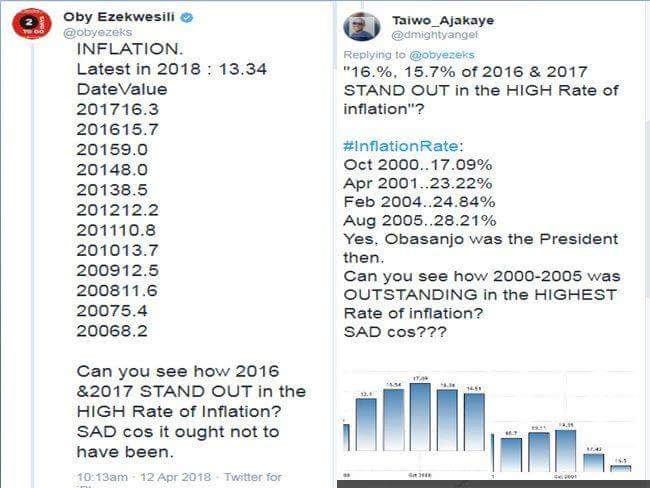
Ahead of the anticipated release tomorrow, the Economic Intelligence Group of Access Bank is predicting a further drop in inflation rate in April 2018 to 12.56 percent year-on-year from 13.34 percent in March 2018.

In its recent report, Access Bank explained that it’s analysis showed a further drop in the food index, one of the main factors that drives the inflation rate.

“Looking in more detail at the drivers, our analysis indicates that the slower inflation rate in April reflects a moderation in food prices and continued stability in the currency.

“Food inflation, which makes up 51.8 percent of the CPI basket, continued its descent in April.

“Based on our survey, this mainly reflected declines in prices for staples such as yam and Irish potato which continue to benefit from robust supplies to the market from barns across the country as well relatively stable transport costs in the month.

“Processed foods such as pasta and milk also nudged slightly lower, enjoying support from stable transport prices.”

Access Bank explained further that April’s easing of price pressures also reflects stability in the core index which excludes farm products and energy prices, owing to improved forex liquidity and sustained CBN interventions.

At the parallel market, the Naira closed at N362/$ in the parallel market on April 30 same as a month earlier.


Dipo Olowookere is a journalist based in Nigeria that has passion for reporting business news stories. At his leisure time, he watches football and supports 3SC of Ibadan. Mr Olowookere can be reached via [email protected]

Economy

Oil Prices Climb 3% on US-Iran Talk Jitters

Published

on

Oil Prices fall

By Adedapo Adesanya

Oil prices surged about 3 per cent on Wednesday after it was reported that planned talks between the United States and Iran on Friday could collapse.

Brent futures grew by $2.13 or 3.16 per cent to $69.46 a barrel, while the US West Texas Intermediate (WTI) futures gained $1.93 or 3.05 per cent to trade at $65.14 per barrel.

The US and Iran had agreed to meet on Friday in Istanbul, with other Middle Eastern countries participating as observers.

However, the Iranians said on Tuesday that they wanted to move the talks to Oman and hold them in a bilateral format, to ensure that they focused only on nuclear issues and not other matters like missiles that are priorities for the US and countries in the region.

US officials were at first open to the request to change the location but then rejected it.

Later, the talks scheduled for Friday were back on, after several Middle Eastern leaders urgently lobbied the Trump administration on Wednesday afternoon not to follow through on threats to walk away.

The talks will be held in Muscat, the capital of Oman, on Friday.

The tensions between the US and Iran and heightened fears of potential disruption to oil flows through the Strait of Hormuz, where 20 per cent of the world’s oil supply passes through.

Members of the Organisation of the Petroleum Exporting Countries (OPEC) such as Saudi Arabia, Iran, the United Arab Emirates, Kuwait and Iraq export most of their crude via the strait.

Recall that the US military on Tuesday shot down an Iranian drone that aggressively approached a US aircraft carrier in the Arabian Sea. Separately, a group of Iranian gunboats approached a US-flagged tanker north of Oman.

The US Energy Information Administration (EIA) said on Wednesday that US crude stocks fell last week as a winter storm gripped large swaths of the country.

US crude oil inventories fell by 3.5 million barrels to 420.3 million barrels last week, as oil output slid to the lowest level since November 2024, the EIA said.

The EIA’s data release follows figures by the American Petroleum Institute (API) that were released a day earlier, which suggested that crude oil inventories fell by a colossal 11.1 million barrels.

Continue Reading

Economy

Dangote Refinery Denies Importing Petrol, Diesel into Nigeria

Published

on

Dangote refinery import petrol

By Modupe Gbadeyanka

Dangote Petroleum Refinery and Petrochemicals has described reports making the rounds that it was importing finished petroleum products like premium motor spirit (PMS), otherwise known as petrol, diesel, and others into Nigeria as false and misleading.

In a chat with newsmen on Wednesday, the company clarified that what it brought into the country were merely intermediate or semi‑processed materials, which it emphasized is a standard practice within the global refining industry.

Intermediate materials—such as naphtha, straight‑run gas oil, vacuum gas oil (VGO), reformate, alkylate and isomerate—serve as feedstock for additional refining into finished fuels like petrol and diesel, as well as petrochemicals.

The chief executive of the facility, Mr David Bird, told journalists in Lagos that as a state‑of‑the‑art and large‑scale merchant refinery, DPRP refines crude oil and processes intermediate feedstocks into premium petroleum products and petrochemicals that meet the highest international standards, noting that this practice does not amount to importing finished petroleum products.

Mr Bird highlighted that Dangote Refinery operates using a European and Asian merchant refinery model, which integrates advanced refining, blending and trading systems designed to meet modern quality and environmental benchmarks.

“DPRP produces high‑quality fuels aligned with international environmental and health standards. Our gasoline is lead‑free and MMT‑free with 50 parts per million sulphur, while our diesel meets ultra‑low sulphur specifications. These standards help reduce emissions, protect engines, and safeguard public health,” the chief executive stated.

Mr Bird reaffirmed that the Dangote Refinery supplies only fully refined, market‑ready products, adding that semi‑finished fuels are unsuitable for vehicles and are therefore not released into the Nigerian market. Samples of both intermediate feedstocks and fully refined products were displayed to journalists during the briefing.

He further noted that the refinery was established to end years of exposure to substandard fuel in Nigeria by providing products that meet stringent global standards, adding that DPRP’s products are now exported to international markets, highlighting their quality and competitiveness.

The refinery chief stressed the company’s commitment to transparency in its operations and engagements with regulators, urging the media to help properly educate the public on the clear distinction between intermediate products and finished fuel.

“It is unfortunate that some individuals are deliberately spreading misleading narratives about a refinery that has transformed Nigeria and the West African region from a dumping ground for substandard fuels into a hub for high‑quality products,” he said, adding that the refinery’s flexible design allows it to process a diverse mix of crude oils and intermediate feedstocks into premium finished fuels.

Mr Bird assured Nigerians of sustained product availability, noting that the refinery has contributed significantly to easing fuel scarcity, stabilising the naira, and reducing pressure on foreign exchange.

On his part, the Chief Brand and Communications Officer of Dangote Industries Limited, Mr Anthony Chiejina, urged journalists to be precise in their choice of terminology, warning that inaccurate reporting could misinform the public and create unnecessary panic.

Continue Reading

Economy

Nigeria to Overtake Algeria as Africa’s Third-Largest Economy in 2026—IMF

Published

on

Nigeria Economy challenges

By Adedapo Adesanya

Nigeria is projected to move from being the become the third-largest economy in Africa in 2026 from the fourth position it clinched last year, according to data from the International Monetary Fund (IMF).

In the IMF’s World Economic Outlook (October 2025 edition), accessed via its datamapper, it was indicated that Nigeria’s gross domestic product (GDP) at current prices stood at about $285 billion in 2025, placing it behind South Africa, Egypt and Algeria.

South Africa topped the African ranking with a GDP of about $426 billion, followed by Egypt at $349 billion, and Algeria ranked third with $288 billion.

However, the IMF forecasts that Nigeria will overtake Algeria in 2026 as economic output rebounds, driven by higher oil production, improved foreign exchange liquidity and the impact of ongoing economic reforms.

According to the IMF’s projections, Nigeria’s GDP is expected to rise to $334 billion, putting it ahead of Algeria ($284 billion) and making it Africa’s third-largest economy, behind South Africa ($443 billion) and Egypt ($399 billion).

The lender’s outlook reflects expectations that recent reforms, including petrol subsidy removal, exchange-rate liberalisation and fiscal adjustments, will support medium-term growth, despite short-term inflationary pressures.

Africa’s largest economy’s position has shifted in recent years amid currency devaluations, rebasing exercises and macroeconomic headwinds across major economies on the continent. Nigeria in 2024 lost its status as Africa’s largest economy and dropped to fourth place after a series of Naira devaluations and wider reforms.

However, these appear to have brought about macro reliefs in the near term. On January 19, the IMF reviewed its forecast for Nigeria’s economic growth rate upward to 4.4 per cent in 2026. The Bretton Woods organisation revised the rate upward from its initial projection of 4.2 percent.

Prior to that, on January 13, the World Bank also increased its projection for Nigeria’s economic growth rate for 2026 to 4.4 percent from the 3.7 percent forecast in June 2025.

The federal government expects the Nigerian economy to grow by 4.68 per cent in 2026, supported by easing inflation, improved foreign exchange stability and continued fiscal reforms.

According to the Minister of Finance and Coordinating Minister of the Economy, Mr Wale Edun, the country’s inflation, which peaked above 33 per cent in 2024, declined to 15.15 per cent by December 2025, adding that foreign exchange volatility has eased, with the Naira trading below N1,500 to the Dollar, while external reserves rose to $46 billion.

He added that GDP growth averaged 3.78 per cent by the third quarter of 2025, with 27 sectors recording expansion.

Continue Reading

Trending