Connect with us

Economy

Trading Remains Bullish on NSE on Strong Buying Interests

Published

on

NSE index falls

By Dipo Olowookere

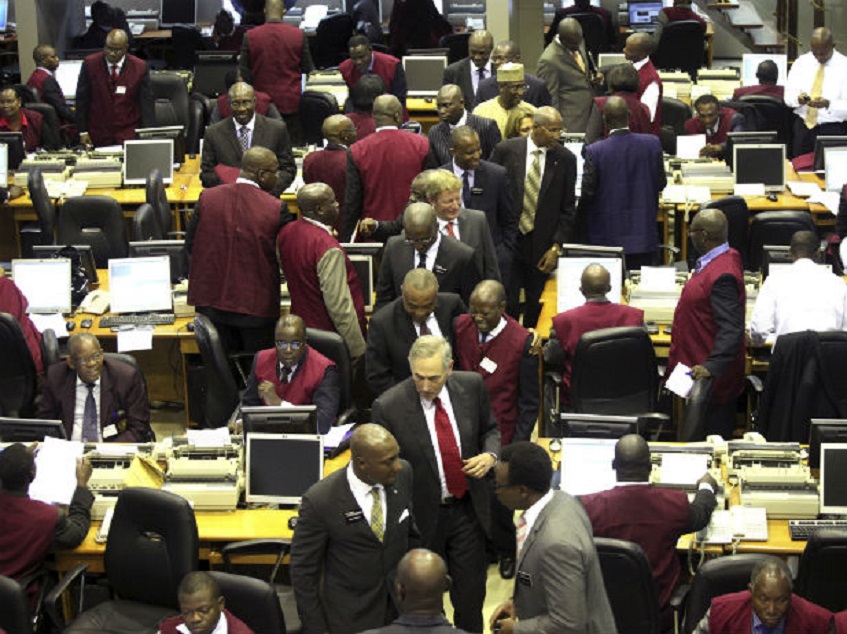
The Nigerian Stock Exchange (NSE) further closed on a positive note on Tuesday, appreciating by 0.83 percent to leave the Year-to-Date returns to 2.42 percent.

The All-Share Index (ASI) gained 322.72 points to finish at 39,167.04 points, while the market capitalisation went up by N116.9 billion to settle at N14.188 trillion.

Business Post reports that the Financial Services sector led the activity chart yesterday with 255.7 million shares traded at N2.9 billion, while the Consumer Goods industry trailed with 65.4 million shares sold for N1.7 billion.

United Capital topped the activity chart with a total of 82.7 million shares traded by investors at N262.7 million.

It was followed by Dangote Sugar, which sold 56.9 million units worth N1.2 billion, and Africa Prudential, which exchanged 49.6 million equities valued at N213.2 million.

GTBank traded 45.3 million shares for N1.9 billion, while UBA sold 13.6 million equities worth N150.8 million.

At the close of transactions on Tuesday, a total of 341.5 million shares exchanged hands in 3,769 deals worth N5.2 billion in contrast to the 603.2 million equities sold on Monday in 3,832 deals valued at N3.9 billion.

This showed that the total volume of shares sold yesterday depreciated by 43.39 percent, while the value increased by 33.57 percent.

The stock market recorded a total of 27 price gainers and 21 price losers on Tuesday, leaving the market breadth to end positive.

Seplat topped the price gainers list with N57.90k added to its share value to settle at N769 per share.

It was followed by Nestle Nigeria, which gained N44.80k to finish at N1495 per share, and Mobil Oil Nigeria, which went up by N8.70k to close at N183 per share.

Dangote Cement increased by N3.20k to end at N239 per share, while Cadbury Nigeria rose by 50k to wrap the day at N13 per share.

On the flip side, Guinness Nigeria topped the laggards’ table with N2.75k of its share price lost to close at N97 per share.

NASCON fell by 90 kobo to finish at N23.10k per share, while Nigerian Breweries also went down by 90 kobo to end at N117.10k per share.

Flour Mills depreciated by 70 kobo on Tuesday to settle at N32.30k per share, while Dangote Sugar crashed by 40 kobo to close at N19.50k per share.


Dipo Olowookere is a journalist based in Nigeria that has passion for reporting business news stories. At his leisure time, he watches football and supports 3SC of Ibadan. Mr Olowookere can be reached via [email protected]

Advertisement
Click to comment

Leave a Reply

Your email address will not be published. Required fields are marked *

Economy

Naira Further Falls to N1.355/$1 at Official FX Market

Published

on

naira official market

By Adedapo Adesanya

The woes of the Nigerian Naira in the Nigerian Autonomous Foreign Exchange Market (NAFEX) further continued on Tuesday, February 24.

During the session, the domestic currency weakened against the United States Dollar by N6.13 or 0.45 per cent to N1,355.37/$1 from the N1,349.24/$1 it was traded in the previous trading day.

The local currency also moved southwards on Tuesday in the same market window against the Pound Sterling after it lost N6.39 to trade at N1,828.26/ÂŁ1 versus Monday’s closing price of N1,821.87/ÂŁ1, and against the Euro, it depreciated by N4.94 to close at N1,596.36/€1, in contrast to the preceding session’s N1,591.42/€1.

Similarly, the Naira crashed against the US Dollar at the GTBank FX counter yesterday by N4 to settle at N1,361/$1 versus the N1,357/$1 it was exchanged a day earlier, and at the parallel market, it remained unchanged at N1,365/$1.

The fall of the Naira coincided with the Central Bank of Nigeria (CBN) buying US Dollars from the market to slow down the rapid rise of the nation’s legal tender. Latest information showed that last week, the apex bank bought about $189.80 million to reduce excess Dollar supply and control how fast the Naira was gaining value.

The rationale was to keep foreign investors from pulling their money out of Nigeria’s fixed-income market. If they sell their investments, it could increase demand for US Dollars and lead to more Dollar outflow from the economy.

Meanwhile, Mr Yemi Cardoso, the Governor of the CBN, said Nigeria’s gross external reserves have risen to $50.45 billion – the highest level in 13 years, while speaking after the 304th meeting of the monetary policy committee (MPC) of the CBN held on February 23 and 24.

The committee also reduced interest rates by 50 basis points to 26.50 per cent from 27 per cent after inflation eased in January 2026.

As for the cryptocurrency market, losses on concerns by embattled software businesses that artificial intelligence (AI) tools will destroy their business models continued and overturned some rallies on Tuesday.

Binance Coin (BNB) lost 2.1 per cent to sell for $585.41, Cardano (ADA) dropped 1.8 per cent to trade at $0.2595, Dogecoin (DOGE) went down by 1.5 per cent to $0.0920, Bitcoin (BTC) shrank by 1.2 per cent to $64,098.80, Litecoin (LTC) slipped 1.1 per cent to $51.31, Ripple (XRP) slumped 0.6 per cent to $1.35, and Ethereum (ETH) declined by 0.4 per cent to $1,857.75.

However, Solana (SOL) appreciated by 0.2 per cent to sell at $78.95. while the US Dollar Tether (USDT) and the US Dollar Coin (USDC) traded flat at $1.00 each.

Continue Reading

Economy

Oil Slides as Iran Signals Willingness to Seal US Nuclear Deal

Published

on

Opumami oil field

By Adedapo Adesanya

Oil depreciated on Tuesday after Iran said it was prepared to take any necessary steps to clinch a deal with the United States ahead of nuclear talks later this week, with Brent futures shedding 72 cents or 1.0 per cent to trade at $70.77 per barrel, and the US West Texas Intermediate (WTI) futures declining by 68 cents or 1.0 per cent to $65.63 a barrel.

Iran, the third-biggest crude producer in the Organisation of the Petroleum Exporting Countries (OPEC), and the US will hold a third round of nuclear talks on Thursday in Geneva, Switzerland.

America wants Iran to give up its nuclear programme, which the country has denied trying to develop an atomic weapon.

Meanwhile, Iran’s deputy foreign minister said on Tuesday that it was ready to take any necessary steps to reach a deal with the US.

However, the US State Department is pulling out non-essential government personnel and their families from its embassy in Beirut, Lebanon, as concerns mount about the risk of a military conflict with Iran.

The US has deployed a vast naval force near the Iranian coast ahead of possible strikes on the Islamic Republic. The American president, on February 19, said he was giving Iran about 10 to 15 days to make a deal.

Also, the US began collecting a temporary new 10 per cent global import tariff on Tuesday, but President Trump’s administration was working to increase it to 15 per cent, a development that has led to confusion after the country’s Supreme Court ruling.

On the supply front, trading houses and buyers of Venezuelan oil have chartered the first very large crude carriers to export from the South American country since a supply deal began between the US and Venezuela. This is set to speed up shipments from March while boosting deliveries to India.

The European Commission will submit a legal proposal to permanently ban Russian oil imports on April 15.

The American Petroleum Institute (API) estimated that crude oil inventories in the United States rose by 11.4 million barrels in the week ending February 20, after falling by 609,000 barrels in the week prior. Official data from the US Energy Information Agency (EIA) will be released later on Wednesday.

Continue Reading

Economy

Nigeria to Export New Crude Grade Cawthorne in March

Published

on

Cawthorne crude oil

By Adedapo Adesanya

The Nigerian National Petroleum Company (NNPC) Limited is set to commence export of a new light, sweet crude grade known as Cawthorne from March 2026.

According to a report by Reuters, an NNPC spokesperson confirmed the development, describing it as part of efforts to increase output and consolidate Nigeria’s recent recovery in crude oil production.

The move aligns with Nigeria’s broader strategy to boost production after years of constraints caused by pipeline vandalism, crude theft, and unrest in oil-producing regions.

This follows the launch of two other new grades, Obodo in 2025 and Utapate in 2024, Nigeria, whic,h as Africa’s top oil exporter, seeks to strengthen its standing within the Organisation of the Petroleum Exporting Countries and its allies (OPEC+)

Cawthorne crude is scheduled for export in the third week of March and has an API gravity of 36.4, making it similar in quality to Nigeria’s Bonny Light, which is prized for high petrol and diesel yields.

According to Reuters, citing a trading source, the state oil national company issued a tender last week for cargo loading between March 24 and 25.

Analysts at Kpler noted that the new grade is expected to be exported via the Floating Storage and Offloading (FSO) vessel Cawthorne, which has a storage capacity of about 2.2 million barrels. The vessel is designed to enhance transportation and production from Oil Mining Lease (OML) 18 and nearby assets in the Eastern Niger Delta.

Kpler estimates that, based on storage capacity, Cawthorne could increase Nigeria’s crude and condensate output from roughly 1.65 million barrels per day to around 1.7 million barrels per day for the remainder of the year.

Nigeria’s crude oil production recently dropped from the OPEC+ quota of 1.5 million barrels per day, with output at 1.48 million barrels per day recorded in January, according to OPEC data.

Beyond increasing Nigeria’s crude offerings to the international market, the introduction of Cawthorne could also attract buyers seeking specific light, sweet crude qualities, buoy foreign exchange earnings, which would help strengthen government revenue and ease borrowing needs.

New crude grades are typically differentiated by sulfur content, API gravity, and production source, enabling producers to target specific refinery configurations and market segments.

In November 2024, NNPC officially launched the Utapate crude oil blend in the international market, describing it as a milestone for Nigeria’s export profile.

Earlier in July 2024, NNPC and its partner, Sterling Oil Exploration & Energy Production Company (SEEPCO), lifted the first 950,000-barrel cargo of Utapate crude, which was shipped to Spain.

Continue Reading

Trending