Economy
Nigerian Stocks Close Last Day of H1 2018 Positive, Gain 1.44%
By Dipo Olowookere
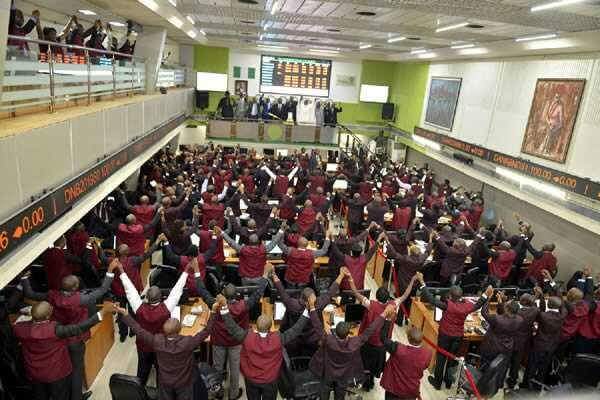
The last trading day of the first half of 2018 on the floor of the Nigerian Stock Exchange (NSE) ended on a positive note with the market bouncing back with 1.44 percent growth, pushing the Year-to-Date (YtD) returns back to the green territory to close at 0.09 percent
At the close of business last Friday, June 29, 2018, the All-Share Index (ASI) increased by 545.11 points to settle at 38,278.55 points, while the market capitalisation appreciated by N197 billion close at N13.866 trillion.
Business Post reports that the volume of shares traded by investors increased by 13.11 percent, while the value of transactions went up by 30.64 percent.
A total of 469.3 million shares were transacted last Friday in 3,355 deals worth N5.8 billion in contrast to the 414.9 million equities exchanged last Thursday valued at N4.5 billion.
These trades were dominated by financial stocks, which exchanged 362.1 units worth N4.6 billion, while the Natural Resources equities followed with 71.4 million units sold for N14 million.
Wema Bank emerged the most active stock, trading 171.3 million shares valued at N120 million.
It was followed by GTBank, which traded 75.1 million equities worth N3 billion, and Multiserve, which exchanged 71.4 million units valued at N14.3 million.
Zenith Bank sold 50.5 million shares valued at N1.3 billion, while Fidelity Bank transacted 20.9 million shares for N47.4 million.
On the price movement chart, the top five advancers chart was led by Nestle Nigeria, which gained N73.90k to close at N1575 per share.
It was followed by Total Nigeria, which went up by N9.50k to finish at N210 per share, and Dangote Cement, which increased by N4 to close at N229 per share.
Nigerian Breweries grew by N3.20k to end at N114.20k per share, while Stanbic IBTC appreciated by N2 to settle at N52 per share.
On the flip side, Forte Oil emerged the day’s biggest loser after shedding N1.20k of its share value to close at N32.85k per share.
It was trailed by Lafarge, which went down by N1.05k to finish at N40.95k per share, and Flour Mill of Nigeria, which fell by 20 kobo to end at N32 per share.
Honeywell Flour declined by 12 kobo to finish at N2.29k per share, while FCMB depreciated by 11 kobo to settle at N2.18k per share.
Economy
Oil Dips 2% Amid Progress in US-Iran Nuclear Talks
By Adedapo Adesanya
Oil was down by about 2 per cent on Tuesday on hopes tensions between the United States and Iran were easing after Iran’s foreign minister said the countries had reached an understanding regarding nuclear talks.
Brent futures fell $1.23 or 1.8 per cent to $67.42 a barrel, and the US West Texas Intermediate (WTI) futures slipped 56 cents or 0.9 per cent to $62.33 per barrel.
According to Iranian Foreign Minister, Mr Abbas Araqchi, his country and the United States reached an understanding on the main “guiding principles” in a second round of indirect talks in Geneva, Switzerland, over their nuclear dispute on Tuesday.
However, this does not mean a deal is imminent.
Iran’s supreme leader said on Tuesday that any US attempt to depose his government would fail as the US continued a military buildup exercise in the Middle East.
Iran will close parts of the critical oil shipping lane in the Middle East, the Strait of Hormuz, for a few hours on Tuesday as it is conducting military drills in the area. The government said the partial closure is due to security precautions.
The Strait of Hormuz, the narrow lane between Iran and Oman, is the world’s most critical oil transit chokepoint, and the oil market has time and again feared Iran could attempt to close the lane. In 2024, oil flow through the strait averaged 20 million barrels per day, or the equivalent of about 20 per cent of global petroleum liquids consumption.
Iran and fellow Organisation of the Petroleum Exporting Countries (OPEC) members Saudi Arabia, United Arab Emirates, Kuwait and Iraq export most of their crude via the Strait, mainly to Asia.
Negotiators from Ukraine and Russia concluded the first of two days of US-mediated peace talks in Geneva on Tuesday, with US President Donald Trump pressing Ukraine to act fast to reach a deal to end the four-year conflict.
Meanwhile, Ukraine continued its attacks on Russian energy infrastructure. Its military said on Tuesday it struck the Ilsky refinery, while a drone attack was also reported at the port of Taman.
A peace resolution could see a lifting of sanctions on Russia, bringing Russian oil back to the mainstream market. In 2025, Russia was the third-biggest crude producer in the world behind the United States and Saudi Arabia.
Economy
MTN Reaches $6.2bn Deal to Fully Own IHS Towers
By Adedapo Adesanya
MTN Group has agreed to take full control of IHS Holding, buying the roughly 75 per cent stake it does not already own in a deal that values the tower operator at about $6.2 billion.
According to a statement, MTN, which is Africa’s biggest mobile operator, will pay $8.50 per share in cash.
The deal will be funded through the rollover of MTN’s existing stake of around 24% in IHS, as well as about $1.1 billion in cash from MTN, roughly $1.1 billion from IHS’s balance sheet, and the rollover of no more than existing IHS debt.
The offer represents a 239 per cent premium to the company’s share price when it announced a strategic review on March 12, 2024, a 36 per cent premium to its 52-week volume-weighted average price as of February 4, 2026, and a three per cent premium to its unaffected closing price of $8.23 on that same date.
The transaction will see MTN transition from being a minority shareholder in IHS to a full owner. Upon completion, IHS will delist from the New York Stock Exchange and become a wholly owned subsidiary of MTN.
For MTN, the deal represents a decisive shift as data demand surges and digital infrastructure becomes increasingly strategic with a booming digitally-oriented youth population on the continent.
Over the past decade, many African telecom operators sold tower assets to independent infrastructure firms to unlock capital and reduce balance sheet pressure. This marks a reversal of the trend.
MTN itself had reduced its direct exposure to tower ownership, retaining a roughly 24 per cent fully diluted stake in IHS before the agreement.
Speaking on this, Mr Ralph Mupita, group president and CEO, MTN Group, described the proposed acquisition as a pivotal step in strengthening MTN’s strategic and financial position in a future where digital infrastructure will be central to Africa’s development.
He said the deal would enhance MTN’s ability to partner with governments and support long-term connectivity growth across its markets.
“This proposed transaction is a pivotal step in further strengthening MTN Group’s strategic and financial position for a future where digital infrastructure will become ever more essential to Africa’s growth and development,” he said.
The board of IHS unanimously approved the agreement and recommended that shareholders vote in favor.
MTN has committed to vote all its shares in support of the deal, while long-term shareholder Wendel has also issued a letter backing the transaction. Together, they account for more than 40 per cent of shareholder support already secured.
On his part, Mr Sam Darwish, chairman and CEO of IHS, said the agreement offers shareholders certainty and immediate value realisation following a strategic review launched during a period of macroeconomic and geopolitical volatility across key markets.
Founded 25 years ago with a single tower in one market, IHS grew into one of the world’s largest independent tower companies by count, operating in 11 countries and managing approximately 40,000 towers at its peak.
If completed, the acquisition will create the largest standalone and integrated tower company in Africa under MTN’s control, tightening the alignment between network operations and physical infrastructure in a region where connectivity remains both a commercial battleground and a development imperative.
Economy
Nigeria Renews Push for West African Single Currency as ECOWAS Hold Talks
By Adedapo Adesanya
Nigeria is stepping up engagement toward the creation of a regional single currency, following fresh consultations among West African monetary authorities, following constant delay of achieving the goal.
In an update by the Central Bank of Nigeria (CBN) via its X handle, the Governor of the apex bank, Mr Yemi Cardoso, led the country’s delegation to the Committee of Governors meeting held in Monrovia, Liberia, where policymakers reviewed progress and renewed discussions on establishing the long-proposed single currency known as the Eco.
Last year, the West African bloc announced that the single regional currency would be launched by 2027 to foster greater economic integration among member states by facilitating trade through a unified payment system, enhancing price stability and reducing inflationary pressures.
In the latest development, the CBN statement noted that the Nigerian delegation also included Deputy Governor (Economic Policy), Mr Muhammad Sani Abdullahi.
“The meeting formed part of statutory engagements jointly organised by the Economic Community of West African States alongside the West African Monetary Agency, the West African Monetary Institute, and the West African Institute for Financial and Economic Management. The consultations brought together financial regulators and economic policymakers across the sub-region to assess convergence benchmarks required for launching the unified currency”, the apex bank said.
The Eco project is designed to deepen economic integration among ECOWAS member states by providing a common legal tender that would facilitate cross-border trade, enhance price transparency and reduce transaction costs tied to multiple currency exchanges. The initiative has been under discussion for over two decades but has experienced repeated postponements as member countries struggle to meet strict macroeconomic convergence criteria.
The apex bank noted that the meeting focused on evaluating member states’ performance against key economic indicators. These include inflation rate ceilings, fiscal deficit thresholds relative to gross domestic product, and foreign reserve adequacy, all considered critical safeguards for ensuring stability within a potential monetary union.
Despite many delays, ECOWAS latest move shows it may be aligning with Nigeria’s Minister of Foreign Affairs, Mr Yusuf Tuggar, saying last year that member states have started attaining benchmarks to see the goal actualised.
-
Feature/OPED6 years agoDavos was Different this year
-
Travel/Tourism10 years ago
Lagos Seals Western Lodge Hotel In Ikorodu
-
Showbiz3 years agoEstranged Lover Releases Videos of Empress Njamah Bathing
-
Banking8 years agoSort Codes of GTBank Branches in Nigeria
-
Economy3 years agoSubsidy Removal: CNG at N130 Per Litre Cheaper Than Petrol—IPMAN
-
Banking3 years agoSort Codes of UBA Branches in Nigeria
-
Banking3 years agoFirst Bank Announces Planned Downtime
-
Sports3 years agoHighest Paid Nigerian Footballer – How Much Do Nigerian Footballers Earn