Economy
Dangote Cement Lifts NSE Index after Gaining N5 Per Share
By Dipo Olowookere
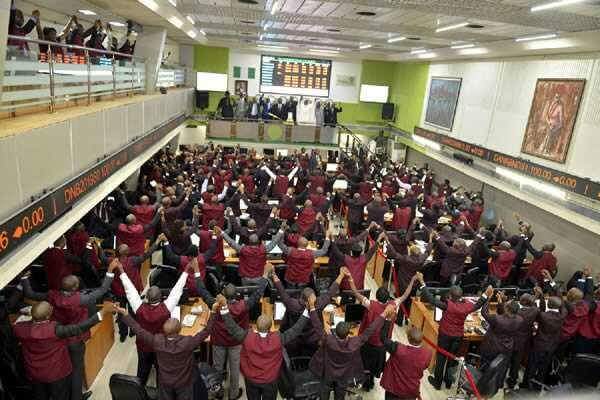
For the first time this week, the Nigerian stock market finished bullish, closing 0.65 percent higher.
Business Post reports that bargain hunting activities as well as gains recorded by Dangote Cement and other stocks lifted the spirit of investors at the market today.
The Nigerian Stock Exchange (NSE) had had to battle with profit taking for the past three sessions this week until Dangote Cement came to its rescue on Thursday.
At the close of business today, the All-Share Index (ASI) increased by 244.15 points to close at 37,743.22 points, while the market capitalisation appreciated by N88 billion to settle at N13.673 trillion.
Dangote Cement, which topped the gainers’ table today, rose by N5 to close at N228 per share, while Nigerian Breweries followed with a gain of N2 to close at N113 per share.
Furthermore, Cement Company of Northern Nigeria (CCNN) grew by N1.10k to close at N24.30 per share, Julius Berger went up by 90 Kobo to end at N28.95k per share, while Dangote Sugar improved by 65 kobo to close at N19 per share.
Conversely, Mobil Oil Nigeria posted the highest price loss today after losing N15 of its share value to settle at N175 per share.
It was followed by Flour Mills, which went down by N1.75k to close at N31 per share, and International Breweries, which depreciated by N1.35k to close at N41 per share.
UAC of Nigeria fell by 35 Kobo today to close at N13.55k per share, while NEM Insurance lost 30 kobo to close at N3.10k per share.
While the volume of shares traded by investors today decreased by 0.52 percent, the value went up by 88.31 percent.
A total of 503.1 million shares were traded on Thursday in 3,710 deals worth N5.9 billion in contrast to the 505.7 million valued at N3.1 billion sold on Wednesday at the market.
It was observed that the Financial Services sector led the activity chart today with 444.3 million shares exchanged for N5.1 billion, while the Oil and Gas thanks industry followed with 21.4 million shares traded for N86 million.
But UBA emerged the toast of investors today with the firm selling a total of 294.9 million shares worth N3.1 billion.
It was followed by Zenith Bank, which traded 38.3 million equities for N930.7 million, and Access Bank, which exchanged 34.4 million shares worth N356.1 million.
GTBank transacted 13.7 million shares valued at N546.1 million, while FBN Holdings sold 11.8 million equities valued at N123.5 million.
With the gains recorded, investors would be expecting the market to maintain today’s momentum tomorrow when the market resumes for the last time this week.
Economy
Airtel Africa Buoys Nigerian Exchange’s 1.20% Surge
By Dipo Olowookere
The first trading session of the week on the floor of the Nigerian Exchange (NGX) Limited ended in the green territory on Monday, with a 1.20 per cent rise.
This was buoyed by the gains recorded by Airtel Africa and other equities, according to analysis of data harvested from the Customs Street yesterday.
During the trading day, the consumer goods index grew by 0.76 per cent, enough to offset the losses recorded by the other sectors.
The insurance counter shrank by 1.64 per cent, the banking space lost 0.24 per cent, the energy sector contracted by 0.09 per cent, and the industrial goods segment retreated by 0.05 per cent.
When trading activities ended for the day, the All-Share Index (ASI) was up by 2,956.15 points to 248,529.75 points from 245,573.60 points, and the market capitalisation gained N1.909 trillion to finish at N160.422 trillion compared with the previous session’s N158.513 trillion.
Fortis Global Insurance expanded by 10.00 per cent to N2.86, Chams surged by 9.80 per cent to N4.48, NAHCO jumped by 9.29 per cent to N153.00, Airtel Africa soared by 8.59 per cent to N6,300.00, and Sovereign Trust Insurance rose by 6.59 per cent to N1.78.
Conversely, AVA Capital shed 10.00 per cent to N9.90, Ecobank decreased by 9.92 per cent to N64.95, Caverton crashed by 9.09 per cent to N5.00, Ikeja Hotel slipped by 8.41 per cent to N43.00, and FTN Cocoa dropped 8.37 per cent to trade at N8.10.
A total of 23 equities were on the gainers’ chart yesterday, while 37 equities ended on the losers’ table, indicating a negative market breadth index and weak investor sentiment.
As for the activity log, the trading volume remained elevated, though lower than the preceding session, as it receded by 26.67 per cent to 1.1 billion units from 1.5 billion units. The trading value, however, increased by 1.12 per cent to N27.0 billion from N26.7 billion, while the number of deals advanced by 39.00 per cent to 59,185 deals from 42,580 deals.
Consolidated Hallmark was the most active stock yesterday, with a turnover of 354.1 million units valued at N1.5 billion, Fortis Global Insurance traded 307.3 million units worth N818.3 million, Access Holdings exchanged 48.1 million units for N1.4 billion, Chams transacted 37.4 million units worth N163.3 million, and First Holdco sold 35.8 million units valued at N5.1 billion.
Economy
Oil Prices Surge 5% as Iran Sets Conditions for Hormuz Reopening
By Adedapo Adesanya
Oil prices traded 5 per cent higher on Monday after Iran and the United States argued about demands for compensation, further stalling a possible deal to reopen the Strait of Hormuz.
Brent crude futures chalked up $4.17 or 4.99 per cent to sell at $87.72 a barrel, while the US West Texas Intermediate (WTI) crude futures surged $3.95 or 5.05 per cent to $82.13 per barrel.
Iran said the US must lift sanctions on it and meet other conditions for reopening the vital waterway, which carried a fifth of the world’s oil and liquefied natural gas before the start of the Middle East conflict in late February.
Meanwhile, US President Donald Trump said Iran must pay compensation for “all of the people that they have killed and gravely wounded.”
This comes as the Middle East country said it was nearing a final pact with Oman to define new shipping lanes through the strait but repeated that the US must meet other conditions, including compensation and an end to sanctions and military threats before the strategic waterway is reopened.
In a further threat to supply, the Iran-aligned Houthis said they had struck Saudi Aramco’s Jazan refinery on Sunday. Saudi Aramco has postponed the restart of the 400,000-barrel-per-day refinery to August 30 after two Houthi attacks in recent weeks.
ADNOC, a state-owned oil company in the United Arab Emirates, said on Friday that 15 of its vessels had been attacked while transiting the Strait of Hormuz since the beginning of the conflict.
Meanwhile, Ukraine’s military continued to attack Russia’s energy infrastructure, hitting the Taneco oil refinery in Tatarstan and the ZapSibNeftekhim petrochemical plant in Russia’s Tyumen region.
On the US supply side, stocks of crude oil in the Strategic Petroleum Reserve (SPR) fell by about 6.1 million barrels to 298.7 million barrels last week, the lowest level since January 1983.
Bank of America (BoFA) warned that oil prices could continue climbing into the winter if the US and Iran fail to reach an agreement reopening the Strait of Hormuz, with severe shortages already emerging in diesel, petrol, and global natural gas markets.
Mr Francisco Blanch, Bank of America’s head of commodities and derivatives research, told CNBC on Monday that only around 5 to 10 ships per day are currently passing through Hormuz, compared with roughly 140 before the war. With some crude now being rerouted through Saudi Arabia and the UAE, traffic would need to recover to around 80 to 100 ships per day just to stabilise energy markets.
Economy
Senate Seeks Stronger Financial Sector Collaboration for Economic Stability
By Adedapo Adesanya
The Senate Committee on Banking, Insurance and Other Financial Institutions has called for stronger collaboration among financial sector regulators and other stakeholders to strengthen Nigeria’s financial system and support sustainable economic growth.
The committee made the call during an expanded stakeholders’ engagement in Lagos, attended by the leadership of the Central Bank of Nigeria (CBN), Nigeria Deposit Insurance Corporation (NDIC), Asset Management Corporation of Nigeria (AMCON), National Insurance Commission (NAICOM) and Nigeria Export-Import Bank (NEXIM), among other industry stakeholders and financial experts.
Chairman of the committee, Mr Adetokunbo Abiru (Lagos East), who was represented by Mr Osita Izunaso (Imo West), said stronger legislative reforms and regulatory collaboration were necessary to reposition Nigeria’s financial architecture for long-term economic prosperity.
Mr Abiru said the financial sector remained critical to investment, job creation, business expansion and macroeconomic stability, stressing that its ability to mobilise savings, channel credit to productive sectors, facilitate investment and manage risks was fundamental to sustainable economic growth.
He said the current economic realities required closer collaboration between the legislature and financial regulators, noting that challenges confronting the sector were interconnected and could not be effectively addressed through isolated interventions.
The lawmaker identified inflationary pressures, global economic uncertainties, cybersecurity threats, low insurance penetration and the need to diversify Nigeria’s export base as some of the challenges requiring coordinated policy responses.
He said the engagement was aimed at generating practical solutions to strengthen the country’s financial architecture and support sustainable economic growth.
According to him, monetary policy, financial safety nets, banking institutions, the insurance industry and export finance were interdependent components of a stable financial system and must therefore be strengthened collectively.
The Commissioner for Insurance and Chief Executive Officer of the National Insurance Commission (NAICOM), Mr Olusegun Ayo Omosehin, said the Nigeria Insurance Industry Reform Act (NIIRA) 2025 had contributed significantly to stabilising and repositioning the insurance sector.
Mr Omosehin disclosed that 43 insurance companies had successfully recapitalised, describing the development as a major milestone for the industry.
He commended Abiru and members of the committee for their role in advancing insurance sector reforms and urged the House of Representatives to expedite action on the relevant insurance reform bill to enable it to receive presidential assent and become operational.
Representatives of the CBN Governor and the Managing Directors of AMCON, NEXIM and NDIC also commended the Senate committee for its oversight and legislative support, saying its interventions had strengthened the agencies’ capacity to discharge their statutory mandates.
The engagement, held under the theme, Strengthening Financial System Architecture for Sustainable Economic Growth and Stability in Nigeria, also featured presentations by Professor Uche Uwaleke, President of Capital Market Academics of Nigeria (CMAN); Professor Biodun Adedipe, Chief Consultant, B. Adedipe Associates Limited; and Dr Tilewa Adebajo, Chief Executive Officer of CFG Advisory.
The experts presented policy recommendations on key issues affecting Nigeria’s financial system, with emphasis on financial stability, investment and sustainable economic growth.
Mr Abiru said the Senate would continue to engage financial regulators and other stakeholders to deepen financial inclusion, strengthen public confidence in financial institutions and improve regulatory effectiveness.
He said the broader objective was to position Nigeria’s financial system to compete more effectively in the global economy while remaining resilient and responsive to the country’s economic transformation agenda.