Economy
$350m BUA Cement Plant in Sokoto Begins Operations
By Modupe Gbadeyanka
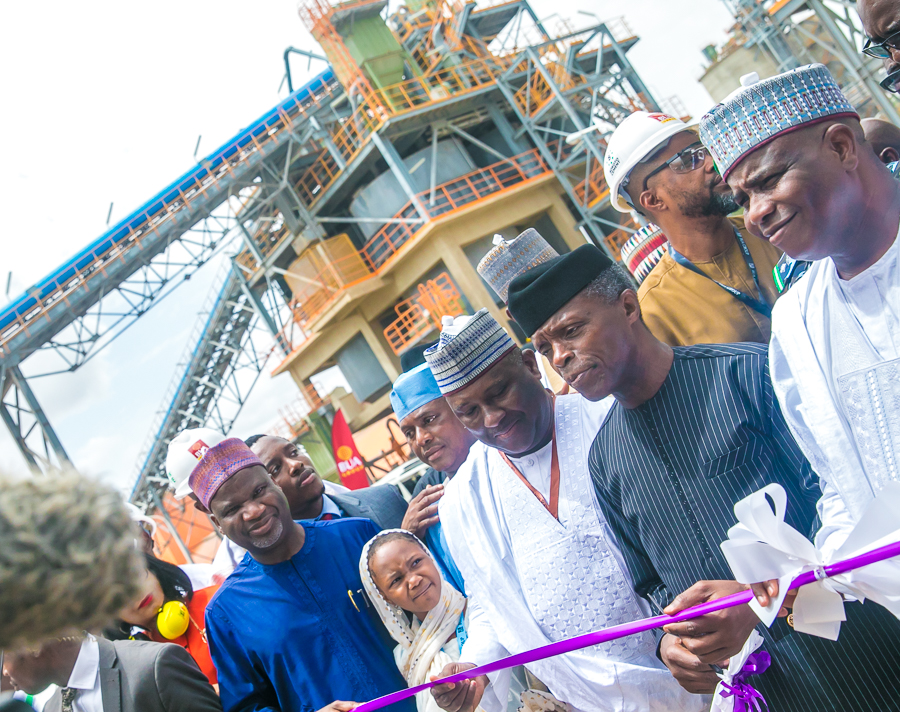
The new 1.5m Metric Tonnes cement factory built in Sokoto State by the Executive Chairman/CEO BUA Group, Mr Abdul Samad Rabiu, has commenced operations.
The plant was commissioned on Tuesday by Nigeria’s Vice President, Professor Yemi Osinbajo, with some top government functionaries in attendance.
The billionaire businessman, who is one of the main rivals of Africa’s richest man, Mr Aliko Dangote, in the cement industry, said his $350 million cement factory remains the single largest investment in North Western part of the country.
According to him, the new plant will provide direct jobs for about 2000 people and indirect jobs for another 10,000 people.
Mr Rabiu commended President Muhammadu Buhari for bringing forth policies that favours investment, while also recalling how the Vice President, about 10 months ago, also commissioned the BUA Cement 3 million tonnes Greenfield plant in Okpella, Edo State.
“Your Excellency Sir, the plant which you are commissioning today, is very unique – from various viewpoints – be it its location, its economic value and social impact, huge limestone deposits, human capital potential amongst others. These were some of the things we took into consideration when we made the decision to site this plant here.
“I must say however that this project would not have been possible without the effort by the President Muhammadu Buhari led administration to put deliberate policies in place to support key industries in the real sector – from agriculture to manufacturing.
“Through these policies, the CBN provided enough foreign exchange for heavy machinery to come in and this was helpful in completing the project on schedule. I therefore want to commend the administration for the policy because without that, it may not have been possible to complete the plant.
“Mr Vice President Sir, let me add that what we have done here is a pointer to the fact that Nigeria is ready for business with the right policies and right operating environment,” he said.
Also speaking at the commissioning, Governor of Sokoto State, Mr Aminu Tambuwal, disclosed that Sokoto is one of the states in Nigeria with lots of unexplored natural resources.
Mr Tambuwal, who said his administration has created enabling environment for investors in the state, added that the state’s independent power project was already 80 percent completed.
The Governor further admonished BUA Group to continue with its commendable corporate social responsibly work in the host community and state at large.
On his part, the Vice President, Mr Yemi Osinbajo, said the significance of the company cannot be over emphasised.
While stressing that the nation’s investment level is simply 35 percent of the total GDP, Mr Osinbajo advised that working with the private sector is the only way to go towards boosting the economy.
According to him, the president Muhammadu Buhari led government has come up with numerous business friendly policies towards achieving the aim of ensuring that every state in Nigeria can compete with every country in Africa in terms of investment opportunities.
He advocated for the use of cement in constructing roads on grounds because, according to him, it is cheaper and better.
However, he urged BUA Group and Dangote Groups of companies to see the possibility of reducing the price of cement so as to close the deficit.
Economy
Naira Weakens to N1,357/$1 at Official Market, N1,385/$1 at Black Market
By Adedapo Adesanya
The Naira suffered a 0.55 per cent or 91 Kobo loss against the US Dollar in the Nigerian Autonomous Foreign Exchange Market (NAFEX) on Tuesday, June 16, closing at N1,357.18 /$1 compared with the previous day’s N1,356.27/$1.
It also weakened against the Pound Sterling at the official market during the session by N11.53 to trade at N1,820.39/£1 versus Monday’s rate of N1,808.86/£1, but appreciated against the Euro by N2.06 to quote at N1,573.79/€1 versus the preceding session’s N1,575.85/€1.
In the black market, the Nigerian currency crashed against the Dollar yesterday by N5 to sell for N1,385/$1, in contrast to the N1,380/$1 it was traded a day earlier, and at the GTBank FX desk, it traded flat at N1,373/$1.
Nigeria’s gross external reserves surged to $50.505 billion, the highest international Dollar balance since January 2009, affirming expectations that the local currency will remain along a stable band. The FX reserves position was buoyed by inflows from oil sales.
In its Article IV consultation report on Nigeria, the International Monetary Fund (IMF) said that the Naira remains significantly undervalued despite recent gains from FX reforms. It noted that its Real Effective Exchange Rate (REER) assessment showed the local currency was still trading below levels supported by the country’s economic fundamentals, saying the Naira should have traded around N1,142.04/$1 using the end-of-2025 exchange rate benchmark, or N1,130.88/$1 when calculated using the average exchange rate for the year.
As for the cryptocurrency market, prices showed renewed risk appetite as total 24-hour trading volume jumped 51 per cent to $207 billion, open interest rose 2.4 per cent to $113.41 billion, and liquidations surged 64 per cent to $561 million, with shorts accounting for the bulk of the forced exits, according to Coindesk data.
Cardano (ADA) slid 2.7 per cent to $0.1731, Binance Coin (BNB) slumped 1.6 per cent to $605.80, Ripple (XRP) declined by 1.5 per cent to $1.22, Bitcoin (BTC) fell 0.8 per cent to $65,739.70, Dogecoin (DOGE) also tumbled by 0.6 per cent to $0.0873, and TRON (TRX) depreciated by 0.6 per cent to $0.3166.
However, Ethereum (ETH) grew by 0.5 per cent to $1,795.40, and Solana (SOL) rose by 0.2 per cent to $73.81, while the US Dollar Tether (USDT) and the US Dollar Coin (USDC) remained unchanged at $1.00 apiece.
Economy
Brent Crude Falls Below $80 as Middle East Peace Deal Eases Risk
By Adedapo Adesanya
The price of Brent crude fell below $80 per barrel following a 5 per cent slide for a second day in a row as details emerged of an interim deal to end the war in the Middle East and reopen the Strait of Hormuz, including an agreement to allow Iran to sell oil on Tuesday.
Brent futures lost $4.21 or 5.1 per cent yesterday to settle at $78.96 a barrel, while the US West Texas Intermediate (WTI) crude fell $4.70 or 5.8 per cent to $76.05 per barrel.
Details of the interim deal to end the war began to emerge on Tuesday, with US President Donald Trump saying it will rule out a nuclear weapon for Iran. He said the text of the deal states clearly that Iran will not have a nuclear weapon, and the full agreement would be made public in a formal setting in a few days.
Speaking at the G7 meetings in France, the American President added that he liked the idea of sending the Iran deal to Congress for review, a request by some Republican lawmakers.
According to Reuters, a senior US official said the deal allows Iran to immediately begin selling oil and fuel, and included banking, transportation and insurance services to facilitate the sales. The official added the agreement has conditions.
The deal would extend a tenuous ceasefire announced in April by another 60 days and reopen the Strait of Hormuz, which Iran has effectively blocked since the US and Israel first attacked Iran.
Under the agreement, Iran will be allowed to immediately resume oil and fuel sales, according to the Wall Street Journal, along with the banking, insurance, and shipping services needed to move those cargoes. The deal effectively reconnects one of the world’s largest oil producers to global energy markets overnight.
The market is also betting that traffic through Hormuz will normalise, easing fears over a chokepoint that normally handles roughly a fifth of global oil flows.
The speed of the decline highlights just how much of crude’s rally had become tied to geopolitical risk.
Other factors weighing on oil prices included worries about China’s economy, rising global inflation and interest rates, and US calls for peace between Russia and Ukraine.
The American Petroleum Institute (API) estimated that crude oil inventories in the United States fell by 8.33 million barrels in the week ending June 12. Official data from the US Energy Information Administration (EIA) will be released later on Wednesday.
Economy
Nigeria’s Petrol Import Bill Plunges 96% in First Quarter of 2026
By Adedapo Adesanya
Nigeria’s petrol import bill crashed further as the latest foreign trade statistics by the National Bureau of Statistics (NBS) indicated that about N87.401 billion was spent on the importation of fuel between January and March 2026.
A comparative analysis showed the figure plunged by 96.2 per cent or N2.184 trillion compared with the N2.271 trillion spent on fuel imports between January and March 2025.
The NBS data revealed that fuel did not feature among the top 19 traded products with the rest of the world, Africa, or West Africa during the review period.
The biggest factor is the ramp-up of production at Dangote Petroleum Refinery, which has significantly reduced Nigeria’s dependence on imported Premium Motor Spirit (PMS). As local supplies increasingly meet domestic demand, marketers have had less need to source petrol from overseas.
According to the data, the leading traded products included crude petroleum oils and oils obtained from bituminous minerals, gas oil, durum wheat, machines for reception, conversion and transmission of data, used vehicles, motorcycles, agricultural seeders, medicaments, aircraft parts, butanes, petroleum bitumen, sugar cane, herbicides and fuel additives.
The report read, “The value of total imports stood at N13,619.33bn in the first quarter of 2026, representing an 18.17 per cent decrease from the value recorded in the corresponding quarter of 2025 (N16,644.42bn) and a 21.05 per cent decrease compared to the value recorded in Q4 2025 (N17,250.93bn).
“Analysis of Nigeria’s import trade reveals that China remained the leading source of imports in the first quarter of 2026, followed by the United States of America, India, Germany, and the United Arab Emirates.
The most imported commodities during the quarter were petroleum oils and oils obtained from bituminous minerals (crude), gas oil, durum wheat, machines for the reception, conversion, and transmission of voice, images, or data, and used vehicles with diesel or semi-diesel engines.
“The value of other oil products imported in Q1 2026 stood at N748.10bn, reflecting an 85.05 per cent decrease from N5,005.22bn in Q1 2025 and an 81.38 per cent decrease from N4,018.31bn recorded in Q4 2025.
“Nigeria spent N2.694tn on petrol imports in the first quarter of 2022. The import bill declined by N661bn, or 24.5 per cent, to N2.033tn in the corresponding period of 2023.”
-
Feature/OPED6 years agoDavos was Different this year
-
Travel/Tourism10 years ago
Lagos Seals Western Lodge Hotel In Ikorodu
-
Showbiz3 years agoEstranged Lover Releases Videos of Empress Njamah Bathing
-
Banking8 years agoSort Codes of GTBank Branches in Nigeria
-
Economy3 years agoSubsidy Removal: CNG at N130 Per Litre Cheaper Than Petrol—IPMAN
-
Banking3 years agoSort Codes of UBA Branches in Nigeria
-
Banking3 years agoFirst Bank Announces Planned Downtime
-
Sports3 years agoHighest Paid Nigerian Footballer – How Much Do Nigerian Footballers Earn