Economy
Federal Reserve Decision in Focus on Wall Street
By Investors Hub
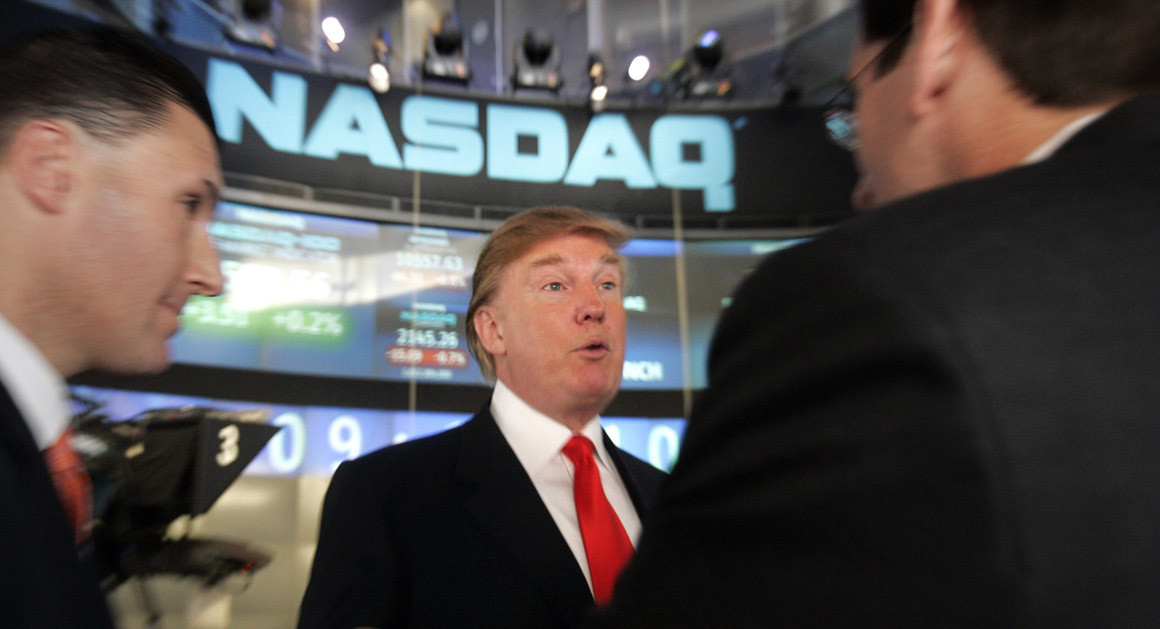
The major U.S. index futures are pointing to a mixed opening on Wednesday as traders look ahead to the Federal Reserve?s monetary policy announcement.
Traders may be reluctant to make any significant moves ahead of the Fed?s announcement of its latest monetary policy decision, which is due at 2 pm ET.
The Fed is widely expected to leave interest rates unchanged, but the accompany statement could provide clues about the outlook for rates.
At its June meeting, the Fed raised interest rates by 25 basis points to a range of 1.75 percent to 2 percent and forecast two additional rate hikes this year.
Traders are also digesting the latest news regarding the escalating trade dispute between the U.S. and China, the world?s two largest economies.
Reports said President Donald Trump?s administration is considering raising the proposed tariff on $200 billion worth of Chinese imports to 25 percent from the 10 percent announced last month.
A spokesman for China?s Foreign Ministry responded by accusing the U.S. of ?blackmail? and warning of inevitable countermeasures if the U.S. takes further escalatory steps.
Stocks showed a strong move to the upside in morning trading on Tuesday and managed to hold on to most of their gains throughout the afternoon. The upward move on the day came on the heels of the notable weakness seen in the previous session.
The major averages pulled back off their best levels of the day but still closed firmly in positive territory. The Dow rose 108.36 points or 0.4 percent to 25,415.19, the Nasdaq advanced 41.78 points or 0.6 percent to 7,671.79 and the S&P 500 climbed 13.69 points or 0.5 percent to 2,816.29.
The strength on Wall Street came following a report from Bloomberg indicating the U.S. and China are trying to restart talks aimed at averting a full-blown trade war.
Citing two people familiar with the effort, Bloomberg said representatives for U.S. Treasury Secretary Steven Mnuchin and Chinese Vice Premier Liu He are having private conversations.
The two people cautioned that a specific timetable, the issues to be discussed and the format for talks aren’t finalized, Bloomberg said.
Traders were also digesting the latest batch of U.S. economic data, including a report from the Commerce Department showing personal income and spending both increased in line with economist estimates in the month of June.
The report said personal income climbed by 0.4 percent in June, matching the increase seen in May as well as expectations.
The Commerce Department said personal spending also rose by 0.4 percent in June after climbing by an upwardly revised 0.5 percent in May.
Economists had expected spending to increase by 0.4 percent compared to the 0.2 percent uptick originally reported for the previous month.
A separate report from the Conference Board showed a modest rebound in consumer confidence in the month of July.
The Conference Board said its consumer confidence index inched up to 127.4 in July from an upwardly revised 127.1 in June. Economists had expected the index to rise to 127.0 from the 126.4 originally reported for the previous month.
Telecom stocks saw considerable strength on the day, resulting in a 1.6 percent advance by the NYSE Arca Telecom Index. With the gain, the index reached its best closing level in well over four months.
Significant strength was also visible among transportation stocks, as reflected by the 1.3 percent gain posted by the Dow Jones Transportation Average.
Matson (MATX), FedEx (FDX), and Landstar Systems (LSTR) turned in some of the transportation sector’s best performances.
Tobacco, real estate, and biotechnology stocks also saw notable strength on the day, moving higher along with most of the other major sectors.
Economy
OPEC Crude Output Falls to 37-Year Low Amid Iran Disruptions
By Adedapo Adesanya
Crude production under the collective Organisation of the Petroleum Exporting Countries (OPEC ) fell in May to its lowest level in at least 37 years as the blockade of Iran by the United States and disruptions in the Persian Gulf, continued to limit output.
According to a Bloomberg survey released on Friday, output from the organisation’s 11 current members, including Nigeria, dropped by 1.22 million barrels per day to 16.33 million barrels per day last month.
Iran accounted for more than half of the decline. The data excludes the United Arab Emirates (UAE), which departed the cartel last month after six decades of membership.
War between a US-Israeli alliance and Iran has reduced oil supplies from the Middle East, largely closing the Strait of Hormuz waterway. Saudi Arabia, Iraq, the UAE and Kuwait have been forced to cut crude production. Iranian shipments face additional pressure following a US blockade of its ports imposed in mid-April.
Iranian output fell by 710,000 barrels per day to a five-year low of 2.34 million barrels per day in May, the survey showed. Central Command reported that US forces have redirected 127 commercial vessels to enforce the blockade of all maritime traffic entering and exiting Iranian ports.
Kuwait recorded the second-largest decline last month, with production falling by 310,000 barrels per day to 490,000 barrels per day, less than one-fifth of pre-war levels. Saudi Arabia, the group’s leader, saw output decrease by 240,000 barrels per day to 6.57 million barrels per day.
The production reductions have not prevented OPEC and its allies from raising quotas over recent months, continuing a year-long process of restoring output halted several years ago.
This comes ahead of a meeting scheduled to be held on Sunday, June 7, where a sub-group of seven members is expected to increase targets by 188,000 barrels again in July. The session is one of four online meetings OPEC and its partners plan to hold that day.
Delegates indicated the alliance has plans for two additional monthly quota increases in August and September. UAE output rose by 300,000 barrels per day to 2.44 million barrels per day in May, according to the survey.
Economy
Debt Repayments: FG Overshoots Budget Allocation by 18%
By Aduragbemi Omiyale
The 2025 third quarter Budget Implementation Report from the Budget Office of the Federation has shown that the federal government exceeded the funds allocation for repayment of debts for the first nine months of the fiscal year by about 18 per cent.
In a report by Punch, the sum of N10.74 trillion was budgeted for debt servicing between January and September 2025, but the government used N12.63 trillion for the purpose, N1.90 trillion or 17.65 per cent more than the allocation for the year.
The funds were spent on domestic debts, foreign debts and sinking fund by the central government in nine months.
Business Post reports that for the whole year, the amount approved by the National Assembly and signed by President Bola Tinubu for debt repayments was N14.31 trillion.
Looking at the nine-month figures, domestic debt service gulped N6.23 trillion, exceeding its N5.39 trillion provision, while foreign debt service was N6.30 trillion versus the budget provision of N5.06 trillion.
According to the report, the figures indicated that 67.2 per cent of the federal government’s retained revenue of N18.63 trillion was spent on debt service in the first nine months of 2025. When the sinking fund is included, debt-related payments consumed about 67.8 per cent of revenue.
It was also observed that aggregate federal government revenue underperformed the budget by N12.03 trillion or 39.24 per cent, as actual revenue of N18.63 trillion fell short of the N30.67 trillion projected for the first three quarters.
In the third quarter alone, the government generated N7.70 trillion versus the quarterly target of N10.22 trillion as a result of persistent oil revenue shortfalls, despite stronger non-oil collections.
The debt burden also crowded out capital spending, as total capital expenditure was N3.10 trillion in the first nine months compared with the N17.58 trillion budgeted for the period, indicating that actual debt-related payments were more than four times capital expenditure.
Economy
Unlisted Stock Investors’ Wealth Shrinks N30bn
By Adedapo Adesanya
The NASD Over-the-Counter (OTC) Securities Exchange recorded a loss of 1.13 per cent on Thursday, June 4, shrinking the market capitalisation by N30.03 billion to N2.630 trillion from N2.660 trillion on Wednesday.
Similarly, this brought down the NASD Unlisted Security Index (NSI) by 50.19 points to 4,396.08 points from the 4,446.27 points recorded a day earlier.
The loss was influenced by the overpowering of the bulls by the bears, after the bourse closed with two price gainers and three price losers, led by FrieslandCampina Wamco Nigeria Plc, which slumped by N20.03 to sell at N190.38 per unit compared with midweek’s N210.41 per unit. Food Concepts Plc declined by 25 Kobo to trade at N2.50 per share versus the previous day’s N3.00 per share, and Acorn Petroleum Plc crumbled by 2 Kobo to end at N1.32 per unit, in contrast to the preceding session’s N1.34 per unit.
For the gainers, Central Securities Clearing System (CSCS) Plc added N2.93 to close at N78.34 per share compared with the previous price of N75.41 per share, and Afriland Properties Plc gained 80 Kobo to settle at N16.80 per unit versus N16.00 per unit.
There was a slip in the volume of transactions yesterday by 46.8 per cent to 280,714 units from 527,221 units, as the value of trades dropped 66.5 per cent to N21.8 million from the preceding session’s N64.2 million, and the number of deals fell by 8.7 per cent to 42 deals from 46 deals.
Great Nigeria Insurance (GNI) Plc ended the session as the most traded stock by value on a year-to-date basis with 3.4 billion units worth N8.4 billion, followed by Infrastructure Credit Guarantee (Infracredit) Plc with 2.3 billion units sold for N6.5 billion, and CSCS Plc with 64.7 million units traded for N4.4 billion.
GNI Plc also finished the day as the most traded stock by volume on a year-to-date basis with 3.4 billion units valued at N8.4 billion, followed by Infracredit Plc with 2.3 billion units exchanged for N6.5 billion, and Resourcery Plc with 1.1 billion units transacted for N415.7 million.
-
Feature/OPED6 years agoDavos was Different this year
-
Travel/Tourism10 years ago
Lagos Seals Western Lodge Hotel In Ikorodu
-
Showbiz3 years agoEstranged Lover Releases Videos of Empress Njamah Bathing
-
Banking8 years agoSort Codes of GTBank Branches in Nigeria
-
Economy3 years agoSubsidy Removal: CNG at N130 Per Litre Cheaper Than Petrol—IPMAN
-
Banking3 years agoSort Codes of UBA Branches in Nigeria
-
Banking3 years agoFirst Bank Announces Planned Downtime
-
Sports3 years agoHighest Paid Nigerian Footballer – How Much Do Nigerian Footballers Earn