Connect with us

Feature/OPED

Will Djibouti Become Latest Country to fall into China’s Debt Trap?

Published

on

Djibouti

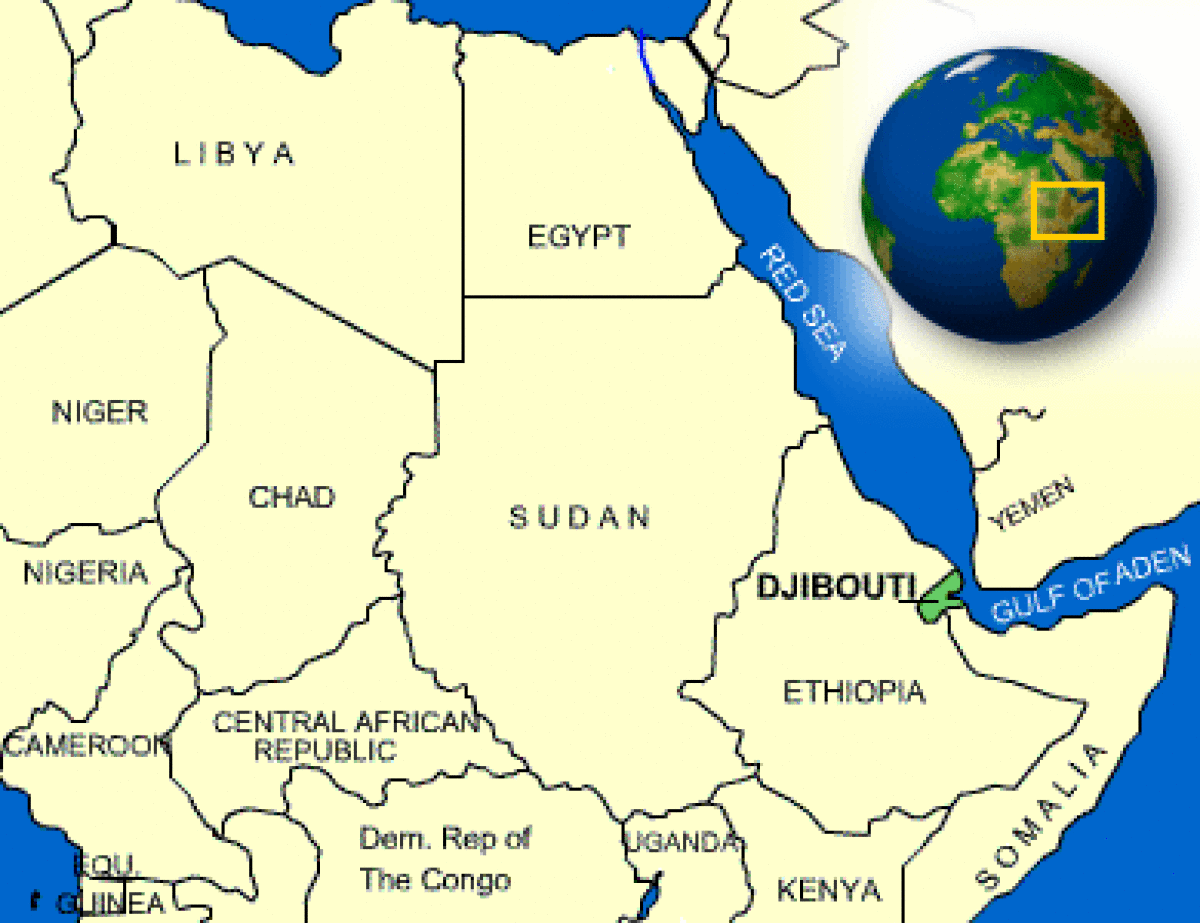
Djibouti lies more than 2,500 miles from Sri Lanka but the East African country faces a predicament similar to what its peer across the sea confronted last year: It has borrowed more money from China than it can pay back.

In both countries, the money went to infrastructure projects under the aegis of China’s Belt and Road Initiative. Sri Lanka racked up more than $8 billion worth of debt to Chinese sovereign-backed banks at interest rates as high as 7 percent, reaching a level too high to service. With nearly all its revenue going toward debt repayment, last year Sri Lanka resorted to signing over a 70 percent stake and a 99-year lease to the new Chinese-built port at Hambantota.

Djibouti is projected to take on public debt worth around 88 percent of the country’s overall $1.72 billion GDP, with China owning the lion’s share of it, according to a report published in March by the Center for Global Development.

It, too, may face the possibility of handing over some key assets to China.

As Chinese President Xi Jinping continues to push lending to developing countries, policy analysts are sounding alarm bells about the fate of smaller nations biting off more than they can chew—and the strategic possibilities opening to China as a result.

Xi’s Belt and Road Initiative, which aims to revive and expand the ancient Silk Road trade routes on land and at sea, has become the crown jewel of his foreign policy since 2013, shortly after coming to power. Government officials regularly talk up the initiative and state media outlets give it broad coverage.

But many of the projects have stalled in the early stages of planning, and the dollar amount attached is left vague.

More importantly, the countries involved are often seduced by the appeal of large infrastructure projects that are financially destabilizing. Eight of the 68 countries involved in the Belt and Road Initiative currently face unsustainable debt levels, including Pakistan and the Maldives, according the Center for Global Development’s report.

Its vulnerability notwithstanding, Djibouti has been keen to work with Beijing. It partnered with China Merchants Ports Holdings Company, or CMPort—the same state-owned corporation that gained control of the Hambantota port in Sri Lanka—to build the Doraleh Multipurpose Port. That project was completed in May 2017.

Earlier this month, Djiboutian President Ismail Omar Guelleh described the new Djibouti International Free Trade Zone, a $3.5-billion venture with China, as a “hope for thousands of young jobseekers.”

But the most noteworthy development in Djibouti—and the most worrying for the United States—is China’s first overseas military base, which is located 6 miles from the U.S. military’s only permanent base in Africa. From Camp Lemonnier, where about 4,000 U.S. troops are stationed, the United States coordinates operations in “areas of active hostilities” in Somalia and Yemen.

In the past year, U.S. diplomats and generals have grown increasingly concerned that the base will provide China a foothold at the Bab el-Mandeb Strait, a strategic chokepoint in international maritime trade. About 4 percent of the global oil supply passes through this waterway connecting the Gulf of Aden with the Red Sea each year.

Gen. Thomas Waldhauser, who commands the U.S. Africa Command, said in a testimony before the House Armed Services Committee in March that the United States was “carefully monitoring Chinese encroachment and emergent military presence” in Djibouti. Local relations between the two great-power rivals have become especially strained in 2018, with each lodging grievances against the other.

China, for its part, maintains that the naval facility will serve as a logistics hub for its anti-piracy, humanitarian, and emergency evacuation missions. The live-ammunition drills conducted at the base should be interpreted as “legitimate and reasonable” exercises for counterterrorism operations, a commentator told the state-owned Global Times.

But satellite images of the People’s Liberation Army base may reveal its true purpose. A retired Indian Army intelligence officer noted last September that the 200-acre facility includes at least 10 barracks, an ammunition depot, and a heliport. Four layers of protective fences surround the perimeter; the two inner fences are eight to 10 meters tall and studded with guard posts. The purported logistical support base is rather a fortress that may accommodate thousands of soldiers. More than 2,500 Chinese peacekeeping personnel are already stationed in countries such as South Sudan, Liberia, and Mali.

“There is nowhere else in the world where the U.S. military is essentially co-located in close proximity to a country it considers a strategic competitor,” said Kate Almquist Knopf, the director of the Defense Department’s Africa Center for Strategic Studies.

“This is not something the Pentagon is used to,” she said.

One concern is that the Djibouti government, facing mounting debt and increasing dependence on extracting rents, would be pressured to hand over control of Camp Lemonnier to China.

In a letter to National Security Advisor John Bolton in May, Sen. James Inhofe (R-Okla.) and Sen. Martin Heinrich (D-N.M.), two members of the Senate Armed Service Committee, wrote that President Guelleh seems willing to “sell his country to the highest bidder,” undermining U.S. military interests.

“Djibouti’s now identified as one of those countries that are at high risk of debt distress. So, that should be sending off all sorts of alarm bells for Djiboutians as well as for the countries that really rely on Djibouti, such as the United States,” said Joshua Meservey, a senior policy analyst at the Heritage Foundation.

“Policymakers are becoming more and more aware of this. The challenge is that there isn’t a strong sense of how to effectively push back or compete with China on some of these issues.”

Meservey says there are simple steps the United States could take to start balancing out China’s expanding influence, including institutionalizing the U.S.-Africa Leaders Summit—a one-off event in 2014 hosted by President Barack Obama. The U.S. government should also incentivize private sector investment in Africa, he said, thus creating competition with Chinese state-backed dollars on the continent.

Other analysts believe China’s debt-driven expansion could backfire on Beijing. Jonathan Hillman, a fellow at the Center for Strategic and International Studies, said one “underappreciated dimension” of China’s predatory lending projects in Africa was the uncertainty that Beijing takes on by doling out trillions of dollars abroad.

“If these projects do not go well, there is a financial and reputational risk to China,” Hillman said.

“The port in Sri Lanka gets a lot of attention, but not too far from the port is an airport that now no plane flies into. That’s not a good advertisement for Chinese soft power or China’s strength or reliability as a partner.”

This article was first published on Foreign Policy: https://foreignpolicy.com/2018/07/31/will-djibouti-become-latest-country-to-fall-into-chinas-debt-trap/

Dipo Olowookere is a journalist based in Nigeria that has passion for reporting business news stories. At his leisure time, he watches football and supports 3SC of Ibadan. Mr Olowookere can be reached via [email protected]

Click to comment

Leave a Reply

Your email address will not be published. Required fields are marked *

Feature/OPED

Observations From Afar on BRICS Common Currency

Published

on

BRICS Countries

By Shmuel Ja’Mba Abm

In a report filed by The Business Standard on August 8, 2026, India, the current BRICS chair, opposes a proposal for a common currency to counter the US dollar.

The Indian Commerce Minister, Piyush Goyal, told reporters in Jaipur, Rajasthan, northwestern India, after a two-day BRICS trade and industry meeting, that India was not in favour of a BRICS currency. He added that India did not support the introduction of any such BRICS currency scheme.

It is good these things are showing signs at this early stage of attempts by BRICS member countries to crystallise a research finding published by a British economist at Goldman Sachs, Jim O’Neil, in 2001.

None of the leaders and country members of BRICS ever conceived on record the formation of such an economic or political bloc until the research publication, which spurred leaders of the mentioned countries to marshal resources and begin a dialogue of formalisation.

The current membership that started involuntarily with just Brazil, Russia, India, and China as a concept published by a research economist, that later included South Africa, now has 10 members – Brazil, Russia, India, China, South Africa, Egypt, Ethiopia, Iran, United Arab Emirates, and Indonesia.

Belarus, Bolivia, Cuba, Kazakhstan, Malaysia, Nigeria, Thailand, Uganda, Uzbekistan, and Vietnam are designated partner countries that participate in framework meetings without full voting rights.

Originally, the publication by Jim O’Neil wasn’t intended or proposed as a vehicle for the political grouping that has drawn the attention of the rest of the world, as mentioned members took a step further from the appraisal or assessment paper to coalesce into a political force overflowing its original boundaries today.

For the above reasons, the initial step of early contacts was to take advantage of things in common in member countries for the stimulation of economic growth and global prosperity. At that stage, suspicions were managed, and plans didn’t consider historical political differences and disagreements as grounds for suspicion or discontinuation of cooperation.

Of course, China and India had trust issues over decades of border disputes. And in the early stages of heightened escalations of the Russian-Ukrainian relationship when India offered to mediate and broker for ceasefire and eventual peace, Russia wasn’t sceptical but took steps to host the Indian Prime Minister, Narendra Modi.

But at the back of the mind of the Russian-Indian relationship, history was revealing about betrayals, especially after what the country endured in assassinations of leading members of the Indian National Congress, that killed Indira Gandhi and swept her son, Rajiv Gandhi, and thereafter ravaged the family dynasty with threats of violence.

These paved the way for the emergence of the Bharatiya Janata Party, a Hindu nationalist party, and its leader, Narendra Modi. The BJP is not directly responsible for the intimidation and violent campaign against the INC, a close former Soviet-era ally of Russia, but a beneficiary. There are grounds to suspect a frosty relationship with Russia, although concealed in diplomatic niceties and global market dynamics of cross-border business and trade.

India turned into the redistribution hub of Russian discounted grains and oil supplies as a third country, after sanctions were imposed on Russia in what Russia described as demilitarisation and denazification special operations in Ukraine.

India is considered by Western powers as a democracy. It was once a British colony, gaining independence on August 15, 1947. It is also a member of the British Commonwealth of Nations. On a normal day, it doesn’t add or take away anything. But under these circumstances, these are serious factors to consider in arriving at a decision.

Be it as it may, China and Russia have found their way out in world trade, bypassing SWIFT. China operates the Cross-border Inter-bank Payment System, whilst Russia is running the System for Transfer of Financial Messages (SPFS). India has IMPS and NEFT. In principle, these payment systems bypass SWIFT and the US dollar, nonetheless.

As the world waits to hear India back its dissenting views with supporting facts, world trade will never remain the same again.

Shmuel Ja’Mba Abm has extensive scholarly publications that establish him as a leading academic expert in regional geopolitical dynamics and diplomatic relations in Africa. Author of e-monographs on geopolitics, ethnic conflicts, and political philosophy.

Continue Reading

Feature/OPED

What Dangote’s Reported $40bn Private-Placement Valuation Could Mean for Nigerian Investors, NGX

Published

on

Dangote refinery petrol production

Dangote Petroleum Refinery could become an unusually large part of Nigeria’s stock market if its eventual IPO valuation is close to the roughly $40 billion implied by a recent private placement.

EBC Financial Group (EBC) highlights that this would value the refinery at about N54.63 trillion, using the Central Bank of Nigeria (CBN) Nigerian Foreign Exchange Market rate of N1,365.6856 per USD on August 7. Against the N158.513 trillion value of companies listed on the Nigerian Exchange (NGX) on the same date, adding the refinery at that value would produce a market worth about N213.14 trillion, with Dangote Refinery accounting for 25.6%.

This scenario assumes the full $40 billion equity value is reflected in NGX market capitalisation and other listed company values remain unchanged. At that size, movements in the company could become highly visible across the Nigerian equity market, although its actual influence on NGX indices may depend on the shares available for public trading and the relevant index rules.

David Precious, Senior Market Analyst at EBC Financial Group, said: “If Dangote Refinery entered the Nigerian Exchange at close to a $40 billion valuation, it could account for roughly one-quarter of the resulting NGX market value. If that valuation is difficult to support, few shares are available for public trading, or investors need to reduce other Nigerian holdings to participate, the effects could extend across Nigeria’s equity market, including existing NGX-listed companies and their shareholders.”

A Private Transaction Can Indicate Value, but Public Investors Need Financial Evidence

Based on the private transaction, $40 billion provides an indication of Dangote Refinery’s value, but it does not establish the eventual IPO price. Details published on August 4 said a $2.5 billion private placement for a 6% stake implied a valuation of roughly $40 billion. The proposed initial public offering (IPO) was reported to target about $5 billion, while the eventual IPO valuation and percentage offered to the public were not disclosed. This is important as a private transaction may produce a different valuation from the price a broad group of public investors is prepared to accept.

For context, public equity market values cited alongside the transaction were about $12 billion for Türkiye’s Tupras and $16 billion for US-listed HF Sinclair. The Dangote figure is about 3.3 times Tupras and 2.5 times HF Sinclair. They are not direct comparisons because profitability, debt, operations and growth plans differ. The gap nevertheless increases the need for audited earnings, cash flow, debt and investment plans that explain what supports the higher valuation.

The reported $5 billion fundraising target is equivalent to about N6.83 trillion at the August 7 exchange rate, or approximately 4.3% of the N158.513 trillion existing NGX market value. Proposed $5 billion raise. If new Nigerian or foreign money funds the offer, the pool of capital invested in Nigerian equities could expand. If investors sell current holdings to participate, capital could instead move away from other listed companies.

Publicly Tradable Shares and New Investment Could Shape the Wider Market Impact

NGX rules show why total company value does not tell investors how much stock they can actually trade. Main Board companies can qualify through either 20% public ownership held by at least 300 shareholders or publicly tradable shares worth at least N20 billion. The Premium Board value alternative is N40 billion. Holdings controlled by promoters, directors and close relatives, government, or strategic investors owning at least 5% are excluded from qualifying public shares.

This means a company worth tens of trillions of naira could still have a much smaller amount of stock available for regular trading if ownership remains concentrated. The key issue is therefore how much of Dangote Refinery becomes accessible to public investors and how widely those shares are held.

Regional investment could also affect the outcome. Details published on 4 August indicated engagement involving South Africa, Kenya, Egypt, Ghana and Rwanda, including possible Kenyan participation of up to $500 million, although no allocations were confirmed. The Johannesburg Stock Exchange separately said Dangote Group had shown strong intent to pursue a South African listing after Nigeria. Regional participation in the Nigerian offer could bring new capital directly into Nigerian equities. A later South African listing could broaden access but would not itself increase money raised through the Nigerian IPO.

Pension funds face the same question of capital allocation. The National Pension Commission (PenCom) waived the usual existence, profitability and dividend requirements so Pension Fund Administrators can consider the IPO, while retaining internal investment policies, risk-management requirements and duties to contributors and retirees. PenCom Circular on Dangote Refiner. PenCom states that the dispensation is exceptional, one-off and specific to this proposed IPO.

Pension funds held N5.907 trillion in domestic ordinary shares at the end of June, compared with the offer’s approximately N6.83 trillion equivalent. This does not imply pension funds would finance the offer. It shows why managers must consider exposure to one company and whether participation requires reducing other investments.

Precious added, “Dangote being listed could become a turning point for Nigeria’s equity market if it brings wider public ownership and additional African capital. Investors still need clear evidence supporting the valuation, clarity on how much of the company they can trade and an explanation of where the money raised will go. Those answers will determine whether the listing expands the Nigerian equity market or concentrates more investment around one company.”

An approved prospectus should clarify the valuation, shares offered, public ownership and use of proceeds. The Securities and Exchange Commission (SEC) said on June 23 that no IPO application had then been filed or approved and ordered unauthorised pre-marketing to stop. Details published on 4 August later said an IPO application had been submitted, with regulatory approval expected in the following weeks. Until final terms are disclosed, the test for Nigeria is whether the listing combines a supportable valuation with broad public ownership and genuinely additional investment.

Continue Reading

Feature/OPED

Moving the Stablecoin Conversation From Hype to Utility in Africa’s Next Payments Evolution

Published

on

Rajat Mishra Onafriq

By Rajat Mishra

For much of the past decade, discussions around stablecoins have been dominated by cryptocurrency speculation. Increasingly, however, stablecoins are emerging as practical financial infrastructure for moving money across borders, managing liquidity and improving payment efficiency.

The real opportunity lies not in choosing between traditional finance and digital assets, but in building an integrated financial ecosystem where both work together to improve efficiency, broaden financial access and deepen economic connectivity across the continent.

Despite significant advances in financial inclusion and digital payments, moving money across African borders remains far more difficult than it should be. Businesses continue to face challenges when making cross-border payments. Fragmented payment networks, multiple intermediaries, and lengthy settlement processes increase costs and create operational inefficiencies.

Remittance providers, the specialised financial services that millions rely on to send money home, face many of the same structural challenges. These providers play a critical role across the continent. In fact, 19 of Africa’s 54 countries receive remittance inflows equivalent to at least 4% of their GDP. Yet Africa remains the world’s most expensive region to send money to.

These challenges are not a reflection of remittance providers themselves, but of the fragmented banking and settlement infrastructure underpinning international money movement. Financial institutions must often manage liquidity across multiple disconnected currency markets while relying on complex correspondent banking networks and clearing systems. The result is higher costs, slower settlements, and capital that remains unnecessarily locked up.

One of the most immediate opportunities for stablecoins lies in improving cross-border settlement. Consider a Kenyan business importing goods from South Africa. Under traditional settlement models, payments often pass through multiple correspondent banking relationships, involve several foreign exchange conversions, and can take days before funds reach the intended recipient.

Stablecoin-enabled settlement rails have the potential to reduce much of this friction by enabling value to move more efficiently between financial institutions across markets. The result can be shorter settlement times, greater transparency and improved predictability for businesses operating across borders.

The benefits extend well beyond businesses. For millions of Africans working abroad, remittances remain a financial lifeline, helping families pay school fees, healthcare costs and daily living expenses. Yet sending money home often involves navigating a complex chain of money transfer operators, correspondent banks, and local payout partners, with each additional layer introducing costs and delays.

Stablecoins can help streamline the backend movement of funds between institutional participants, reducing settlement costs and improving efficiency across the value chain.

For end users, the advantage is simplicity. Recipients do not need to interact with, or even understand stablecoins directly. They continue to receive money through familiar, trusted channels, whether a local bank account or mobile money wallet, only faster and at a lower cost.

Beyond payments, stablecoins also address one of the less visible but most significant challenges in cross-border finance: liquidity management. Financial institutions operating across multiple markets must constantly ensure they have sufficient funds in the right currency, in the right jurisdiction and at the right time. Today, this often requires pre-funding accounts across multiple countries, a costly practice that traps large amounts of capital and limits financial flexibility.

Stablecoins introduce a new model for moving value across borders in near real time, enabling institutions to manage liquidity dynamically as demand arises. This can reduce the need for large pre-funded balances, improve treasury efficiency and free up capital that can be deployed more productively. Ultimately, these efficiencies can translate into faster settlements, lower costs, and better services for businesses and consumers alike.

However, the true value of stablecoins will not come from isolated blockchain networks operating independently of existing financial systems. Their long-term impact will depend on how effectively they integrate with banks, mobile money platforms, payment service providers and existing payment infrastructure. Interoperability will be critical to ensuring payment flows move seamlessly between systems, markets and currencies. The goal should be to strengthen and modernise today’s payment ecosystem, not replace it.

From experiment to infrastructure: what global moves are telling us

Some of the clearest signals that stablecoins are moving from experimentation to infrastructure are coming from card networks. Mastercard’s reported agreement to acquire BVNK, valued at up to $1.8 billion, points to a strategic investment in the settlement layer connecting stablecoin rails with traditional banking and reflects growing institutional confidence in stablecoin-enabled cross-border payments.

Visa’s expansion of stablecoin-backed cards through Stripe’s Bridge to more than 100 countries reflects a complementary strategy. Rather than acquiring infrastructure outright, Visa is leveraging its existing global network as the final distribution layer for stablecoin-funded payments.

The inclusion of African markets is particularly significant. It signals growing confidence that stablecoin-backed payment instruments can operate alongside, and in some cases complement, the mobile money ecosystems that already dominate wallet-based payments across much of the continent.

Taken together, these developments point to a broader shift. Card payment networks are moving from observing the stablecoin conversation to investing directly in the infrastructure that underpins it. For Africa, the implication is not that stablecoins will replace existing payment rails, but that success will increasingly belong to institutions capable of orchestrating multiple settlement rails – cards, bank transfers, mobile money and stablecoins- within a unified, interoperable ecosystem. Local market expertise, regulatory relationships and last-mile distribution will remain decisive competitive advantages.

Building for scale through trust and regulation

But despite their potential, stablecoins cannot operate outside the boundaries of regulated financial systems. Their long-term viability across Africa depends on clear regulatory frameworks, robust compliance standards and trusted infrastructure that supports transparency, risk management and consumer protection.

We are already seeing this evolution. In markets such as South Africa, institutions facilitating cross-border settlements must navigate increasingly sophisticated regulatory requirements, including approvals for certain offshore crypto-related activities. Globally, initiatives such as the OECD’s Crypto-Asset Reporting Framework (CARF) and expanded Travel Rule obligations are raising expectations around reporting, tax transparency and compliance.

These developments reinforce a simple reality: stablecoin infrastructure does not reduce compliance obligations. It raises the bar for governance, transparency and institutional risk management. The objective is not to bypass regulation, but to build interoperable payment systems that can innovate confidently within it.

From the edges to the plumbing

The stablecoin conversation is steadily moving beyond speculation and towards practical implementation. What once sat at the edges of the payments debate is becoming part of the plumbing of cross-border finance rather than a parallel system to it.

The question is no longer whether stablecoins have a role to play in payments. The question is where they deliver the greatest value. In Africa, that value is increasingly clear: faster settlement, improved liquidity efficiency and more connected cross-border commerce. The winners will not be those that replace existing financial systems, but those that successfully connect stablecoin rails with the banks, mobile money networks and payment providers that already power the continent’s economy.

For pan-African payment networks such as Onafriq, the priority is ensuring that emerging technologies complement the financial infrastructure businesses and consumers already trust, rather than introducing new layers of complexity.

The opportunity lies in connecting stablecoin settlement with banks, mobile money networks and payment providers, ensuring the benefits of this new infrastructure deliver tangible outcomes for African businesses and consumers.

Rajat Mishra is the CPO for Network Product & Deputy Group CPIO at Onafriq

Continue Reading