Economy
AIICO Insurance Seeks Shareholders’ Nod to Raise Fresh Capital
By Dipo Olowookere
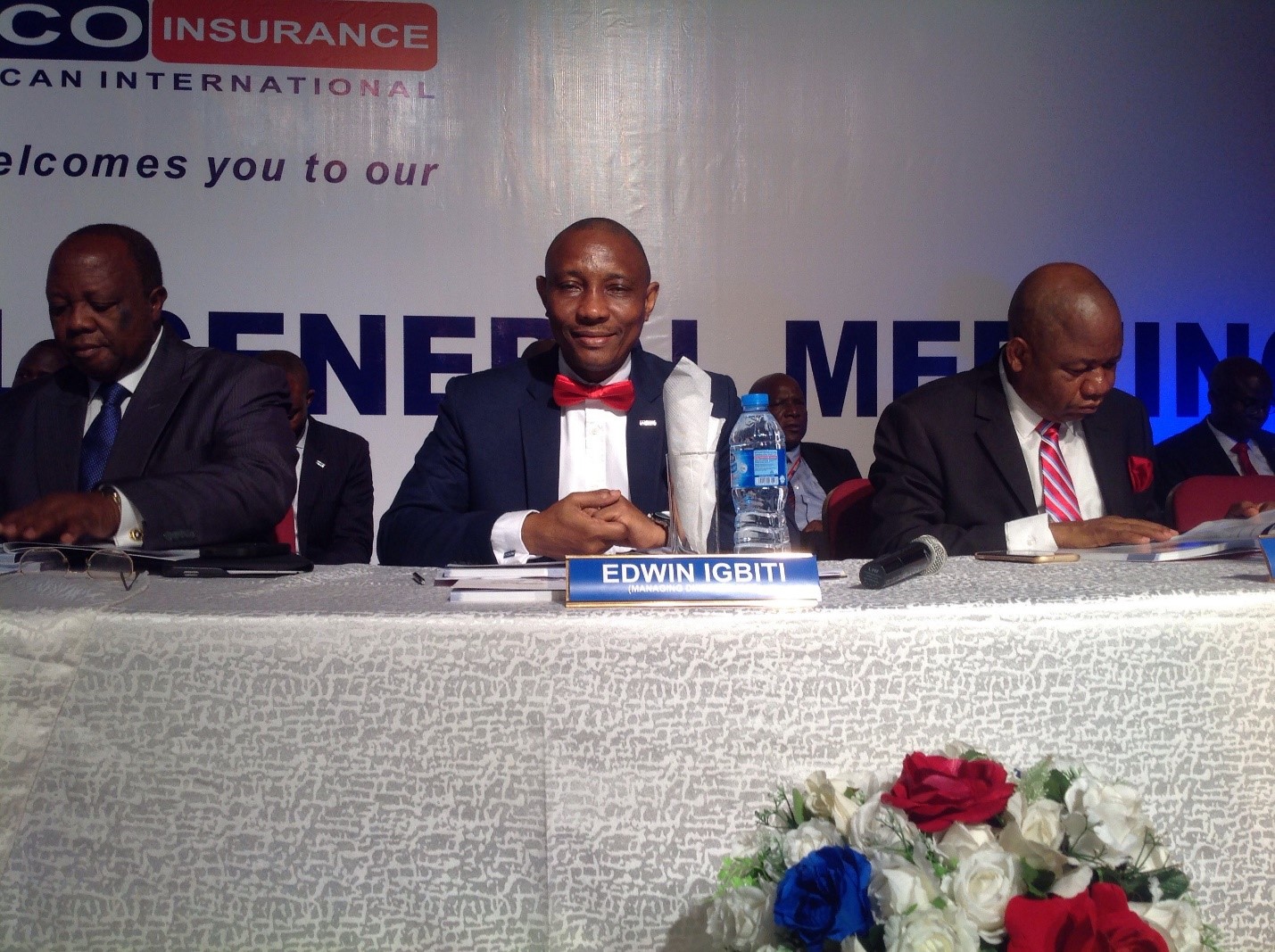
The board of AIICO Insurance Plc has called shareholders of the company to an Extra-Ordinary General Meeting (EGM) to approve the raising of fresh capital to boost operations of the firm.
The meeting is slated for Friday, October 5, 2018, at the Federal Palace Hotel, Victoria Island, Lagos by 11am.
A statement to the regulatory agency yesterday said the meeting is mainly to get shareholders’ approval to raise 4.4 billion ordinary shares of N0.50 each at N1.20 per share by way of a special/private placement.
However, this would still be subjected to approval of relevant authorities in the capital market as well as the insurance industry.
According to the board of the insurer, the proposed shares to be issued “shall rank parri passu with the ordinary shares held by existing members of the company.”
Also during meeting, the shareholders would be expected to authorise the board “to exercise all the power of the company to modify and/or conclude the terms of the special/private placement, seek approvals from the relevant regulatory authorities, appoint professional parties and advisers, finalise and execute all agreements or documents and to do all such acts and deeds which the board of directors in its absolute discretion may deem necessary and expedient for the purpose of the special/private placement without being required to seek any further consent or approval of members of the company or otherwise to the end and intent that they shall be deemed to have given approval thereto expressly by the authority of this resolution.”
Economy
Nigeria to Import 154m Litres of Petrol Despite Rising Local Refining Capacity
By Adedapo Adesanya
Nigeria will receive about 154.2 million litres of imported Premium Motor Spirit (PMS) this week despite increased domestic refining capacity driven by the Dangote Petroleum Refinery.
The latest Nigerian Ports Authority (NPA) shipping schedule shows that five petrol-laden vessels carrying a combined 115,000 metric tonnes of PMS are expected to berth at Tin Can Island Port in Lagos and Calabar Port between Monday and Wednesday.
The continued inflow of imported petrol highlights how marketers are balancing local supplies with overseas purchases based on pricing, availability and commercial considerations, even as domestic refining capacity expands.
According to the NPA’s Daily Shipping Schedule – Vessels Expected, four vessels will discharge their cargoes at the KLT Phase 3A terminal in Tin Can Island, while one vessel is scheduled to berth at the North West Petroleum & Gas terminal in Calabar.
The vessel LESTE is expected to arrive on Monday with 30,000 metric tonnes of PMS, equivalent to about 40.23 million litres, while BORA will deliver 10,000 metric tonnes, or approximately 13.41 million litres, to the same terminal.
On Tuesday, ST ILHAAM is scheduled to discharge another 30,000 metric tonnes (about 40.23 million litres), followed by STELLAR, which is expected on Wednesday with an additional 30,000 metric tonnes, also translating to roughly 40.23 million litres.
At Calabar Port, SL AREMU is expected to berth on Tuesday with 15,000 metric tonnes of PMS, equivalent to approximately 20.12 million litres, at the North West Petroleum & Gas terminal.
The shipping schedule also lists STELLAR at the Dangote terminal in Lekki Deep Sea Port with an arrival date of July 24.
However, its cargo status is marked “INB”, indicating the vessel is in ballast and not carrying cargo, suggesting it may be positioning to load refined products rather than discharge them.
The latest imports come as Nigeria continues to operate a liberalised downstream petroleum market that allows marketers to source products from either domestic refineries or international suppliers.
Industry operators have consistently argued that imports remain necessary to guarantee supply, encourage competition and take advantage of favourable pricing opportunities.
The Nigerian Midstream and Downstream Petroleum Regulatory Authority (NMDPRA) has also maintained that the market remains open to all qualified operators, with fuel prices expected to reflect prevailing market conditions.
Although local refining output has risen significantly following the ramp-up of the 700,000 barrels per day Dangote refinery and ongoing rehabilitation of government-owned refineries, imported petrol continues to account for a portion of Nigeria’s fuel supply, reflecting the competitive dynamics of the deregulated market.
Economy
FrieslandCampina, Afriland Properties Drive NASD Exchange 1.11% Higher
By Adedapo Adesanya
The duo of FrieslandCampina Wamco Nigeria Plc and Afriland Properties Plc lifted the NASD Over-the-Counter (OTC) Securities Exchange by 1.11 per cent on Monday, July 27.
FrieslandCampina Wamco Nigeria, the milk producer famed for Peak Milk and Three Crowns, added N13.61 to its share price to sell for N149.80 per unit compared with the previous session’s N136.19 per unit, and Afriland Properties Plc grew by N1.60 to N19.01 per share from N17.41 per share.
The two securities offset the 30 Kobo loss posted by Nitrox Industrial Gases Plc. This stock closed at N20.00 per unit compared with last Friday’s closing value of N20.30 per unit.
As a result, the market capitalisation of the trading platform went up by N28.72 billion to N2.606 trillion from N2.577 trillion, and the NASD Security Index (NSI) increased by 47.85 points to 4,342.60 points from 4,294.75 points.
The first trading session of the week witnessed a drop in activity level, as the volume of securities crashed by 79.8 per cent to 604,565 units from 2.99 million units, the value of securities declined by 71.7 per cent to N19.6 million from the preceding session’s N69.4 million, and the number of deals dipped by 40 per cent to 33 deals from 55 deals.
At the close of trades, Great Nigeria Insurance (GNI) Plc remained the most traded stock by value on a year-to-date basis, with a turnover of 3.4 billion units valued at N8.4 billion, followed by Infrastructure Credit Guarantee (Infracredit) Plc with 2.3 billion units sold for N6.5 billion, and Central Securities Clearing Systems (CSCS) Plc with 75.6 million units exchanged for N5.4 billion.
GNI Plc was also the traded stock by volume on a year-to-date basis, with the sale of 3.4 billion units worth N8.4 billion, followed by Infracredit Plc with 2.3 billion units transacted for N6.5 billion, and Resourcery Plc with 1.1 billion units traded for N415.7 million.
Economy
Naira Slips at Official Market as FX Turnover Drops
By Adedapo Adesanya
The Naira opened the week marginally down against the United States Dollar in the Nigerian Autonomous Foreign Exchange Market (NAFEX) by 12 Kobo or 0.01 per cent on Monday, July 27, to trade at N1,362.21/$1, in contrast to the preceding session’s N1,362.09/$1.
This occurred amid a sharp decline in interbank FX turnover during the trading session, with deals among financial institutions also reducing strongly. The FX turnover for the day stood at $39.587 million, approximately 56 per cent lower than the $89.082 million recorded last Friday.
In the same official market, the Nigerian Naira lost 43 Kobo against the Pound Sterling yesterday to quote at N1,814.05/£1 compared with the previous session’s rate of N1,813.62/£1, and against the Euro, it slid by N1.09 to close at N1,550.19/€1 versus the preceding session’s N1,549.10/€1.
However, the local currency appreciated against the greenback by N7 at the GTBank forex desk on Monday to sell for N1,372/$1 versus N1,379/$1, and at the parallel market, it maintained stability at N1,400/$1.
The Naira has been able to remain firm despite a very strong US Dollar, largely due to market liquidity on the back of a $52 billion foreign reserves buffer, which makes it easier for banks, traders, and businesses to trade at the FX market without triggering volatility with their demands.
The Dangote Refinery also resumed selling petrol in Naira, a decision it said was driven by the need to stabilise the market, amid claims that fuel importers were withholding supplies in anticipation of higher prices. This has lifted pressure that may come due to foreign-currency buying from fuel importers.
In the cryptocurrency market, most tokens fell, as the US Senate delayed action on the closely watched CLARITY Act to focus on a Russia sanctions bill, likely pushing any vote on crypto regulatory legislation to next week before the August 8 recess.
Analysts say Bitcoin (BTC) and other coins tend to move with stocks when macro and interest-rate stress is high, and they expect volatility across asset classes around the Federal Reserve’s rate decision Wednesday and key US data on Thursday.
Cardano (ADA) dropped 6.0 per cent to finish at $0.1556, Ripple (XRP) depreciated by 4.4 per cent to $1.05, Solana (SOL) fell by 4.0 per cent to $73.27, Ethereum (ETH) slid by 3.9 per cent to $1,884.11, Dogecoin (DOGE) depleted by 3.8 per cent to $0.0699, BTC crashed by 3.0 per cent to $63,420.37, TRON (TRX) retreated by 2.3 per cent to $0.3241, and Binance Coin (BNB) slumped by 1.6 per cent to $565.57, while the US Dollar Tether (USDT) and the US Dollar Coin (USDC) sold flat at $1.00 apiece.