

Economy
Seplat Sheds N15 Per Share on News of Chairman’s $144m Court Case

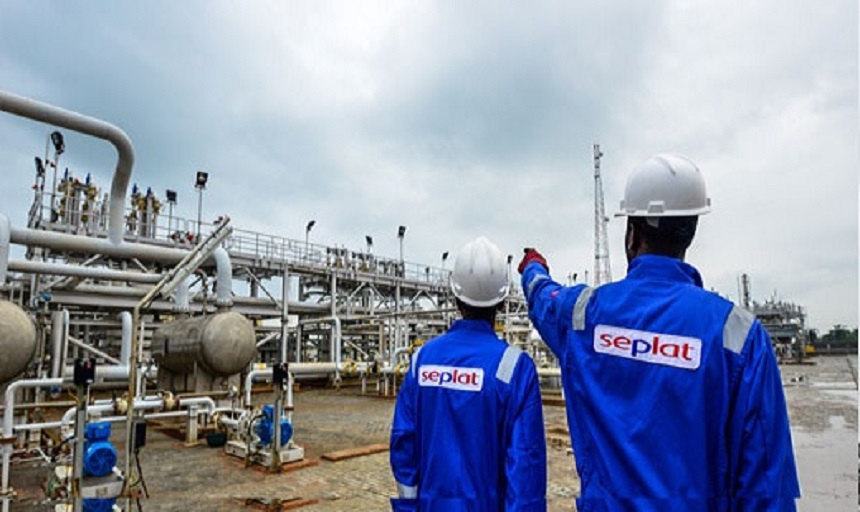
By Dipo Olowookere
Shares of Seplat Plc have depreciated by N15 since the beginning of this week, Business Post is reporting.
This development came on the back of news last weekend about Chairman of the oil firm, Mr Ambrosie Ojiako, being ordered by a Lagos court to pay three financial institutions the sum of $144 million.
According to reports, Mr Orjiako and his firm known as Shebah Exploration and Production Company Limited were asked to pay the amount to Skye Bank (now defunct and known as Polaris Bank), Diamond Bank and the Africa Import Export Bank.
A Federal High Court sitting in Ikoyi had certified judgment delivered by the High Court of Justice Queen’s Bench Division and upheld by the Supreme Court of the United Kingdom, directing Shebah Exploration & Production Company Ltd, Allenne Ltd and its president, Mr Orjiako, to pay the three lenders a sum of $144.2 million.
Seplat is a company trading its shares on both the Nigerian Stock Exchange (NSE) and the London Stock Exchange (LSE).
At the local stock market on Monday, Seplat closed flat, trading at N630 per share.
However on Tuesday, shares of the firm depreciated by N10, ending at N620 per share at the close of the day’s session.
At the market on Wednesday, Seplat lost N5 to settle at N615 per share.
Business Post reports that yesterday, the management of Seplat had to release a statement to the NSE, emphasising that the company was never a party to the suit, but only its Chairman, Mr Ojiako.
“Seplat, a leading Nigerian indigenous oil and gas company listed on both the Nigerian Stock Exchange and London Stock Exchange, has been made aware of some media publications on the enforcement by the Federal High Court in Ikoyi, Lagos, Nigeria of a $114 million judgment made by a UK High Court against Shebah Exploration & Production Company Ltd, Allene Ltd and Dr Ambrosie Orjiako (who is also the Chairman of the Board of Directors of SEPLAT).
“Seplat is not a party to the litigation. The company will monitor the progress of this suit and issue further communication on the matter as appropriate,” the statement had clarified.
This may have had a little effect on the shares of the company today as its securities closed flat at the close of transactions at N615 per share.
BACKGROUND OF THE $144 MILLION CASE
Reports have it that the Lagos court certified the judgments on March 28 and ordered the defendants to comply with the judgment, denying them the permission to appeal it.
The first defendant, Shebah Exploration & Production Company Ltd is a Nigerian company engaged in oil exploration and production while the second defendant, Allenne Ltd is the guarantor of the borrowed loan.
The third defendant, Mr Orjiako, is the President of Shebah and a personal guarantor of the liabilities of Shebah and Allenne pursuant to a Deed of Guarantee and Indemnity dated July 1, 2011.
The claimants had dragged the defendants before the High Court of Justice Queen’s Bench Division in order to be able to recover an outstanding of the facility loan granted to them.
The claimants had apply for a summary judgment against the defendants for sums outstanding under a syndicated loan facility agreement totalling over $144.2 million, together with interest on those sums.
They had prayed the court to determine whether it is arguable that, in entering the Facility Agreement, the parties were contracting on the claimants’ written standard terms of business so as to engage section 3 of the Unfair Contract Terms Act 1997 (‘UCTA’).
In a judgment delivered by Mr Justice Phillips of the High Court of Justice Queen’s Bench Division on February 19, 2016, the court said Shebah had taken the loan for purpose of discharging certain of its existing borrowing and to provide working capital for its operations, including funding for a work-over programme to stimulate production at oil wells in the Ukpokiti oil field.
According to the court, the defendants never denied that the claimants advanced $150 million to Shebah pursuant to the Facility Agreement, nor dispute that, apart from paying one instalment of $6,111,111.11 in June 2012 but Shebah has failed to meet any further repayment instalment, despite the claimants agreeing to the deferral of several instalments.
The judge said in a previous proceeding, which commenced on March 11, 2014, the defendants agreed that, in exchange for the claimants’ discontinuing the proceedings, Shebah would repay all sums outstanding under the Facility Agreement in two tranches: $49.999,999.86 (with accrued interest) by April 30, 2014 and the balance of the loans and interest by July 1, 2014.
He added that Shebah failed to pay any part of the sum due on April 30, 2014. “The claimants were therefore entitled, under the terms of the Discontinuance Agreement, to commence fresh proceedings in respect of their claims.
These proceedings were commenced on June 2014, repeating the claims previously made and adding a claim against Shebah in respect of the $49.999,999.86 due under the Discontinuance Agreement”, the judge said.
Phillips stated that notwithstanding their previous stance, the defendants now contended that no sums whatsoever are due to the claimants, adding that they (the defendants) have arguable defence to the claim.
The judge however ruled that there is no merit in the defendants’ contention on the issues on the ground that there is simply no basis for inferring that the claimants, or any of them, habitually put forward the LMA form (or a tailored version of it) as a basis for their syndicated loan transactions.
“The most likely scenario is that it was chosen or selected by the claimants’ lawyer and that they will have adapted it to reflect the specifics of the transactions. It is impossible to draw any inferences as to what starting points may have been taken in other transactions, involving other permutations of lenders and other lawyers.
“I therefore satisfied that the defendants do not have a realistic prospect of establishing at trial that the Facilities Agreement is on the claimants’ written standard terms of business. The suggestion that the disclosure might alter the position is a classic example of hoping that something may turn up, in this case a forlorn hope given the evidence that there was in fact a degree of real negotiation of the final terms.”
Phillips in his judgment held that whilst the claimants’ purported acceleration of the loans on October 16, 2013 was ineffective, the defendants do not have a defence to the claimants’ alternative case, based upon the acceleration notice dated October 2, 2014 and subsequent demands dated April 14, 2015 and July 27, 2015.
“For the reasons set out above, the claimants are entitled to summary judgment against all three defendants for (i) the principal outstanding under the Facility Agreement of $143,888,888.89, subject to giving credit for the sum paid during the course of this application and the sums conceded in respect of default charges and hedging fees; (ii) the management fees claimed; and (iii) interest calculated on the alternative basis that the loan was accelerated on October 2, 2014”, the judge held.
Dissatisfied with the judgment, the defendants approached the Supreme Court of the United Kingdom, seeking to quash the judgment.
Ruling on the defendants’ application, the Supreme Court sitting comprising Lord Mance, Lord Reed and Lord Lloyd-Jones upheld the decision of the lower court and refused the permission to appeal the decision.
“After consideration of the application filed on behalf of the Appellants seeking permission to appeal the order made by the Court of Appeal on June 28,2017 and of the notice of objection filed by the Respondents.
“The court ordered that (1). Permission to appeal be refused because the application does not raise an arguable point of law of general importance. “(2). The Appellants pay the Respondents costs of the application and, where the Respondents apply for costs, the costs to be awarded be assessed.”


