Economy
FG, States Shared N2.3tr in Q3 2018—NEITI
By Modupe Gbadeyanka
The latest edition of the NEITI Quarterly Review released by the Nigeria Extractive Industries Transparency Initiative (NEITI) has revealed that a total of N2.28 trillion was shared among the three tiers of government comprising federal, state and local governments in the third quarter of 2018.
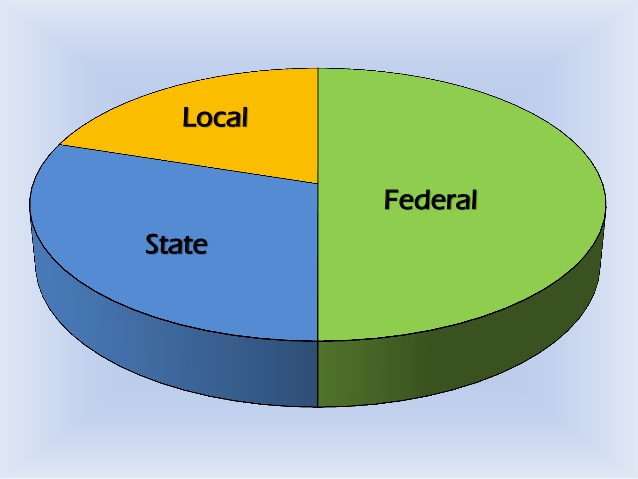
The disbursements were made by the Federation Account Allocation Committee (FAAC), with the federal government receiving the highest sum of N904.8 billion, followed by states, which received N718.5 billion and local governments receiving the lowest disbursements of N432.1 billion.
“Total FAAC disbursements in the third quarter of 2018 amounted to N2.28 trillion representing a 17.6 percent increase over the N1.938 trillion disbursed in the first quarter of 2018 and 13.5 percent higher than the N2.008 trillion disbursed in the second quarter,” a statement issued by NEITI’s Director of Communications & Advocacy, Mr Orji Ogbonnaya Orji, disclosed.
“It is interesting that with the exception of July, the lowest amount disbursed so far in 2018 is higher than disbursements in all other months in 2016 and 2017,” the statement added.
A breakdown of the disbursed sums for 2016, 2017 & 2018 shows that the disbursements in the third quarter of 2018 (N2.28 trillion) were 31 percent and 18 percent higher than disbursements in the third quarters of the last two years.
NEITI also reports that the last time total disbursements exceeded the N2.5 trillion mark was in the second quarter of 2014 (N2.510 trillion).
Further analysis of the increases as reported by the NEITI Quarterly Review shows that the federal government’s receipt of N904.8 billion in the third quarter of 2018, was 11.3 percent and 7.8 percent higher than the amounts received in the first (N812.8 billion) and second (N839.5 billion) quarters of 2018 respectively.
“The amount disbursed to states represented an increase of 5.1 percent over the N683.5 billion disbursed in the first quarter, and an increase of 3.8 percent over the N692.1 billion disbursed in the second quarter.
For local governments, the amount received was 9.8 percent and 7.5 percent higher than the respective amounts of N393.4 billion and N402.1 billion received in the first and second quarters,” the NEITI Quarterly Review disclosed.
On a year-by-year analysis, NEITI reveals that the increase to third quarter disbursements to states in 2018 were the highest when compared to 2016 and 2017 figures disbursed to other federating units.
A breakdown of the figures showing the level of growth indicates that, “Total disbursements to states in the third quarter of 2018 came to N718.5 billion, representing a growth of 40.1 percent and 22.5 percent over disbursements in the third quarters of 2016 (N512.7 billion) and 2017 (N586.6 billion) respectively” NEITI observes.
The NEITI Quarterly Review continues, “For the LGCs, disbursements in 2018 Q3 totalled N432.1 billion. This figure was 33.2 percent higher than the N324.3 billion disbursed in 2016 Q3, and 18.7 percent higher than the N324.3 billion disbursed in 2017 Q3.
“Total disbursements to the FGN in the third quarters of 2016, 2017 and 2018 were respectively, N697.9 billion, N752.7 billion, and N904.8 billion indicating that in 2018 Q3, the FGN received 29.7 percent higher disbursements than 2016 Q3, and 20.2 percent higher disbursements than 2017 Q3.”
The review further disclosed that total net FAAC disbursements to states in the first nine months of 2018 ranged between N16.41 and N150.59 billion, with Osun and Delta states receiving the lowest and highest amounts respectively.
A comparison of the state-by-state net disbursement shows a stark disparity in the amounts received.
For instance, the net disbursement received by Delta State in January alone sums up to the total net disbursements to Osun State from January to September 2018.
This clearly indicates that disbursements to Delta State were higher than the one to Osun by over 800 percent.
The NEITI Quarterly Review also shows that average monthly net disbursements to states in the first nine months of 2018 ranged between N1.82 billion and N16.73 billion with Osun receiving the least monthly sum and Delta, the highest.
As observed in previous reviews, states that received the highest allocations of N100 billion and above are all in the Niger Delta region and this is on account of the 13 percent derivation.
Furthermore, a comparison of state-by-state debt deductions in the first nine months of 2018 revealed that Lagos State had the highest deduction of N26.84 billion while Yobe State had the lowest deduction of N1.12 billion (a percentage difference of 2,300 percent).
The state with the lowest ratio of deductions to net disbursements was Anambra with 2.85 percent, while Osun had the highest deduction to net disbursements ratio of 132.85 percent, signalling that deductions exceeded disbursements to Osun State.
The review however explained that the wide disparities in disbursements to states were as a result of differences in disbursements arising from the revenue sharing formula, deductions from states due to external debts, contractual obligations, among others.
The NEITI review advised that the increase in disbursements is a ground for cautious optimism in the fiscal positions of all tiers of government, noting that the upswings and downswings pattern is reflective of the volatile nature of revenue resulting from reliance on primary commodity exports The publication also observed that while increase in revenue will reflect positively on the fiscal situation of the federating units, states will still have to struggle to finance their budgets considering their poor Internally Generated Revenue (IGR).
“There is virtually none of the states that can adequately finance their budgets from IGR and FAAC disbursements. States will have to resort to different levels of borrowing”, the NEITI review noted.
The NEITI Quarterly Review, designed to provide timely information and data, is a tool to support citizens’ engagement, advocacy, constructive debate, information sharing and enlightenment in tracking the utilization of public funds for purposes of development.
NEITI’s interest in FAAC disbursements and the statutory recipients is in view of the fact that more than 50 percent of the funds are derived from the extractive industry. Net Disbursements and Total Deductions from States January to September 2018
Economy
First Holdco Lifts All-Share Index by 0.46% After Significant Trades
By Dipo Olowookere
The Nigerian Exchange (NGX) Limited rebounded by 0.46 per cent on Tuesday despite continued weak investor sentiment due to low confidence in the market.
The gains recorded yesterday were largely impacted by significant trades in First Holdco by a major shareholder of the financial institution.
In terms of price gainers and losers, the bears won the race, as 28 equities closed in the red and 24 equities ended in the green, indicating a negative market breadth index.
Learn Africa grew by 10.00 per cent to N9.90, First Holdco expanded by 9.98 per cent to N72.15, Thomas Wyatt rose by 9.80 per cent to N2.69, RT Briscoe improved by 8.68 per cent to N13.15, and Transcorp Hotels increased by 8.37 per cent to N242.00.
Conversely, International Energy Insurance lost 9.86 per cent to close at N4.66, Legend Internet slipped by 9.18 per cent to N4.45, Fortis Global Insurance decreased by 7.67 per cent to N2.77, FTN Cocoa tumbled by 7.55 per cent to N8.21, and International Breweries dropped 4.79 per cent to trade at N13.90.
Business Post reports that First Holdco led the activity chart with a turnover of 326.9 million units worth N22.3 billion. GTCO traded 22.5 million units valued at N2.8 billion, Access Holdings transacted 18.5 million units for N461.6 million, FCMB sold 16.1 million units worth N166.8 million, and Zenith Bank exchanged 15.9 million units valued at N1.7 billion.
At the close of business, a total of 634.8 million stocks valued at N53.3 billion exchanged hands in 42,494 deals versus the 523.5 million stocks sold for N22.3 billion in 59,945 deals on Monday, indicating a shortfall in the number of deals by 29.11 per cent, and a surge in the trading volume and value by 21.26 per cent and 139.01 per cent, respectively.
The All-Share Index (ASI) was up during the trading day by 1,121.33 points to 242,870.44 points from 241,749.11 points, and the market capitalisation gained N719 billion to settle at N155.849 trillion compared with the previous day’s N155.130 trillion.
Market participants will be looking forward to the release of inflation data for June 2026 by the National Bureau of Statistics (NBS) today, Wednesday, July 15.
Economy
Brent Climbs Above $84, WTI Near $80 as Iran Tensions Stoke Oil Rally
By Adedapo Adesanya
Oil prices climbed about 2 per cent to a one-month high on Tuesday after the US reportedly reimposed a naval blockade on Iran, which will reduce oil flows from the region through the Strait of Hormuz.
Brent futures rose by $1.43 or 1.7 per cent to settle at $84.73 per barrel, while the US West Texas Intermediate (WTI) crude increased by $1.20 or 1.5 per cent to $79.34 a barrel.
Brent closed at its highest since June 12, and WTI at its highest since June 15. The closing price increase kept Brent in technically overbought territory for a second day in a row for the first time since March.
Before the Iran war, about 20 per cent of global oil supplies flowed through the strait.
US President Donald Trump stepped back from a proposal to charge a 20 per cent fee to guard the Strait of Hormuz as part of the conflict with Iran, saying he would instead seek investment deals with Gulf states.
US forces had carried out waves of attacks for the third night after Iran said it had closed the strait. President Trump on Monday reinstated a blockade of Iranian shipping and proposed the fee, but hours before the fee was to take effect, the American President said the strait was open to all shipping traffic except that of Iran.
The renewed attacks have fed doubts that a memorandum of understanding signed last month will lead to a permanent halt in the war that has disrupted global energy supplies and stoked inflation fears.
Data showed that US consumer inflation slowed more than expected in June as energy prices retreated, but financial markets still expect an interest rate hike from the Federal Reserve.
The Federal Reserve Chairman Kevin Warsh on Tuesday vowed to “do my job” if challenged by President Trump, who has said he wants the US central bank to cut interest rates and boost economic growth.
The American Petroleum Institute (API) estimated that crude oil inventories in the US fell by 564,000 barrels in the week ending July 10. In the week prior, US crude oil inventories fell by 399,000 barrels.
Although commercial crude oil inventories excluding the SPR have been falling rapidly for three months now, shedding just over 60 million barrels over the last twelve weeks, US crude inventories are only down 9.2 million barrels so far this year. The US Energy Information Administration (EIA) will release its report later on Wednesday.
Economy
Dangote Refinery Stops Pricing Petrol, Diesel, Jet Fuel in Naira, Opts for Dollars
By Adedapo Adesanya
The 700,000 barrels per day Dangote Petroleum Refinery has begun pricing fuel products for the local market in US Dollars amid crude supply challenges.
The company cited difficulties securing sufficient crude under the government’s Naira-for-crude programme and rising global oil prices as reasons for the development.
The Naira-for-crude programme, launched in October 2024, allowed domestic refiners to purchase crude in the local currency and reduced pressure on the foreign exchange market.
Mr Edwin Devakumar, the vice president of the Dangote Group, said the refinery had been absorbing a currency mismatch by selling products in Naira while sourcing crude in Dollars, but limited crude supply under the Naira-for-crude programme had undermined the arrangement’s viability.
Dangote has now set the ex-depot price of petrol at $0.779 per litre, diesel at $1.087 per litre and aviation fuel at $0.942 per litre, according to a pricing template circulated to marketers.
Although the Nigerian National Petroleum Company (NNPC) Limited increased Dangote’s allocation to seven cargoes in May from about five previously, the refiner has said it requires 13 to 15 cargoes a month and has been forced to import the remainder at international prices.
The decision could boost demand for Dollars among fuel marketers and make domestic fuel prices more sensitive to exchange-rate fluctuations.
Dangote Refinery is steadily ramping up operations toward full capacity after a gradual start since late 2023. In April alone, it received 21 separate crude cargoes, with all supplies coming from West Africa, mainly Nigerian crude grades, with one cargo from Cameroon; however, it boosted international cargoes in recent months.
The refinery has been broadening the range of crude grades it processes as part of its ambition to operate as a fully merchant refinery. In 2025, about 70 per cent of the refinery’s crude imports came from Nigeria, while 24 per cent originated from the United States.
Dangote plans to double the refinery’s processing capacity to 1.4 million barrels per day by the end of 2028, a level that would enable it to process about 80 per cent of Nigeria’s recent crude oil production in a single day.