Economy
Safer Mining Practices Reduce Hazardous Exposures—Study
By Modupe Gbadeyanka
A new study has showed that a pilot program to reduce lead poisoning in Nigerian gold mining communities has brought extraordinary improvements to an area where hundreds of children had died from lead poisoning.
The study authors concluded that a two-year effort to introduce safer mining practices was effective at preventing deaths and reducing lead poisoning in highly exposed villages.
“Our pilot project demonstrated that low-cost dust control measures were effective at reducing average airborne lead exposures by 95 per cent,” said Perry Gottesfeld, Executive Director of Occupational Knowledge International (OK International) whose organization partnered with Doctors Without Borders/ Médecins Sans Frontières (MSF) in this effort.
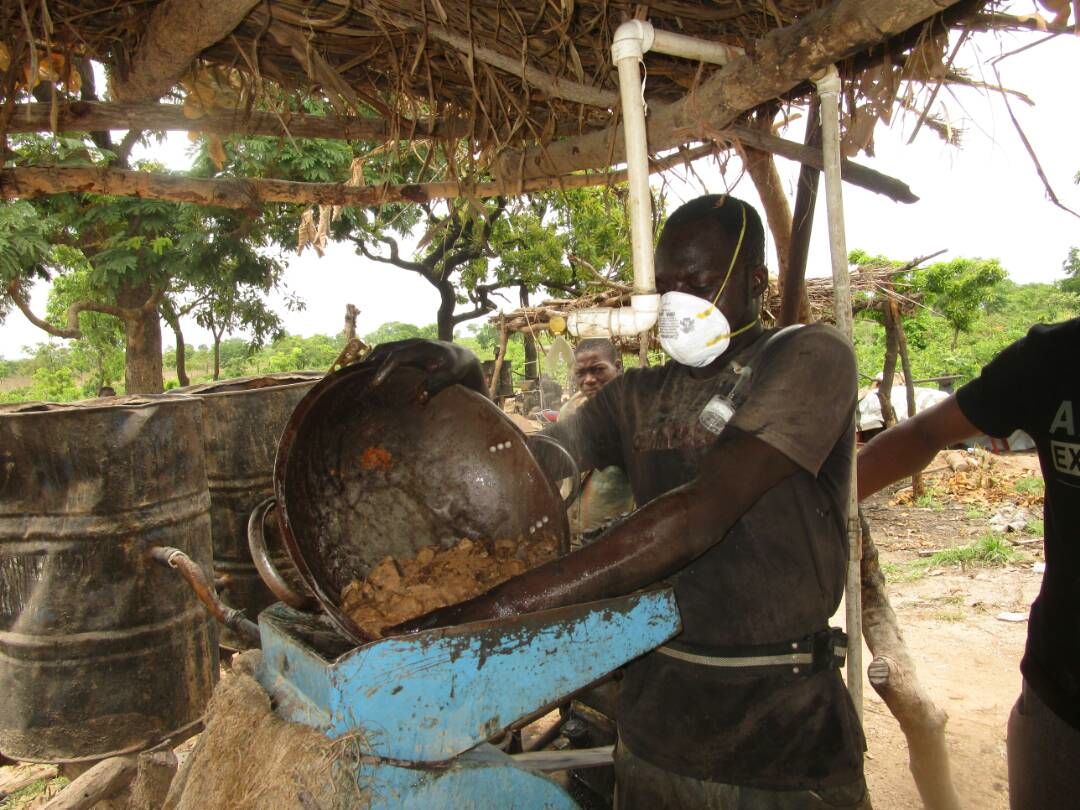
The safer mining project took place in the Shakira community in Niger State where high levels of lead are naturally present in the gold ore. The primary objective was to reduce lead exposures among artisanal small-scale miners and minimize take-home exposures.
“We worked cooperatively with miners to provide them with the information and tools to reduce their exposures to lead and silica dust. Together we showed that these efforts minimized contamination and helped save lives.” Gottesfeld said.
The organization demonstrated the effectiveness of reducing airborne lead levels by working with miners to convert dry operations into wet methods. Water spray misting was proven to be highly effective while minimizing water consumption. In addition to significant reductions in the airborne lead, the authors reported that these control measures reduced the smaller respirable silica dust by 80 percent.
Philip Aruna, Head of Mission in Nigeria for Doctors Without Borders said: “OK International has exceeded expectations in bringing an entire community together to prevent severe lead poisoning and by demonstrating significant reductions in lead exposures among miners.”
Gottesfeld noted that “Following our extensive outreach and training, these miners were motivated to take measures to reduce hazardous lead exposures and invested their own time and money to implement these protective measures.”
The authors of the Study “Reducing Lead and Silica Dust Exposures in Small-Scale Mining in Northern Nigeria” published in Annals of Work Exposures and Health noted that average lead exposures among ore processors before the implementation of safer practices were 19 times greater than the U.S. Occupational Safety and Health Administration (OSHA) permissible limit for lead.
In Nigeria and in most other African countries, there are no occupational limits for exposure for lead or silica dust.
Silica dust causes silicosis, lung cancer and is a significant risk factor for tuberculosis (TB). Lead causes severe neurological deficits and death among children in these communities, but even at low exposure levels is responsible for 674,000 deaths each year primarily due to cardiovascular disease.
There are an estimated 40 million informal small-scale miners working in at least 70 countries around the world. Although some programs have attempted to reduce mercury exposures in these communities, this is the first such intervention to demonstrate reductions in lead and silica dust exposures. The authors of the published article note that in mining communities lead and silica hazards pose a far greater risk to human health than the use of mercury.
Dr. Adolphe Fotso, Medical Coordinator for Nigeria with Doctors Without Borders, and an author on the paper said, “this effort was an extraordinary success in reducing these significant health risks and protecting children from lead poisoning.”
In addition to introducing wet methods, OK International focused on training miners to implement simple measures including handwashing, showering, setting up separate eating areas, and changing out of work clothing before going home at the end of the day. The study estimated that the overall cost for introducing these measures in this community was approximately $5,000.
Economy
Worries Intensify as Attacks in Nigeria Spread Southwards
By Adedapo Adesanya
Nigeria’s security crisis is spreading southwards as jihadists and armed gangs step up attacks in parts of the country largely untouched by decades of violence.
Over the last few months, there had been an alarming increase in violence, especially in relatively low-conflict areas. The Nigerian government has long been fighting an array of jihadist groups, including Boko Haram and IS-linked factions, but largely in the North-East. However, some new groups are gaining footholds, spreading south.
Earlier this month, 162 people were killed in an attack in Kwara State. The gruesome murder in the central part of the country last week highlighted the fundamental shift in the nature and geography of the insecurity crisis facing Africa’s most populous nation.
The increased attacks come even as President Bola Tinubu declared a security emergency and the United States deployed troops to the nation, as part of cooperation efforts to tackle insecurity.
This weekend, at least 32 people were killed after gunmen launched simultaneous attacks on three separate communities in Niger State, which has the Federal Capital Territory (FCT) to the southeast and Kwara State to its southwest. The communities of Tunga-Makeri, Konkoso, and Pissa, all located in the Borgu area of Niger state, were targeted in early raids on Saturday, February 14.
According to Niger State police spokesman, Mr Wasiu Abiodun, six people died in the assault on Tunga-Makeri, adding that it was not clear how many people had been abducted.
Mr Abiodun said that Konkoso was also attacked, but gave no other details other than that security teams have been sent to the scene and a rescue operation for those who were abducted was under way.
A resident, Mr Abdullahi Adamu, from Konkoso, reportedly said 26 people were killed in the attack there, describing how the attackers were “operating freely without the presence of any security”.
The attack on Tungan Makeri reportedly began on Friday, when over 200 armed men stormed the village, shooting sporadically and setting several houses on fire.
There were also reports that an Air Force aircraft was sighted around Tungan Makeri after the initial attack, a development some residents believe forced the bandits to withdraw from the village.
Economy
Stock Market Gains N2.367trn as All-Share Index Rises 2.06%
By Dipo Olowookere
The Nigerian Exchange (NGX) Limited appreciated by 2.06 per cent on Friday, amid a rush for local equities due to encouraging earnings of companies for 2025.
Business Post reports that the buying pressure was across the key sectors of Customs Street yesterday, with the banking index growing by 2.49 per cent. The energy industry appreciated by 2.05 per cent, the consumer goods counter grew by 0.78 per cent, the insurance space improved by 0.64 per cent, and the industrial goods sector expanded by 0.44 per cent.
At the close of trades, the market capitalisation went up by N2.367 trillion to N117.027 trillion from N114.660 trillion, and the All-Share Index (ASI) gained 3,687.45 points to close at 182,313.08 points compared with the previous day’s 178,625.63 points.
Cornerstone Insurance, Infinity Trust, and Nestle Nigeria appreciated by 10.00 per cent each to sell at N6.38, N9.90 and N2,662.00, respectively, while Okomu Oil rose by 9.99 per cent to N1,327.00, with RT Briscoe up by 9.97 per cent to N17.42.
Conversely, SAHCO depleted by 10.00 per cent to M135.00, Guinness Nigeria lost 9.97 per cent to trade at N103.00, Omatek shrank by 9.39 per cent to N2.99, NPF Microfinance Bank decreased by 6.51 per cent to N5.60, and eTranzact slipped by 6.33 per cent to N10.80.
A total of 53 stocks ended in the green side and 33 stocks finished in the red side, representing a positive market breadth index and strong investor sentiment.
Data showed that 936.4 million shares valued at N52.7 billion were transacted in 50,068 deals on Friday versus the 698.3 million shares worth N28.438 billion traded in 50,886 deals on Thursday, indicating a rise in the trading volume and value by 34.10 per cent, and 85.56 per cent apiece, and a slip in the number of deals by 1.61 per cent.
First Holdco closed the session as the most active equity with 106.3 million units worth N5.1 billion, Zenith Bank transacted 72.6 million units valued at N5.7 billion, United Capital traded 45.4 million units for N963.2 million, GTCO sold 45.0 million units worth N4.9 billion, and Fidelity Bank exchanged 31.4 million units valued at N639.0 million.
Economy
OTC Securities Exchange Extends Positive Run by 0.86%
By Adedapo Adesanya
The NASD Over-the-Counter (OTC) Securities Exchange rose further by 0.86 per cent on Friday, February 13, with the market capitalisation growing by N20.27 billion to N2.378 trillion from the previous session’s N2.357 trillion, and the NASD Unlisted Security Index (NSI) rising by 33.87 points to 3,974.77 points from the 3,940.90 points it ended a day earlier.
The improvement recorded by the bourse yesterday was influenced by six price gainers led by Okitipupa Plc, which went up by N18.00 to sell at N260.00 per share compared with the previous day’s N242.00 per share.
Further, Central Securities Clearing System (CSCS) Plc added N3.39 to quote at N80.47 per unit versus N77.08 per unit, IPWA Plc chalked by 31 Kobo to finish at N3.44 per share versus N3.13 per share, Lagos Building Investment Company (LBIC) Plc gained 31 Kobo to settle at N3.41 per unit versus N3.10 per unit, Afriland Properties Plc appreciated by 31 Kobo to N16.51 per share from N16.20 per share, and Food Concepts Plc increased by 8 Kobo to N3.28 per unit from N3.20 per unit.
There were three price losers, led by MRS Oil Plc, which weakened by N10.00 to close at N170.00 per share compared with Thursday’s price of N200.00 per share, FrieslandCampina Wamco Nigeria Plc lost N2.59 to sell for N65.52 per unit compared with the preceding session’s N68.10 per unit, and Geo-Fluids Plc depreciated by 33 Kobo to N3.30 per share from N3.63 per share.
During the session, the volume of securities transacted by the market participants went up by 9.5 per cent to 9.4 million units from 8.6 million units, the value increased by 1,206.5 per cent to N703.6 million from N53.9 million, and the number of deals grew by 7.1 per cent to 45 deals from 42 deals.
CSCS Plc remained the most traded stock by value (year-to-date) with 27.1 million units exchanged for N1.5 billion, followed by Resourcery Plc with 1.05 billion units traded at N408.6 million, and Geo-Fluids Plc with 29.9 million units valued at N152.6 million.
Resourcery Plc ended the day as the most traded stock by volume (year-to-date) with 1.05 billion units sold for N408.6 million, followed by Geo-Fluids Plc with 29.9 million worth N152.6 million, and CSCS Plc with 27.1 million units sold for N1.5 billion.
-
Feature/OPED6 years agoDavos was Different this year
-
Travel/Tourism10 years ago
Lagos Seals Western Lodge Hotel In Ikorodu
-
Showbiz3 years agoEstranged Lover Releases Videos of Empress Njamah Bathing
-
Banking8 years agoSort Codes of GTBank Branches in Nigeria
-
Economy3 years agoSubsidy Removal: CNG at N130 Per Litre Cheaper Than Petrol—IPMAN
-
Banking3 years agoSort Codes of UBA Branches in Nigeria
-
Banking3 years agoFirst Bank Announces Planned Downtime
-
Sports3 years agoHighest Paid Nigerian Footballer – How Much Do Nigerian Footballers Earn