General
2019 Polls: CPJ Tasks FG to Probe Assault on Journalists
By Dipo Olowookere
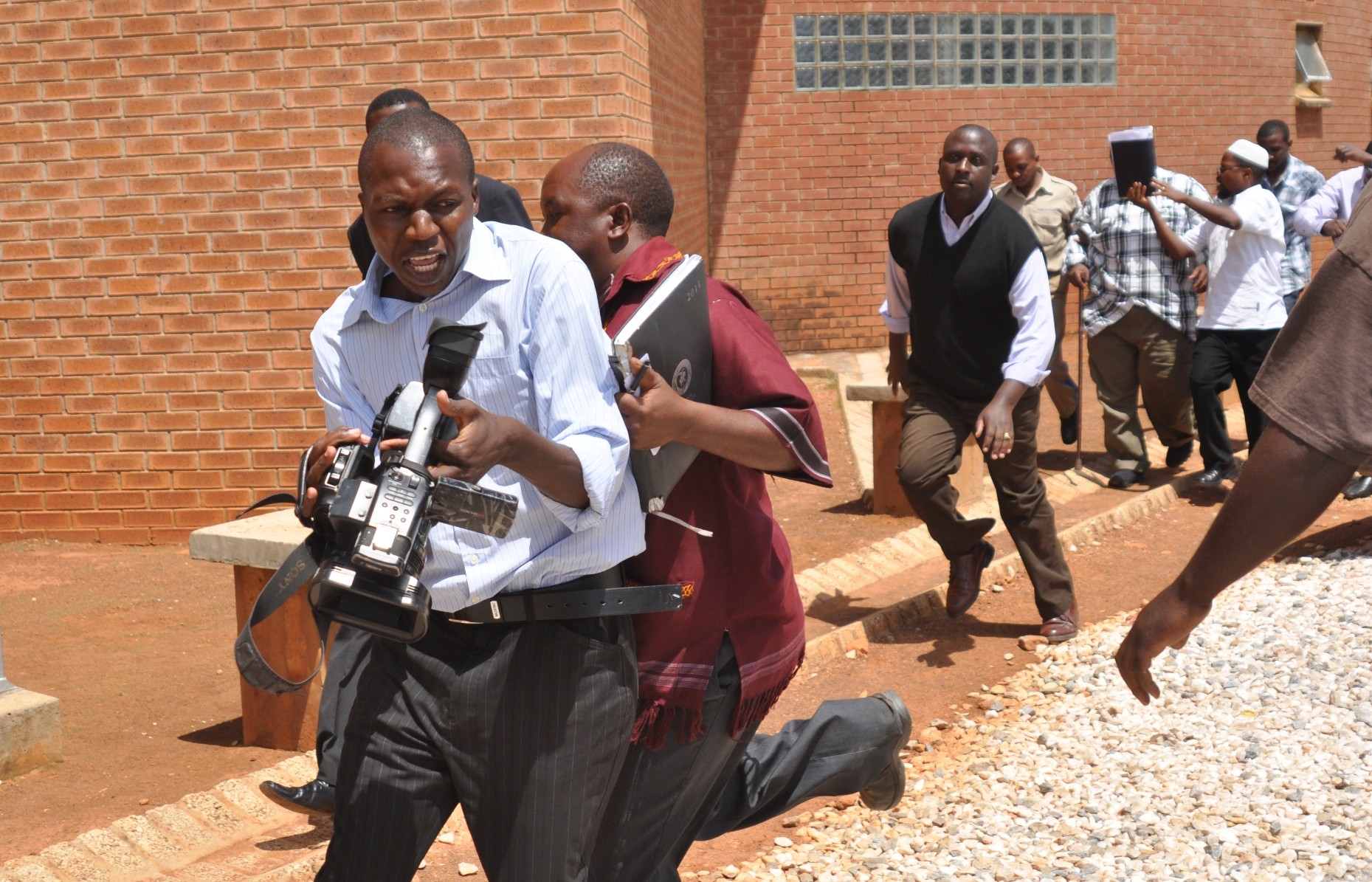
Nigerian authorities have been charged to investigate and hold accountable those responsible for the detention, harassment, and assault of journalists nationwide during the March 9 gubernatorial and state assembly elections.
The task was given by the Committee to Protect Journalists in a statement issued on Thursday, saying it was informed that some journalists who covered the polls were detained and harassed by security services or other armed individuals, denied access to report on polling stations, forced to delete photographs, and assaulted.
“The freedom and fairness of any election requires that journalists are permitted to work unimpeded and without fear,” said Angela Quintal, CPJ Africa program coordinator, in New York. “Nigeria must act to ensure journalists can work safely during elections, and the first step is to hold responsible those who attacked or impeded the media during the recent polls.”
Nonso Isiguzo, a news editor with the privately owned Nigeria Info radio station, told CPJ that he was traveling on election day between polling stations to report on elections in the Ahoada West local government area in Rivers state when armed men, some wearing camouflage uniforms, stopped their Nigeria Info-branded car, told Isiguzo and his driver, Sunday Isiitu, to get out, and took their car keys. Shortly afterwards, a second car carrying five others whom Isiguzo identified as journalists with accredited press tags was also stopped at the same point on the road, he said.
“I said, ‘I’m a journalist. I’m just here to monitor the election’,” Isiguzo told CPJ. But the armed men told Isiguzo, without elaborating, that their “boss” was being held by the military and the journalists would only be released once the boss was free.
The men released Isiguzo, Isiitu, and the other journalists after holding them on the side of the road for two hours, after which Isiguzo did not continue reporting in the area, he told CPJ.
CPJ could not immediately determine the identities of the five people from the second car.
On March 10, Nigeria’s Independent National Electoral Commission (INEC) suspended all election processes in Rivers due to “widespread disruption,” including violence and hostage taking, according to a statement posted on the official election administration body’s verified Twitter account.
Also on election day, Segun Adewale, a local politician known as “Aeroland” and a member of the People’s Democratic Party (PDP), hit and shoved BBC reporter, Ajoke Lijadu-Ulohotse, according to a report by BBC Pidgin, which included video of the incident, and a BBC statement emailed to CPJ.
“We will be notifying the police in due course following an incident involving a BBC reporter in Lagos-Abeokuta on 9 March,” the BBC statement said.
Adewale claimed the BBC “lied” and he did not “beat up a lady,” in a tweet from a social media account linked to his official webpage. CPJ emailed Adewale for comment but received an error message stating that his account was no longer active.
In Damatuzu, a local government area in Nigeria’s northeastern Yobe state, members of the Nigerian military detained for over an hour journalists Musa Mingyi, with the privately owned Blueprint newspaper, and Hamisu Kabir Matazu, of the privately owned Daily Trust newspaper, according to Mingyi and the Daily Trust.
“We told them we are journalists and we are covering [the] election,” Mingyi told CPJ. “They did not harm us, but they denied us access to go do our rightful duties.”
A statement issued on the Nigerian army’s Facebook page by Njoka Irabor, the army’s acting assistant director of public relations, said “no journalist was held hostage” and the journalists’ car was stopped as part of “routine checks on vehicles as part of security measures during the elections.”
CPJ called Irabor repeatedly for comment and was disconnected; texts to his number were not immediately returned.
Kunle Sanni, a reporter for the privately owned Premium Times news website, told CPJ he was held for nearly 30 minutes in the Shendam local government area of Plateau state and forced by three men who identified themselves as “farmers” to delete photos of what he believed were underage voters.
After witnessing Sanni photograph children holding voting cards, the men took him aside, charged his phone because it had died, searched through his apps (including his social media accounts), and deleted images, Sanni said.
“They
[even]
went into the Google backup and deleted [photos],” Sanni said, but added he had already managed to send several photos to his editor.
Collin Ossai, a broadcast reporter with the privately owned Channels TV station, told CPJ that he, his cameraperson, and a radio journalist with Speed FM were blocked from reporting at a polling station in the Esan Central local government area in Edo state.
Ossai said a man identifying himself as a state assembly candidate blocked their car from approaching the polling station at around 7:35 a.m., as the journalists were trying to see if election materials had arrived on time.
Ossai told CPJ that he exited the car and tried negotiate passage with the candidate. But about 10 men surrounded the car and began pushing him and telling him he could not enter the polling station, he said. The journalists left without gaining access, and Ossai said that “big guys” intimidated him into not bringing his camera out while trying to cover several other polling stations in the area.
In Kaduna state, a group of more than 20 men attacked Shinzong Bala, a reporter with the publicly funded Radio Nigeria station, and Amos Tauna, a reporter with the privately owned Daily Post newspaper, while they were investigating alleged election-related arrests and burning cars around the town of Zonkwa’s police station, Bala and Tauna told CPJ.
“We tried to identify ourselves… we were even wearing media vests that were given to us by INEC [the Independent National Electoral Commission],” Bala told CPJ.
The men attacked the journalists with stones and wooden sticks, took Bala’s phone, recorder, and car keys, as well as Tauna’s press pass, the journalists said.
Bala managed to retrieve his belongings after paying the men, but said his clothes were ripped and his body was bruised in the attack. Tauna said his pass was not returned.
CPJ contacted Yakubu Soba, a public relations officer for the Nigerian police in Kaduna, via WhatsApp for comment. Soba requested more specifics about the incident for the police to be able to follow up, which CPJ provided.
During Nigeria’s 2019 federal and state elections, CPJ worked with local civil society and press freedom groups including YIAGA, Civil Society Situation Room, Premium Times Centre for Investigative Journalism, Institute for Media and Society, the Nigerian Union of Journalists, and the Lagos-based International Press Centre to track press freedom issues.
General
QNET’s Global Reach in 100+ Countries: What International Access Means for Local Distributors
Global scale means market access and international supply chains. For individual distributors in direct selling, it can shape everything from product availability to income stability and long-term opportunity.
QNET, the multinational wellness and lifestyle direct selling company, positions its business model around that idea: connecting locally based independent distributors to an international operating platform. With activity spanning more than 100 countries, the company sits within a direct selling industry that, according to the World Federation of Direct Selling Associations (WFDSA), has stabilized after several relatively volatile post-pandemic years.
Global Reach Within a Stabilizing Industry
The WFDSA’s latest global report estimates worldwide direct selling retail sales at roughly $163.9 billion in 2024, essentially flat year over year. That flat performance, however, masks gradual improvement beneath the surface. Nearly half of reporting markets showed growth in 2024, and average market growth rates rebounded to positive territory.
The report estimates more than 104 million independent sales representatives globally in 2024, a figure that has remained largely stable year over year.
This stabilization sets a backdrop for companies like QNET. A global footprint is no longer about rapid expansion alone; it is increasingly tied to resilience: operating across regions with different economic cycles, consumer behaviors, and growth trajectories.
For distributors, this matters because opportunities extend beyond individual effort. They are often shaped by the health of the company’s broader channel and product reach.
A Platform Designed for Distributed Entrepreneurship
QNET’s model centers on local execution supported by centralized infrastructure. Products—ranging from nutritional supplements and wellness devices to home and lifestyle solutions—are sold through the company’s proprietary e-commerce platform. Independent distributors do not manage warehouses, shipment logistics, or customer service systems.
As Ramya Chandrasekaran, who heads communications at QNET, explained in a recent interview, the company views direct selling as a form of accessible “micro-entrepreneurship.” The idea is to reduce the operational burden typically associated with starting a business, allowing distributors to focus on product education, customer relationships, and market development.
Why Global Scale Changes the Distributor Equation
One practical benefit of international reach is product continuity. WFDSA data shows that wellness products account for roughly 29% of global direct selling sales, making it the largest category worldwide. In the Asia-Pacific region, the largest direct selling region by sales, wellness represents more than 40% of total category share.
QNET’s emphasis on wellness and lifestyle products places distributors in line with the strongest demand segments globally. Instead of relying on narrow local trends, distributors operate within product categories that have shown consistent global interest.
International scale also supports consistency in training, compensation structures, and digital tools. Distributors in different countries access identical back-end systems, tracking referrals, commissions, and orders through the same platform. This standardization reduces friction and uncertainty, particularly for individuals operating in markets where informal commerce is common.
Workforce Shifts
The WFDSA’s report highlights notable shifts in the global direct selling workforce. Women continue to make up more than 70% of participants worldwide, and representation among individuals aged 35 to 54 remains the largest cohort.
Independent Distributors increasingly value flexibility, long-term viability, and support systems that allow them to operate sustainably rather than aggressively scale. QNET’s emphasis on digital access, centralized operations, and gradual business building reflects those priorities.
For many participants, especially those balancing work with caregiving or other responsibilities, direct selling infrastructure offers a way to stay engaged at their own pace.
Training, Exposure, and Cross-Market Learning
QNET’s international conventions and training programs connect distributors across regions, creating informal networks for peer learning. Events that draw participants from dozens of countries expose distributors to varied approaches to sales, customer engagement, and market adaptation.
This mirrors one of WFDSA’s broader conclusions: direct selling increasingly functions as a global learning ecosystem, with companies providing tools and education that help individuals navigate uncertain economic conditions.
For distributors, exposure to cross-border experiences can recalibrate expectations, reinforcing that success often comes from steady engagement rather than rapid recruitment or short-term activity.
International Access, Interpreted Locally
Despite its global scale, QNET’s business ultimately plays out in local communities. Distributors adapt messaging around wellness, home quality, and lifestyle enhancement to cultural norms and household priorities. The international platform provides reach and structure, but relevance is built locally.
That balance, global systems supporting local relationships, defines much of modern direct selling. The WFDSA describes the industry not as a single growth story, but as a framework that can scale proportionally with economic conditions across regions.
For QNET distributors, international presence does not guarantee income or uniform outcomes. What it offers is access: to resilient product categories, standardized systems, training resources, and a global marketplace that extends beyond any single region. For local distributors navigating today’s uncertain global economic environment, that is an important foundation to maintain.
General
FCCPC Unseals Ikeja Electric Headquarters
By Adedapo Adesanya
The Federal Competition and Consumer Protection Commission (FCCPC) has unsealed the headquarters of Ikeja Electric Plc in the Lagos State capital after a week under lock and key.
According to a statement on Friday, the electricity distribution company committed to a binding undertaking to comply with the remedial process following consumer rights violations.
The statement signed by Mr Ondaje Ijagwu, Director of Corporate Affairs at the commission, Ikeja Electric undertook to resolve all consumer complaints referred to it by the FCCPC within agreed timelines
The headquarters was earlier sealed on December 11, 2025, because Ikeja Electric allegedly failed to comply with a directive by the Nigerian Electricity Regulatory Commission (NERC) to unbundle a Maximum Demand account into 20 individual accounts for a customer who had been without power for over two and half years.
The FCCPC noted that following the resolution, any breach of the undertaking would expose it to renewed and escalated enforcement action under the Federal Competition and Consumer Protection Act.
Reacting, the Executive Vice Chairman and Chief Executive Officer of the FCCPC, Mr Tunji Bello, said the Commission’s intervention was necessary to enforce the provisions of the FCCPA (2018).
“Our responsibility is to ensure that consumers are treated fairly and that service providers comply with lawful decisions and directives. Enforcement is not an end in itself. Where compliance is achieved and credible commitments are made, the Commission will respond appropriately,” he said.
Clarifying further, Mr Bello said the outcome reflects the commission’s balanced approach to regulation.
“We intervene decisively where consumer harm persists, and we de-escalate where enforceable compliance is secured. What remains constant is our duty to protect consumers and uphold regulatory accountability,” he said.
General
All On’s Clean Energy Access Transforms Over One Million Lives
By Modupe Gbadeyanka
The decision by a leading impact investment company focused on expanding clean energy access, All On, to support over 50 clean energy businesses and provide grants and technical assistance to more than 80 enterprises in Nigeria is already yielding positive results.
This is because the organisation’s Impact Evaluation Report indicated that more than one million lives have been transformed through clean energy access.
The report covered from 2018 t0 2024 and it was discovered that the interventions of All On enabled the connection of over 230,000 households, businesses, and public facilities to reliable energy solutions, while strengthening the operational capacity of energy providers and improving affordability and service reliability for end users.
Prior to the commencement of All On’s operations in 2016, nearly half of Nigeria’s population lacked access to electricity, and the sector faced an estimated 92 per cent annual funding gap.
In response, the group adopted a bold, risk-tolerant strategy—deploying catalytic capital, innovative financing instruments, and ecosystem-building initiatives to unlock private sector participation and drive progress toward universal energy access.
Central to these achievements is All On’s holistic support model, which combines rigorous, tailored due diligence, deep sector expertise, and active ecosystem engagement.
This approach has positioned All On as a trusted partner capable of delivering both commercial viability and systemic impact.
Flagship initiatives such as the Demand Aggregation for Renewable Technology (DART) programme have further amplified results by reducing procurement costs for supported businesses by up to 50 per cent, enabling developers to scale faster and pass cost savings on to consumers due to access to reliable, affordable, and sustainable energy solutions.
In the report, it was revealed that half of supported households reported improved air quality, enhanced safety, and reduced noise pollution, contributing to better health outcomes and improved quality of life, alongside measurable environmental benefits.
“This report confirms that our approach is delivering real results. By combining patient capital, technical assistance, and ecosystem support, we are enabling scalable and sustainable energy solutions for Nigeria’s unserved and underserved communities,” the chief executive of All On, Ms Caroline Eboumbou.
The company plans plans to scale proven models, strengthen local capacity, and expand its reach—particularly in underserved regions such as the Niger Delta.
“While the progress to date is encouraging, our work is far from done. As we look toward 2030, we remain committed to deepening our impact and creating even more meaningful connections across Nigeria,” Ms Eboumbou added.
-
Feature/OPED6 years agoDavos was Different this year
-
Travel/Tourism9 years ago
Lagos Seals Western Lodge Hotel In Ikorodu
-
Showbiz3 years agoEstranged Lover Releases Videos of Empress Njamah Bathing
-
Banking7 years agoSort Codes of GTBank Branches in Nigeria
-
Economy3 years agoSubsidy Removal: CNG at N130 Per Litre Cheaper Than Petrol—IPMAN
-
Banking3 years agoFirst Bank Announces Planned Downtime
-
Banking3 years agoSort Codes of UBA Branches in Nigeria
-
Sports3 years agoHighest Paid Nigerian Footballer – How Much Do Nigerian Footballers Earn