General
Collapsed Buildings: Era of Impunity Over—Buhari Talks Tough
By Dipo Olowookere
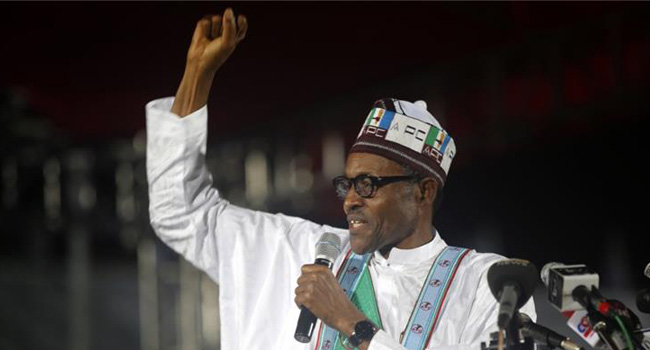
President Muhammadu Buhari Tuesday in Abuja said the dark days of impunity are gone for good, assuring Nigerians that his administration will remain focused and committed to creating an inclusive and diversified economy.
Receiving the leadership of the Nigerian Institute of Quantity Surveyors (NIQS), led by Mr Obafemi Onashile, President Buhari, again, thanked Nigerians for clearly expressing their desire to move the nation forward.
“Let me start by thanking you for your kind prayers,” the President told members of the Institute, who came to congratulate him on his re-election and pledge their solidarity with his administration.
“Nigerians have clearly spoken of their desire for the country to move forward. On our part, we remain committed to the Change Agenda. By the grace of God, and with your continued prayers and support, the dark days of impunity are gone for good,” he added.
President Buhari used the occasion to highlight the administration’s achievements in stimulating the economy in the past three years, noting that growing the nation’s economy means “national growth must impact the silent majority.”
“This is why in the past three years; we focused on key job-creating sectors such as agriculture and infrastructure development.
“You will all recall that our agriculture and infrastructure programmes contributed to our exit from recession. This is a clear example of how, if we push ‘inclusive’ job-creating policies, growth will follow.
“We will remain committed to these and other programmes to ensure the success of our nation is felt by the majority of Nigerians,” he said.
On the incessant building collapses across the country, the President warned that those responsible for such incidents of professional negligence will feel the full wrath of the law.
He told members of the Institute that the recent tragic incident in Lagos, and many others across the country, were reminder of the need to strictly adhere to quality standards on construction projects.
“Young innocent lives must never be lost due to incompetence and greed. Simply put, no corners must be cut. I want to assure you that those responsible for such incidents of professional negligence will feel the full wrath of the law,” he said.
The President welcomed recommendations and suggestions from the Institute on how to enhance the construction industry, directing that they make a formal submission to the Minister of Power, Works and Housing as soon as possible.
In his presentation, the President of NIQS, Onashile appealed to the Federal Government to create a Directorate of Quantity Surveying and Projects Costs Management to address the issue of unclear delineation of professional functions amongst construction professions within the Government.
Onashile also made a case for Quantity Surveyors to be mandated and allowed to undertake cost management of projects of all forms on behalf of Government, among others.
The Institute while congratulating the President on his well-deserved re-election, expressed its support and “total confidence in his administration and leadership direction which have brought hope, progress and stability to Nigeria.”
A highpoint of the visit was the conferment of the Fellowship Grade of the NIQS-the highest cadre of membership- on President Buhari. The President was also honoured with the Life Champion of Anti-Corruption Crusade in Nigeria award.
General
Rivers Speaker, 15 Other Lawmakers Leave PDP for APC
By Modupe Gbadeyanka
The Speaker of the Rivers State House of Assembly, Mr Martin Amaewhule, has defected to the All Progressives Congress (APC).
At the plenary on Friday, Mr Amaewhule joined the ruling party from the opposition Peoples Democratic Party (PDP), along with 15 other members of the state parliament.
This development comes some months after they had earlier declared their support for the APC in the wake of a crisis with the state governor, Mr Sim Fubura.
The lawmakers had an issue with Mr Fubura, which led to a state of emergency declared on the oil-rich state by President Bola Tinubu in March 2025.
This embargo was only lift in September 2025 after the duration of the six-month emergency rule in the state.
A few days ago, members of the Rivers Assembly passed a vote of confidence on President Tinubu, backing him to remain in office till 2031, when he would have spent eight years in office if re-elected in 2027.
Announcing their defection today, the lawmakers pinned their decision on the crisis rocking the PDP at the national level.
It is not certain if their political godfather, Mr Nyesom Wike, who is the current Minister of the Federal Capital Territory (FCT), will join them in APC.
Mr Wike, who governed Rivers State from 2015 to 2023, has been accused of instigating the crisis in the opposition PDP. He was expelled from the party last month at a national convention held in Ibadan, Oyo State.
General
Nigeria Risks Brain Drain in Energy Sector—PENGASSAN
By Adedapo Adesanya
The Petroleum and Natural Gas Senior Staff Association of Nigeria (PENGASSAN) has warned that Nigeria risks massive brain drain in the oil and gas sector due to poor remuneration.
The president of PENGASSAN, Mr Festus Osifo, said at the end of the National Executive Council (NEC) meeting of the union on Thursday in Abuja that the industry was facing challenges arising from Naira devaluation and inflation, noting that, oil and gas skills remained globally competitive.
Painting an example, he said, “A drilling engineer in Nigeria does the same job as one in the US or Abu Dhabi,” noting that the union must take steps to bridge the wage gap to prevent members from leaving the country for better opportunities abroad.
“If we don’t act, the brain drain seen in other sectors will be child’s play,” he said.
According to him, PENGASSAN has recorded significant gains through collective bargaining across oil and gas branches.
“We signed numerous agreements across government agencies, IOCs, service and marketing sectors,” he said.
He said the agreements brought relief to members facing rising costs of living, adding that, the association’s duty is to protect members’ jobs and enhance their pay.
Mr Osifo urged companies delaying salary reviews and those foot-dragging as a result of the prevailing economic realities, to do the needful.
He said the industry employed some of the nation’s best talents, making competitive pay critical to retaining skilled workers.
“This industry recruits the best. Companies must provide the best conditions,” he said.
On insecurity, Mr Osifo urged government to take decisive action against terrorism and kidnappings across the country.
“We are tired of condemnations. government must expose sponsors and protect citizens,” he said.
He urged government at all levels to prioritise tackling insecurity through better funding and equipment for security agencies.
Mr Osifo said PENGASSAN supported calls for state police to improve local security response, adding that decentralising policing will protect citizens better than rhetoric.
He also said economic indicators meant little, if food prices remained high and farmers could not return to farms due to insecurity.
“Nigerians want to see food on the table, not macroeconomic figures,” he said, urging the government to coordinate fiscal and monetary policies to ensure economic gains reach households.
General
Bill Seeking Creation of Unified Emergency Number Passes Second Reading
By Adedapo Adesanya
Nigeria’s crisis-response bill seeking to establish a single, toll-free, three-digit emergency number for nationwide use passed for second reading in the Senate this week.
Sponsored by Mr Abdulaziz Musa Yar’adua, the proposed legislation aims to replace the country’s chaotic patchwork of emergency lines with a unified code—112—that citizens can dial for police, fire, medical, rescue and other life-threatening situations.
Lawmakers said the reform is urgently needed to address delays, miscommunication and avoidable deaths linked to Nigeria’s fragmented response system amid rising insecurity.
Leading debate, Mr Yar’adua said Nigeria has outgrown the “operational disorder” caused by multiple emergency numbers in Lagos, Abuja, Ogun and other states for ambulance services, police intervention, fire incidents, domestic violence, child abuse and other crises.
He said, “This bill seeks to provide for a nationwide toll-free emergency number that will aid the implementation of a national system of reporting emergencies.
“The presence of multiple emergency numbers in Nigeria has been identified as an impediment to getting accelerated emergency response.”
Mr Yar’adua noted that the reform would bring Nigeria in line with global best practices, citing the United States, United Kingdom and India, countries where a single emergency line has improved coordination, enhanced location tracking and strengthened first responders’ efficiency.
With an estimated 90 per cent of Nigerians owning mobile phones, he said the unified number would significantly widen public access to emergency services.
Under the bill, all calls and text messages would be routed to the nearest public safety answering point or control room.
He urged the Senate to fast-track the bill’s passage, stressing the need for close collaboration with the Nigerian Communications Commission (NCC), relevant agencies and telecom operators to ensure nationwide coverage.
Senator Ali Ndume described the reform as “timely and very, very important,” warning that the absence of a reliable reporting channel has worsened Nigeria’s security vulnerabilities.
“One of the challenges we are having during this heightened insecurity is lack of proper or effective communication with the affected agencies,” Ndume said.
“If we do this, we are enhancing and contributing to solving the security challenges and other related criminalities we are facing,” he added.
Also speaking in support, Senator Mohammed Tahir Monguno said a centralised emergency number would remove barriers to citizen reporting and strengthen public involvement in security management.
He said, “Our security community is always calling on the general public to report what they see.
“There is a need for government to create an avenue where the public can report what they see without any hindrance. The bill would give strength and muscular expression to national calls for vigilance.”
The bill was referred to the Senate Committee on Communications for further legislative work and is expected to be returned for final consideration within four weeks.
-
Feature/OPED6 years agoDavos was Different this year
-
Travel/Tourism9 years ago
Lagos Seals Western Lodge Hotel In Ikorodu
-
Showbiz3 years agoEstranged Lover Releases Videos of Empress Njamah Bathing
-
Banking7 years agoSort Codes of GTBank Branches in Nigeria
-
Economy2 years agoSubsidy Removal: CNG at N130 Per Litre Cheaper Than Petrol—IPMAN
-
Banking3 years agoFirst Bank Announces Planned Downtime
-
Banking3 years agoSort Codes of UBA Branches in Nigeria
-
Sports3 years agoHighest Paid Nigerian Footballer – How Much Do Nigerian Footballers Earn


1 Comment