Connect with us

Economy

London Stock Exchange Admits Finablr Shares

Published

on

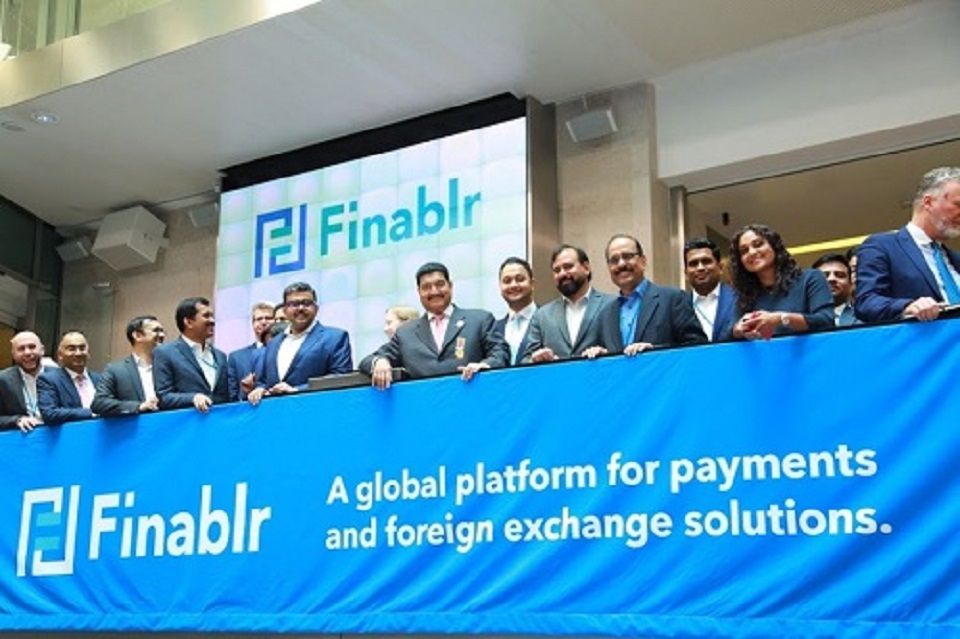
London Stock Exchange (LSE) has welcomed Finablr Plc, a global payments and foreign exchange company, to open London’s markets for trading and to celebrate the listing of the company’s shares on the Premium Segment of the Main Market of London Stock Exchange.

Finablr is a global platform for Payments and Foreign Exchange solutions underpinned by modern proprietary technology.

With deep regulatory know-how, a relentless focus on innovation and leading industry partnerships, Finablr group companies provide a broad array of tailored and trusted financial solutions for consumers and businesses.

The company is primed for growth as it benefits from structural drivers, such as the globalisation of commerce driven by migration and mobility, cross-border trade, growth of e-commerce and the creation of connected communities.

Through category-renowned brands, including UAE Exchange, Travelex, Xpress Money, Unimoni, Remit2India, Ditto and Swych, Finablr  sits  at  the  centre  of  these  intersecting  trends,  with  an  ability  to  serve  both  the  end consumer and global corporates.

Finablr is present across the entire payments and foreign exchange value chain, from origination to processing to last-mile distribution.

An integrated platform is at the heart of the company’s proposition, supporting its omni-channel strategy with  best-in-class  operating capabilities and connectivity to global payment networks. This allows the company to develop a deep understanding of its customers’ requirements and deliver a range of solutions tailored to their lifestyle and business needs.

In 2018, the company managed over 150 million transactions, shifting the equivalent of $115 billion in volumes for its customers. Finablr has a broad global reach spanning over 170 countries and has relationships with more than 100 regulators.

The truly global reach of the company, sophistication of its technology and the economies of scale of its platform have made Finablr a partner of choice for leading global banks, financial institutions, retailers, mobile wallet providers and payment and technology companies.

Dr  B  R  Shetty,  Founder  and  Chairman  of  Finablr  said:  “Today  marks  a  momentous milestone for Finablr and the beginning of an exciting new era to support the ever-evolving needs of a global customer and I would like to take this opportunity to thank our global patrons for their trust and faith in our commitment.”

Dr Shetty, Finablr’s largest shareholder and acknowledged by investors for star-studded track record of all round value creation, had bought UK-based Travelex in 2015 $1.1 billion.

The Finablr, as a group, has a global presence in over 170 countries, managed $114.5 billion in annual volumes for its clients in 2018. The group, comprises of UAE Exchange, Travelex Holdings and Xpress Money, among others, has been seeking to raise $200 from the IPO.

Promoth Manghat, Group Chief Executive Officer of Finablr said: “We are delighted that Finablr has joined the London Stock Exchange’s Premium Market, providing a new platform to grow over the coming years.

“We are very confident about the long-term prospects of the payments and foreign exchange solutions and the overarching presence of technology in such transactions and remain committed to generating the greatest value for our all our shareholders.”

Amidst unstable global macro and micro market situations bringing uncertainty in the broader socio-economic conditions, a rational price revision to 175 pence per share, down from an initially anticipated range above 200 pence, gave Finablr an implied market value of about $1.59 billion, said the bookrunner.

Books were covered at full value of the deal worth 192.5 million shares, thereby making the share offering to raise about £337 million. The deal size shall include a revised base deal size of 175 million shares and 17.5 million of over-allotment option shares.

The group claims to have built on the strength of their technology platform to provide best in class payments experiences to consumers and businesses. The group further claims that they are very well positioned to capture the future opportunities.

Dr.  B  R  Shetty  concluded  with  his  words,  “We  have  grown  with  a  principle  theme  of Customer Service as our Currency and our endeavor would always be to serve the last person in the queue with equal zeal and care.”

Barclays, Goldman Sachs and J.P. Morgan Cazenove acted as Joint Global Co-ordinators and Joint Bookrunners, with EFG-Hermes, BofA Merrill Lynch and Numis also acting as Joint Bookrunners to the listing. Evercore acted as financial adviser to Finablr.


Modupe Gbadeyanka is a fast-rising journalist with Business Post Nigeria. Her passion for journalism is amazing. She is willing to learn more with a view to becoming one of the best pen-pushers in Nigeria. Her role models are the duo of CNN's Richard Quest and Christiane Amanpour.

Click to comment

Leave a Reply

Your email address will not be published. Required fields are marked *

Economy

Tanzania Tasks Africa to Prioritise Economic Integration Through Industrialisation

Published

on

Dangote Tanzania

By Aduragbemi Omiyale

African leaders have been advised to focus on economic integration through industrialisation, as this would make the continent a formidable force in the global market.

This charge was given by the Minister of State in the Tanzanian President’s Office responsible for Planning and Investment, Prof. Kitila A. Mkumbo, during a visit to the Dangote Petroleum Refinery and Petrochemicals in Lagos.

“Africa now needs economic liberation, and that can only come through industrialisation,” he said, describing Mr Aliko Dangote as Africa’s leading industrialist whose investments are increasingly extending beyond Nigeria to support development across the continent.

He added that Tanzania looks forward to working with Dangote Group as part of a broader vision of accelerating Pan-African industrialisation and strengthening regional manufacturing capacity.

The Minister also highlighted the importance of local refining capacity in improving Africa’s energy security, particularly in light of recent disruptions in global oil markets.

Referring to the impact of tensions around the Strait of Hormuz on global fuel prices, he said increased refining capacity from facilities such as the Dangote Petroleum Refinery would help cushion African economies against external shocks.

According to him, affordable and reliable energy remains one of the most important drivers of economic development, noting that expanded refining capacity across the continent would contribute significantly to lowering energy costs and improving the quality of life for millions of Africans.

The Tanzanian delegation was in Nigeria to follow up on discussions held earlier this year between President Samia Suluhu Hassan and Mr Dangote regarding the expansion of Dangote Group’s investment footprint in Tanzania.

The East African nation reaffirmed its commitment to deepening economic cooperation with Dangote Group, expressing strong interest in attracting new investments in fertiliser production, energy and industrial infrastructure to support the country’s long-term development agenda.

“We have come here to make a follow-up on what they deliberated with our President in terms of further Dangote investments in Tanzania,” Mr Mkumbo said.

Continue Reading

Economy

Champion Breweries to Strengthen Market Position

Published

on

champion breweries uyo

By Aduragbemi Omiyale

One of the leading brewers and beverage companies listed on the Nigerian Exchange (NGX) Limited, Champion Breweries Plc, has expressed its commitment to strengthening its market position.

The beer maker gave this assurance while reacting to its financial performance for the first half of 2026, which was strong, driven by solid commercial performance, improved operational efficiencies, and the successful expansion of its business portfolio following the acquisition of EnjoyBev B.V.

In the period under review, the organisation boosted its growth platform through strategic investment, delivered resilient operating performance, and successfully transitioned to a new group structure.

Its revenue reached N35.73 billion, while second-quarter revenue amounted to N21.37 billion. Operating profit stood at N6.17 billion, and profit after tax attributable to the group was N2.65 billion, with second-quarter profit after tax of N1.76 billion.

The firm also successfully completed the acquisition of an 80 per cent equity interest in EnjoyBev B.V., strengthened its capital base through a successful capital raising programme that increased shareholders’ equity to N69.08 billion, and maintained full compliance with NGX free float requirements, with free float increasing to 25.72 per cent as of June 30, 2026.

“The first half of 2026 marks a defining chapter in Champion Breweries’ journey. We have not only delivered a strong operating performance but also successfully transformed our business into a broader beverage group with an expanded platform for sustainable growth.

“While higher finance costs associated with our strategic investment programme impacted profitability during the period, our underlying business remains strong.

“The combination of disciplined commercial execution, continued investment in our brands and route-to-market capabilities and improving operational efficiency positions us well for future growth.

“We remain focused on creating long-term value for shareholders, strengthening our market position, and capturing the opportunities presented by our expanded business platform,” the acting chief executive of Champion Breweries, Mr Rasheed Adebiyi, said.

Continue Reading

Economy

How Digital Payments Are Changing the Way Global Businesses Operate

Published

on

crypto payment

For businesses operating across borders, payments are no longer simply the final step in a transaction. The way money moves can influence where a company sells, how quickly it can enter a new market, and how easily customers can complete a purchase. As digital payment methods become more diverse, businesses are adjusting not only their checkout options but also the way payment processes fit into wider operations.

This shift is particularly visible in international commerce. A company can now serve customers in multiple markets without relying on a single payment method or a traditional physical presence in each location. Digital payments have become part of the infrastructure that supports increasingly distributed business models.

A More Connected Payment Environment

Global commerce has created a more complicated payment environment. Customers in different countries may have very different expectations about how a purchase should be paid for. Some markets rely heavily on cards, while others have seen rapid adoption of digital wallets, bank-based payment methods, or other local alternatives.

For businesses, this variety creates both opportunities and practical challenges. Offering payment options that customers recognize can reduce friction during a transaction, while supporting several markets may require businesses to work with different payment technologies and providers.

Digital payments have therefore become closely connected to market expansion. A company entering a new country does not only need to consider demand for its products or services. It also needs to understand how customers in that market prefer to pay and whether its existing payment setup can accommodate those expectations.

6a7b071354914.webp

More Choices for Businesses and Customers

The growth of digital payments has expanded the range of choices available on both sides of a transaction.

Consumers can increasingly choose between cards, digital wallets, bank transfers, mobile payment methods and other forms of electronic payment. Businesses, meanwhile, can select from different technologies and payment providers depending on their markets and operational requirements.

This development has changed the role of payments in the customer experience. Payment is no longer necessarily treated as an isolated technical process that begins only after a purchasing decision has been made. The available options can influence whether a customer completes a transaction in the first place.

For international businesses, flexibility can be particularly important. A payment method that is familiar and convenient in one market may be less relevant in another. Supporting a broader selection can allow businesses to adapt their payment experience without changing the underlying product or service.

The Rise of Alternative Payment Models

Traditional card and bank-based payments remain important, but the digital payments landscape has expanded beyond these established methods. Digital wallets, account-to-account payments, mobile solutions and cryptocurrency have all contributed to a broader definition of what a digital transaction can look like.

Cryptocurrency remains a smaller part of the overall payments landscape, but it has created another category of payment technology for businesses to consider. Specialized solutions such as BitHide can provide businesses with tools for handling crypto payments as part of their broader payment operations.

The significance of this development is not necessarily that every business will adopt cryptocurrency. Rather, it demonstrates how the payment landscape continues to diversify. Businesses operating internationally can increasingly choose from different models instead of relying on a single approach across every market.

Payments Are Becoming Part of Business Operations

As payment systems become more digital, their role increasingly extends beyond accepting money from customers. Payment processes can interact with accounting, order management, customer records and other parts of a company’s digital operations.

This is particularly relevant for businesses with large transaction volumes or customers in multiple countries. Manual payment processes can become difficult to manage as the number of transactions, currencies and payment methods increases. Digital systems can help businesses organize these processes within a wider operational framework.

The result is a gradual shift in how companies think about payments. Instead of treating payment processing as a separate function, businesses are increasingly considering it alongside other elements of their digital infrastructure.

This does not mean that every company needs a complex payment setup. The appropriate approach depends on the business model, target markets, transaction volumes and types of customers involved. For some companies, a small number of established payment methods may be sufficient. Others may need a more flexible arrangement because of the markets they serve.

Adapting to Different Markets

One of the more important changes brought by digital payments is the ability to adapt payment experiences to different markets.

International businesses often face differences in consumer behavior, financial infrastructure and preferred payment methods. A payment strategy that works well domestically may therefore require adjustments when a company expands internationally.

Digital payment technology can make these adjustments more practical, but it does not remove the need for local market knowledge. Businesses still need to understand customer preferences, applicable requirements and the practical costs associated with different payment methods.

This makes payment strategy part of international expansion rather than an issue that can be addressed only after a new market has been entered.

What Comes Next for Global Businesses

The digital payments market is likely to continue becoming more diverse as businesses and customers adopt new ways of moving money. The important change may not be the replacement of one payment method by another, but the growing ability to combine different methods according to the needs of a particular business or market.

For global companies, this creates an emphasis on adaptability. Payment systems need to support the way a business operates rather than becoming a limitation on where and how it can sell.

Digital payments are consequently becoming more than a convenient alternative to cash or traditional payment processes. They are increasingly connected to international commerce, customer experience and day-to-day business operations. As payment options continue to develop, companies that can adapt their payment strategies to different markets will be better positioned to operate in an increasingly digital global economy.

Continue Reading