Banking
Ecobank Deepens Financial Inclusion via Tech
One of the lenders making efforts to reach the unbanked and under-banked in the country is Ecobank Nigeria. The company has been pushing the frontiers of financial inclusion by leveraging on technology with the introduction EcobankPay, Xpress Agency Points and other digital platforms into the market space.
These products have provided key solutions to address the rapid shift to mobile payment and the adoption of digital channels across the country.
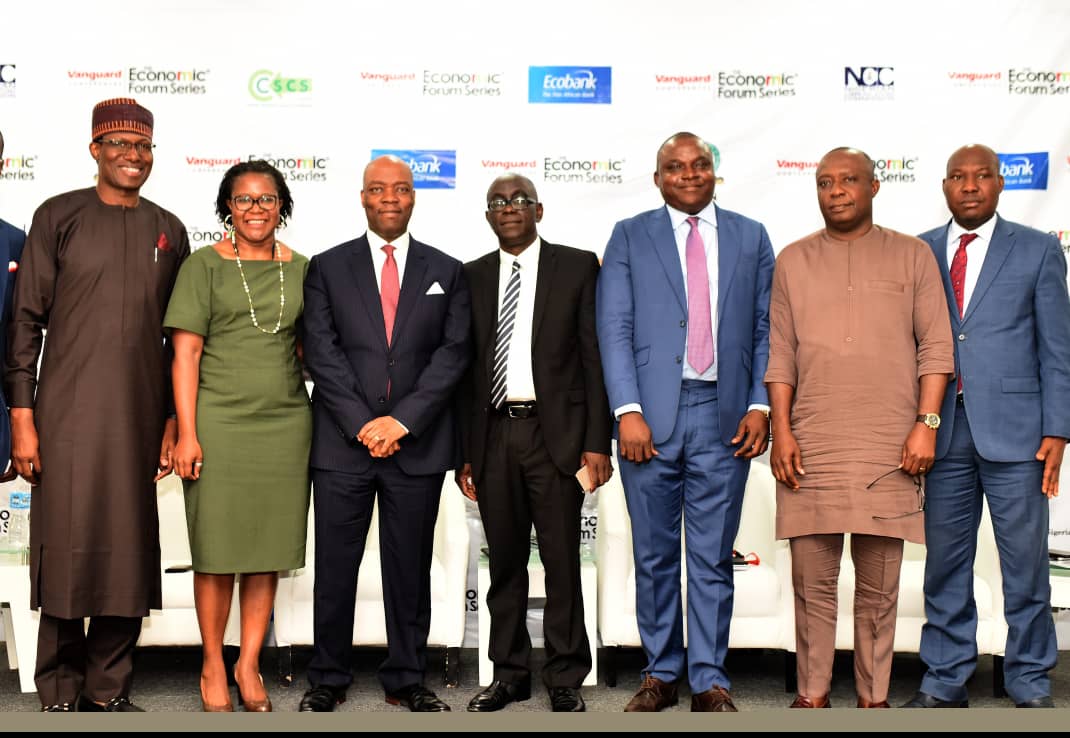
Confirming this was the Managing Director of Ecobank Nigeria, Mr Patrick Akinwuntan, who spoke at the Vanguard Economic Forum series on mobile money market and Fintech, with the theme Leveraging Fintech Innovation for Unlocking Growth and Competitiveness in Nigeria’s Mobile & Payment Ecosystem.
During the event held in Lagos, Mr Akinwuntan pointed out that Nigeria, which has improved financial inclusion from 47 percent to 63 percent in the last decade, remains a dynamic market with a lot of opportunities for digital financial expansion.
He stated that Ecobank has built an ecosystem that leverages digital technology to bring affordable, easy and convenient financial services to the people and businesses.
He described EcobankPay as “a lifestyle scan and pay digital payment and collection service which accepts payments from other platforms – mVisa, Masterpass and mCash.
“Payment can be made with any phone by scanning the QR code or using USSD at merchant locations,” he explained, adding that, “It’s unique offering, is its interoperability, that is, all bank customers in Nigeria can pay through their accounts in other banks.
“It is free to set up, as the shop owner only needs his/her QR code and phone for notifications to start receiving quick and easy payments. Merchant QR can also be set up via Facebook Messenger as well as USSD payment for low-income phone users.”
He noted that EcobankPay “is currently available at over 90,000 merchant locations across the country. This is in addition to over 6,000 Xpress point agent locations in the country.
“Also, we have over 8 million mobile banking subscribers across the Ecobank Group. Our Ecobank Mobile App is unique, as it is one universal app available in 33 countries where we operate in Africa.
“Furthermore, Ecobank has so far set up EcobankPay Zones in over 50 locations in different parts of the country. These are digital hubs enabling businesses within a location adopt Ecobank’s wide range of digital products for ease of payments for goods and services. The payment options at the zones include EcobankPay, Xpress points, Automated Teller Machines (ATMS) and Point of Sale (PoS)”.
Mr. Akinwuntan said also that the banks’ strategy includes collaboration with Fintechs to surmount the financial inclusion and adoption of financial services challenge.
Quoting the Efinafintech 2018 report, he noted that “there is an increased partnership with Fintechs as Nigeria is currently home to over 250 Fintechs and approximately 60 percent of them supporting payments and lending capabilities.”
“The cumulative Fintech funding by banks in Nigeria has surpassed $250 million in the past five years,” he pointed out.
“Ecobank hosts an annual Africa Fintech challenge and we are providing support infrastructure for Fintechs that excel at the challenge.
“At Ecobank our vision and mission focuses on providing Africans affordable and easy to access financial products and services. We believe innovation and technology could help remove barriers to 24/7 access to financial services through the use of self-service applications.”
He also noted that increasing mobile phone penetration has been a key enabler whilst the positive regulatory regime of the Central Bank is driving financial inclusion and seamless payment services initiatives in the country.
While commending Vanguard newspaper for organizing the event and choice of the theme and the Central Bank of Nigeria (CBN)’s various initiatives targeted at promoting and creating enabling environment for mobile banking to thrive in the country, he made case for collaboration of all stakeholders to achieve the desired result.
Deputy Director, Payment System Department, CBN, Musa Jimoh, in his goodwill message at the forum said: “Cost of service is one of the reasons why people refuse to use some banking services including mobile money.
“So, we came out with a guidelines to bank charges to make sure that we regulate the charges and we have also come out with some other initiatives under the cashless scheme to see how we can bring people to the digital channel and reduce the high cost of operations in the bank. “There are several initiatives that CBN is pushing to ensure the mobile money operators grow and help us deepen financial inclusion.”
Earlier in her presentation, Professor Olayinka David-West, Academic Director, Lagos Business School, LBS, explained that financial inclusion is the access to unleash affordable financial services to the huge population of the unbanked and the under-banked in the society. She stated: “Affordable financial service is important because not everybody can afford to pay for account maintenance of N500 a month. “To address financial inclusion, innovation is important because it will help us address the easy access to financial services. It has nothing to do with literacy; it is about how do we design it knowing the capabilities of the people we are trying to serve.”
Ecobank is a leading pan-African bank with an unrivalled platform in Africa. Its vision is to build a world class Pan African bank contributing to the socioeconomic development of Africa, while also providing customers convenient accessible and reliable financial products and services.
Banking
OneDosh Raises $3m to Build Stablecoin-Powered Infrastructure for Cross-Border Payments
By Adedapo Adesanya
OneDosh, a fintech company focused on stablecoin-powered payments, has raised $3 million in pre-seed funding to develop infrastructure aimed at improving how individuals and businesses move money across borders.
The firm, co-founded in February 2025 by the trio of Mr Jackson Ukuevo, Mr Godwin Okoye, and Mr Babatunde Osinowo, was shaped by the founders’ firsthand experiences navigating blocked cards, frozen accounts, delayed international transfers, and currency restrictions while living and travelling globally. These challenges highlighted a consistent gap between the demand for seamless global payments and the systems available to support them.
Now, OneDosh operates in the United States and Nigeria, two active remittance corridors with strong demand for faster and more flexible payment solutions. Through our platform, users can transfer funds from the U.S. to Nigeria, hold value in stablecoins, and spend using stablecoin-powered cards compatible with Apple Pay and Google Pay, subject to network and regional availability.
Commenting on OneDosh’s mission, Mr Ukuevo said, “Millions of people are locked out of efficient cross-border payments because legacy systems are slow, expensive, and restrictive. OneDosh is building the infrastructure to change that, starting with the U.S.-Nigeria corridor and expanding from there. This funding helps us turn stablecoins into practical payment solutions for real people and businesses.”
“Beyond our current consumer-facing products, we are building payment infrastructure designed to connect wallets, cards, and markets into a single programmable system. Our approach focuses on enabling compliant, real-world use cases for stablecoins, particularly in regions where traditional cross-border payment systems remain costly or inefficient,” he added.
OneDosh’s founding team brings experience from organisations such as ZeroHash, Plaid, and Amazon, with backgrounds spanning payments infrastructure, compliance operations, and large-scale product development.
The pre-seed funding will be used to expand into additional payment corridors, deepen liquidity partnerships, and support senior team hires. These efforts are intended to boost capacity to support cross-border spending and settlement use cases as adoption of digital payment technologies continues to grow.
With the increasing interconnectedness of global commerce, OneDosh aims to contribute infrastructure designed to support faster, more accessible cross-border payments using stablecoins as a settlement layer.
Banking
EFCC Accuses Banks of Aiding N18.7bn Investment, Airline Discount Scams
By Modupe Gbadeyanka
One new generation bank and six financial technology (fintech) and microfinance banks have been accused of aiding fraudsters in defrauding Nigerians through fraudulent schemes.
This allegation was made by the Economic and Financial Crimes Commission (EFCC) while addressing the media in Abuja on Thursday.
The Director of Public Affairs of the EFCC, Mr Wilson Uwujaren, said these schemes involved about N18.7 billion fraudulent investment and airline discount scams.
He disclosed that in the airline discount fraud, fraudsters lure their victims to lose their hard-earned money by involving “a string of carefully devised airline discount information that any unsuspecting foreign traveller will fall for.”
“What they do is to advertise a discount system in the purchase of flight tickets of a particular foreign carrier. The payment module is designed in such a way that their victims would be convinced that the payment is actually made into the account of the airline. No sooner the payment is made than the passenger’s entire funds in his bank account are emptied,” he narrated to newsmen.
According to him, over 700 victims have fallen into the trap of fraudsters through the scheme with a total loss of N651.1 million to them.
Though the commission succeeded in recovering and returning N33.6 million to victims of the scam, Mr Uwujaren cautioned Nigerians to be more vigilant as foreign actors involved in the scheme are converting their illicit sleaze into cryptocurrency and moving them into safer destinations through Bybit.
Narrating the second scheme, the EFCC spokesman said it involved a company named Fred and Farid Investment Limited, simply called FF investment, which lured Nigerians into bogus investment arrangements.
He said over 200,000 victims have been defrauded in this regard, with about N18.1 billion raked in through nine companies offering diverse investment packages. .
In all, more than 900 Nigerians have been fleeced by fraudsters through the connivance of banks.
Mr Uwujaren claimed foreign nationals are behind the schemes, with three Nigerian accomplices who have been arrested and charged to court.
On the specific role of banks and fintechs in the schemes, two other directors of the EFCC, Abdulkarim Chukkol in charge of Investigations, and Mr Michael Wetcas in charge of Abuja Zonal Directorate, explained that, “a new generation bank and six fintechs and microfinance banks are involved in this. The financial institutions clearly compromised banking procedures and allowed the fraudsters to safely change their proceeds into digital assets and move into safe destinations”
“A total of N18,739, 999,027.35 had been moved through our financial system without due diligence of customers by the banks. It is worrisome that investigations by the commission showed that cryptocurrency transactions to the tune of N162 billion passed through a new generation bank without any due diligence. Investigations also showed that a single customer maintained 960 accounts in the new generation bank and all the accounts were used for fraudulent purposes.”
The EFCC called on regulatory bodies to bring financial institutions to compulsory compliance with regulations in the areas of Know Your Customers (KYC), Customer Due Diligence (CDD), Suspicious Transaction Reports (STRs) and others.
The agency charged regulatory bodies that Deposit Money Banks (DMBs), fintechs, MFBanks found to be aiding and abetting fraudsters should be suspended and referred to the EFCC for thorough investigation and possible prosecution.
It also warned that negligence and failure to monitor suspicious and structured transactions by banks would no longer be allowed, assuring that it will continue its work against money laundering by fraudulent actors.
Mr Uwujaren also tasked financial institutions to firm up their operational dynamics and save the nation from leakages and compromises bleeding the economy.
Banking
Nigeria Records Significant Decline in Payment Fraud Losses
By Adedapo Adesanya
The Nigeria Inter-Bank Settlement System (NIBSS) Plc has disclosed that electronic payment fraud losses declined significantly in 2025 due to coordinated actions by regulators, security agencies and industry operators.
Speaking at the 2026 Nigeria Electronic Fraud Forum (NeFF) Technical Kick-Off Session in Lagos, attended by regulators, banks, payment service providers, identity agencies and law enforcement agencies, the chief executive of NIBSS, Mr Premier Oiwoh, said the development showed the need to strengthen collaboration to sustain recent declines in electronic fraud and support deeper digital inclusion.
“The reduction in electronic payment fraud losses was recorded despite rising transaction volumes.
“We can only attribute this improvement to interventions by CBN, the Nigerian Financial Intelligence Unit (NFIU), security agencies and enhanced monitoring across the payments ecosystem,” he disclosed, noting, however, that internet banking and e-commerce remained the main fraud channels, with social engineering and insider-assisted fraud emerging as dominant trends.
The NIBSS boss said the gains recorded could only be sustained through stricter controls, stronger regulatory compliance and industry-wide collaboration.
He stressed zero tolerance for non-reporting of fraud, warning that weak reporting, poor identity verification and abuse of transaction limits continued to expose the system to risks.
Mr Oiwoh pointed out that the effective Know-Your-Customer (KYC) and Know-Your-Device (KYD) processes, supported by real-time validation of NIN and BVN, were critical to curbing fraud.
He added that stronger reporting requirements, joint industry action and a central “Persons of Interest” database—covering over 13,000 individuals—had improved detection and prevention.
He disclosed that the NIBSS was working with the CBN and other stakeholders on advanced AI-driven monitoring tools and a new national payment infrastructure to further strengthen fraud prevention and deepen financial inclusion.
Also speaking, the Deputy Governor, Financial System Stability, CBN, Mr Philip Ikeazor, said sustained cooperation under NeFF since 2011 had strengthened the resilience and security of Nigeria’s payments system.
Mr Ikeazor, represented by Mr Ibrahim Hassan, Director, Development Finance Institutions Supervision Department, said the sustained cooperation had reduced fraud losses in spite of rapid growth in digital transactions.
He highlighted industry achievements, including migration to EMV chip-and-PIN cards, two-factor authentication, enhanced transaction monitoring, centralised fraud reporting, and the integration of the Bank Verification Number (BVN) with the National Identification Number (NIN).
“Emerging threats such as social engineering, SIM-swap abuse, insider compromise and Authorised Push Payment (APP) scams require faster, integrated and proactive responses.
“The industry is committed to reducing fraud response times to under 30 minutes and to adopt enterprise-wide fraud management systems leveraging real-time analytics and shared intelligence,” the deputy governor said.
On her part, Mrs Rakiya Yusuf, Director, Payments System Supervision Department, CBN, and Chairman, Nigeria Electronic Fraud Forum (NeFF), urged continued coordinated action by regulators, banks, payment providers and law enforcement agencies.
Mrs Yusuf highlighted gains such as EMV chip-and-PIN migration, two-factor authentication, and improved identity management.
She warned that emerging threats required standardised frameworks, faster response times, and proactive use of ISO 20022 and analytics to sustain fraud reduction, expressing confidence that the forum’s deliberations would reinforce the foundations for a safer and more trusted digital financial ecosystem in Nigeria.
-
Feature/OPED6 years agoDavos was Different this year
-
Travel/Tourism9 years ago
Lagos Seals Western Lodge Hotel In Ikorodu
-
Showbiz3 years agoEstranged Lover Releases Videos of Empress Njamah Bathing
-
Banking8 years agoSort Codes of GTBank Branches in Nigeria
-
Economy3 years agoSubsidy Removal: CNG at N130 Per Litre Cheaper Than Petrol—IPMAN
-
Banking3 years agoSort Codes of UBA Branches in Nigeria
-
Banking3 years agoFirst Bank Announces Planned Downtime
-
Sports3 years agoHighest Paid Nigerian Footballer – How Much Do Nigerian Footballers Earn