Economy
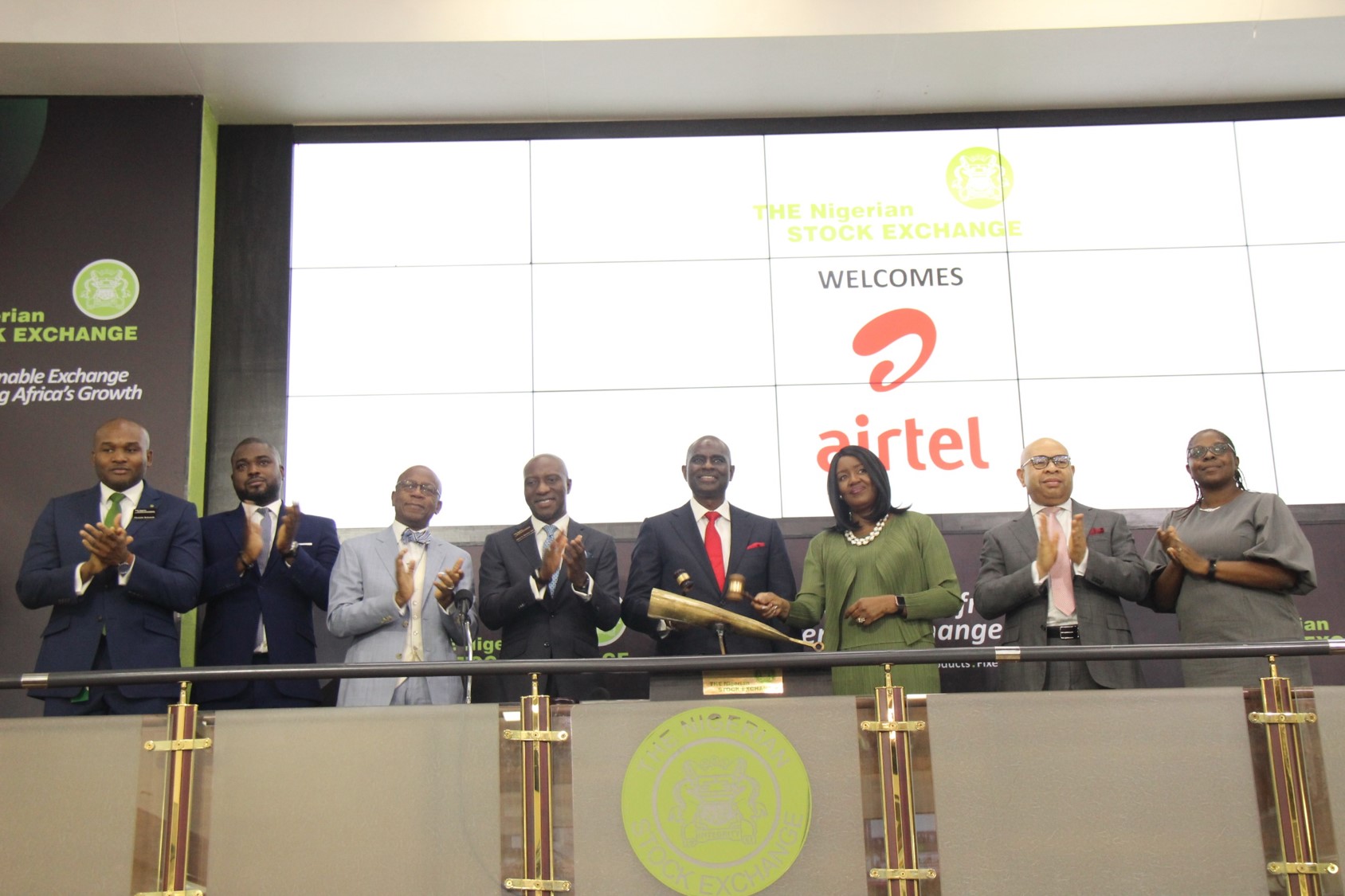
Airtel Africa Tops Price Gainers Chart as Index Picks 1.28%
By Dipo Olowookere
The second largest telecommunications company in Nigeria, Airtel Africa Plc, led the price gainers table on Friday after adding N26.50k to its share value to settle at N350 per unit.
The stock was among the 31 counters that appreciated during the trading session as against the eight equities which depreciated.
It was the first price appreciation shares of the telco were recording this week and in a long time since they were admitted on the Nigerian Stock Exchange (NSE) Tuesday, July 9, 2019.
Seplat occupied the second position after going up by N10 to finish at N460 each, Okomu Oil gained N4.25k to settle at N48.40k per share, Forte Oil improved by N1.20k to end at N16.55k per unit, while Cadbury Nigeria increased by 85 kobo to close at N10.75k per share.
At the other side, Stanbic IBTC picked the top spot after shedding 75 kobo to close at N35 per share, while Lafarge Africa followed with a loss of 15 kobo to end at N14.70k per share.
Oando went down by 11 kobo to finish at N3.80k per unit, Champion Breweries declined by 8 kobo to close at N1.30k per share, while Axa Mansard decreased by 4 kobo to finish at N1.71k per unit.
At yesterday’s trading session, the market closed 1.28 percent with the market capitalization increasing by N171.5 billion to close at N13.523 trillion, while the All-Share Index (ASI) appreciated by 352.36 points to settle at 27,779.00 points.
The level of transactions improved at the market with the number of deals, volume of trades and the value of shares exchanged by investors increasing by 16.12 percent, 43.25 percent and 206.82 percent respectively.
Business Post reports that a total of 165.3 million shares worth N2.6 billion were traded in 3,270 deals in contrast to the 115.4 million equities worth N854.3 million transacted in 2,816 deals on Thursday.
GTBank was the most actives stock at the session with a turnover of 42.5 million shares worth N1.2 billion sold, with Zenith Bank trailing with 22.5 million equities worth N427.8 million.
Mutual Benefits Assurance traded 13.4 million stocks valued at N2.8 million, UBA exchanged 12.4 million equities for N77.4 million, while FBN Holdings transacted 8.8 million shares worth N47.8 million.
Economy
Naira Strengthens to N1,379/1$ at Official Market
By Adedapo Adesanya
The Naira appreciated against the US Dollar by N3.95 0r 0.29 per cent to exchange at N1,379.68/$1 in the Nigerian Autonomous Foreign Exchange Market (NAFEX) on Tuesday, June 30, compared with the previous day’s N1,383.63/$1.
The positive movement was also seen against the Pound Sterling at the same official market window, where it gained N6.59 to trade at N1,825.05/£1 versus the preceding day’s N1,831.64/£1, and improved against the Euro by N5.05 to sell for N1,572.98/€1 compared with Monday’s price of N1,578.03/€1.
At the GTBank FX counter, the Nigerian Naira, however, lost N2 against the Dollar yesterday to quote at N1,389/$1, in contrast to the previous session’s N1,387/$1, and at the black market, it remained unchanged at N1,395/$1,
A look at the cryptocurrency market yesterday showed that Bitcoin (BTC) depleted for the fifth straight day, selling at $58,668.93. This sits below the levels that sparked rebounds in February and earlier in June, as well as the 50-day and 200-day moving averages.
Dogecoin (DOGE) crashed by 1.5 per cent to sell at $0.0713, Binance Coin (BNB) lost 1.4 per cent to close at $544.98, Ethereum (ETH) went down by 1.0 per cent to $1,574.60, TRON (TRX) depreciated by 0.8 per cent to $0.3164, and Ripple (XRP) dropped 0.8 per cent to finish at $1.03.
Conversely, Cardano (ADA) grew by 2.9 per cent to $0.1493, and Solana (SOL) increased by 0.3 per cent to $74.19, while the US Dollar Tether (USDT) and the US Dollar Coin (USDC) traded flat at $1.00 apiece.
Economy
Oil Market Gains as Iran-US Negotiations Face Fresh Uncertainty
By Adedapo Adesanya
The oil market rose on Wednesday morning amid concerns that breakdowns in discussions between Iran and the United States for a final agreement to end their war may extend supply disruptions in the key Middle East producing region.
Brent futures gained 33 cents or 0.45 per cent to trade at $73.28 a barrel, while the US West Texas Intermediate (WTI) crude climbed 34 cents or 0.49 per cent to $69.84 a barrel.
US officials arrived in Qatar for talks on the Iran war, but will meet with mediators, not Iranian negotiators. The lack of direct talks further complicates efforts to find a lasting end to the conflict and fully reopen the Strait of Hormuz.
The representatives, which include US President Donald Trump’s son-in-law Jared Kushner and envoy Steve Witkoff, arrived in Doha for what the White House described as “high-level” talks on Tuesday, but Iran and host Qatar said they would meet with mediators, rather than the Iranians themselves.
The Wall Street Journal reported that while hardline military officials are pushing for full control of Hormuz, Iranian civilian leaders like President Masoud Pezeshkian are aiming to get access to billions in frozen assets, indicating different priorities.
Brent fell by around $45 a barrel between the first and second quarters of this year, its largest quarterly loss since 2008 during the financial crisis in the US. Crude futures meanwhile fell by around $31, their largest quarterly loss since 2020, when the COVID-19 pandemic crushed global oil demand.
The declines followed progress toward ending the Middle East conflict, pulling back from the sharp gains triggered earlier by the hostilities.
Analysts have cut their 2026 oil price forecasts after five straight monthly increases, as the reopening of the Strait of Hormuz eased concerns over prolonged supply disruptions.
Tanker traffic through the critical waterway has started to recover, with US Vice President JD Vance claiming that oil flows through the strait had been restored to pre-war levels.
The American Petroleum Institute (API) estimated that crude oil inventories in the US fell by 6.072 million barrels in the week ending June 26. In the week prior, US crude oil inventories fell by 765,000 barrels.
Official oil stock data from the US Energy Information Administration (EIA)will be released later on Wednesday.
Economy
Nigeria’s FTSE Russell Frontier Market Status Upgrade Suffers Setback
By Aduragbemi Omiyale
The planned reclassification of Nigeria’s Frontier Market status by FTSE Russell has suffered a major setback.
This is because the global index provider is reviewing this after the country transitioned into a T+1 settlement cycle on June 1, 2026, from a T+2 settlement cycle.
Last month, Nigeria became the first market in Africa to implement the shortened settlement framework designed to enhance efficiency, reduce risk, and improve global competitiveness.
The move, according to the Securities and Exchange Commission (SEC), was to align the ecosystem with global best practices, where shorter settlement cycles are increasingly being adopted to improve post-trade efficiency, reduce counterparty risk, and strengthen investor confidence, reaffirming regulators’ commitment to continued modernisation of market systems and processes.
The Director General of SEC, Mr Emomotimi Agama, had enthused that, “The era of T+1 has begun. In just six months, Nigeria has successfully progressed from T+2 to T+1 settlement, joining a growing group of markets embracing faster and more efficient settlement cycles.
“This achievement signals that Nigeria is prepared to undertake the structural reforms required to compete for global capital.”
However, FTSE Russell seems not to buy into this development, as it raised concerns about it, pointing out that the shorter settlement period could effectively make the Nigerian market a prefunded market for international institutional investors, requiring them to provide funds before trades are completed.
It argued that compulsory pre-funding is considered a disadvantage under its Settlement Cycle (Delivery versus Payment) criterion, one of the five key Quality of Markets standards that countries must satisfy to qualify for Frontier Market status under its Equity Country Classification framework.
The platform said it would conduct a further assessment before taking a final decision on the proposed reclassification and would provide an update by the end of August 2026.
Nigeria was upgraded from Unclassified to Frontier Market status in March 2026, with the change initially scheduled to take effect in September.
-
Feature/OPED6 years agoDavos was Different this year
-
Travel/Tourism10 years ago
Lagos Seals Western Lodge Hotel In Ikorodu
-
Showbiz3 years agoEstranged Lover Releases Videos of Empress Njamah Bathing
-
Banking8 years agoSort Codes of GTBank Branches in Nigeria
-
Economy3 years agoSubsidy Removal: CNG at N130 Per Litre Cheaper Than Petrol—IPMAN
-
Banking3 years agoSort Codes of UBA Branches in Nigeria
-
Banking3 years agoFirst Bank Announces Planned Downtime
-
Sports3 years agoHighest Paid Nigerian Footballer – How Much Do Nigerian Footballers Earn