Economy
Nigerian Exchange Gives up 0.23% to Profit-Taking
By Dipo Olowookere
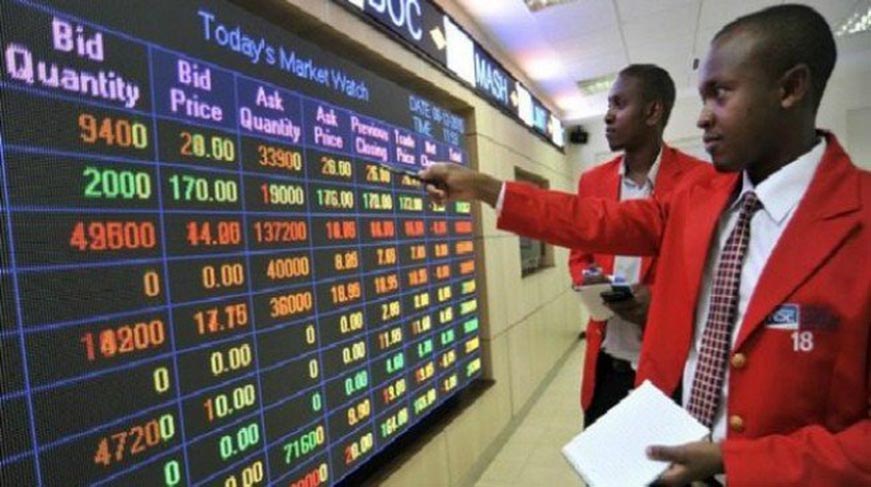
Profit-taking by investors crashed Nigerian Exchange (NGX) Limited by 0.23 per cent on Friday amid liquidation of equities for pressing needs.
The sell-offs were mostly witnessed in the banking and industrial goods sectors, which retreated by 1.14 per cent and 0.46 per cent, respectively.
They overpowered the gains of 1.10 per cent, 0.46 per cent and 0.33 per cent recorded by the insurance, consumer goods and energy counters, respectively.
As a result, the All-Share Index (ASI) crumbled by 221.10 points to 97,829.02 points from the preceding day’s 98,050.12 points and the market capitalisation came down by N134 billion to N59.292 trillion from the N59.426 trillion it closed on Thursday.
The activity log showed that the bourse was quiet as the trading volume, value and number of deals decreased by 19.75 per cent, 33.70 per cent, and 7.79 per cent, respectively.
This was because a total of 366.6 million shares valued at N6.1 billion exchanged hands in 9,677 deals during the session versus the 456.8 million shares worth N9.2 billion traded in 10,495 deals a day earlier.
FBN Holdings ended the day as the busiest after selling 42.4 million equities worth N1.1 billion, Guinea Insurance traded 34.9 million shares valued at N20.5 million, Prestige Assurance transacted 27.1 million stocks for N20.7 million, Cutix sold 21.9 million shares for N50.9 million, and Fidelity Bank traded 15.8 million equities valued at N251.0 million.
On the last session of the week, MeCure was the worst-performing stock after it shed 9.83 per cent to quote at N10.55, Multiverse depreciated by 9.03 per cent to N6.55, DAAR Communications fell by 8.82 per cent to 62 Kobo, FBN Holdings slumped by 5.75 per cent to N25.40, and Lafarge Africa plunged by 5.26 per cent to N54.00.
Conversely, Eunisell ended the day as the best-performing stock after it increased its share price by 9.99 per cent to N19.27, Austin Laz gained 9.92 per cent to settle at N2.66, Haldane McCall grew by 9.91 per cent to N5.10, Thomas Wyatt appreciated by 9.77 per cent to N1.91, and Tantalizers expanded by 9.26 per cent to N1.18.
At the close of business, the bourse recorded 27 appreciating equities and 25 depreciating equities, representing a positive market breadth index and strong investor sentiment despite the poor outcome.
Economy
Oil Prices Gain Over 1% on Supply Concerns, Middle East Escalation
By Adedapo Adesanya
Oil prices settled over 1 per cent higher on Monday as the market weighed the prospect of renewed US-Iran negotiations against escalating supply risks following escalations in the Middle East.
Brent crude futures gained $1.12 or 1.3 per cent to trade at $89.22 per barrel, while the US West Texas Intermediate (WTI) crude soared by 74 cents or 0.9 per cent to $83.23 a barrel.
The Middle East conflict escalated over the weekend, with the US conducting a ninth straight night of attacks against Iran, while American allies Kuwait and Bahrain reported more Iranian strikes.
Traders weighed hopes of renewed US-Iran negotiations against Yemen’s Houthis’ imposition of a naval blockade against Saudi Arabia. The group said the “maritime embargo” was retaliation for what it described as a Saudi siege of Yemen.
This development brings the US-Iran war officially to the southern entrance of the Red Sea and threatens an export route used by Saudi Arabia to bypass disruptions in the Strait of Hormuz. About 20 per cent of global oil supplies flowed through the waterway.
Iran had previously instructed the Houthis to prepare to close the Bab el-Mandeb Strait if the US continued attacking Iranian power infrastructure. A full closure could disrupt oil shipments equivalent to about 7 per cent of global supply.
Meanwhile, Iran has received a proposal for a 10-day ceasefire, and both Iran and the US have left open the possibility of renewed negotiations.
Market analysts noted that if a ceasefire does not materialise and the Strait of Hormuz remains largely closed while the Houthi threat to Red Sea shipping intensifies, the risk of a significant rebound in oil prices would be substantial.
Kpler analysts said in a note that there is also the possibility that a record amount of crude oil on water, estimated at around 1.35 billion barrels, could limit the next leg of oil price increases.
A drone struck a tanker loading crude oil at the Caspian Pipeline Consortium’s (CPC) Black Sea export terminal on Monday, forcing the suspension of exports for the second time in less than 24 hours.
The CPC system accounts for roughly 1 per cent of global oil supply, carrying crude primarily from Kazakhstan’s giant Tengiz, Kashagan and Karachaganak fields, with additional volumes from Russian producers in the Caspian region.
Economy
CSCS Declares N1 Interim Dividend as H1 2026 Pre-Tax Profit Jumps 115%
By Adedapo Adesanya
The Central Securities Clearing System (CSCS) Plc has declared the first interim dividend in its history after posting its financial results for the first half of 2026, reflecting robust earnings growth, improved operating efficiency and stronger capital market activity.
The board approved an interim dividend of N1.00 per ordinary share for the six months ended June 30, 2026, citing the company’s strong cash generation, resilient balance sheet and confidence in the sustainability of its earnings.
The interim payout represents about 56 per cent of the total dividend of N1.78 per share paid for the 2025 financial year, underscoring its strong earnings momentum while preserving financial flexibility to invest in technology, innovation and future growth.
CSCS recorded one of the strongest financial performances in its history during the review period, with total operating income rising by 92 per cent to N18.51 billion from the corresponding period of 2025.
The growth was driven by higher transaction fee income as capital market activity strengthened, continued expansion in depository services, increased collateral management revenues and stronger contributions from data and technology-enabled services. Investment income also improved as the company optimised its investment portfolio.
Despite the sharp rise in revenue, operating expenses increased by only 38 per cent, reflecting disciplined cost management and the scalability of the company’s business model.
As a result, operating profit surged by 186 per cent to N10.11 billion, while profit before tax climbed by 115 per cent to N13.21 billion. Earnings per share also rose significantly to 190.1 kobo from 109.1 kobo in the corresponding period of 2025.
The organisation also recorded improvements in operating efficiency. Its cost-to-income ratio declined to 45.4 per cent from 63.2 per cent a year earlier, while operating profit margin improved to 54.6 per cent from 36.8 per cent.
According to the company, the results demonstrate not only the benefits of stronger market activity but also the resilience of its operating model and its ability to convert revenue growth into higher profitability, improved shareholder returns and sustainable long-term value creation.
Commenting on the interim dividend, the Chairman of CSCS Plc, Mr Temi Popoola, said the board’s decision reflected confidence in the firm’s financial strength, earnings quality and long-term strategic direction.
He said the strong performance was driven not only by increased market activity but also by sustained improvements in operational efficiency, disciplined cost management and the continued diversification of revenue streams.
Mr Popoola noted that the Board remained committed to balancing shareholder returns with investments in technology, innovation, resilience and new growth opportunities that would strengthen CSCS’ position as Nigeria’s leading financial market infrastructure and one of Africa’s foremost post-trade institutions.
The chief executive of CSCS Plc, Mr Shehu Yahaya Shantali, attributed the strong performance to the resilience of the entity’s business model, the dedication of its workforce and the confidence of market participants.
He said the first-ever interim dividend demonstrated the company’s ability to translate strong earnings growth and improved operating efficiency into enhanced shareholder value.
Mr Shantali added that CSCS would continue to strengthen its core market infrastructure, invest in technology and innovation, diversify its revenue base and enhance value creation for stakeholders while supporting the development of Nigeria’s capital market.
Economy
Axxela’s National Scale Long-Term Issuer Rating Gets GCR Upgrade
By Aduragbemi Omiyale
The national scale long-term issuer rating of Axxela Limited has been upgraded by GCR Rating to A+(NG), just as its short-term issuer rating was affirmed with a stable outlook.
The rating firm upgraded the long-term issue rating for Axxela Funding 1 Plc’s N16.4 billion series 1 senior unsecured bond to A+(NG), while the N11.5 billion series 1 senior secured bond was lifted to A+(NG)(EL).
GCR noted in a note that the actions reflect the leading gas and power portfolio company’s robust business model, strong earnings performance, and sustained financial profile, reinforcing its ability to deliver long-term value while maintaining financial discipline.
Axxela’s recent achievements have been driven by its continued focus on responsible growth, customer satisfaction, and creating lasting value for national development.
“The ratings upgrade by GCR is a strong endorsement of Axxela’s disciplined approach to business. Beyond recognising our financial strength, it reflects the resilience of our business model and the confidence in our strategic direction.
“Over the past few years, we have continued to make significant strides across the business by expanding our natural gas infrastructure, strengthening our operational footprint, advancing our sustainability agenda, and maintaining an unwavering commitment to operational excellence and safety,” the chief executive of Axxela, Mr Moshood Olajide, commented on the development.
As the company continues to advance its long-term growth strategy, the upgraded ratings reinforce confidence in Axxela’s credit profile, financial resilience, and ability to create enduring value for investors, customers and other stakeholders.