Banking
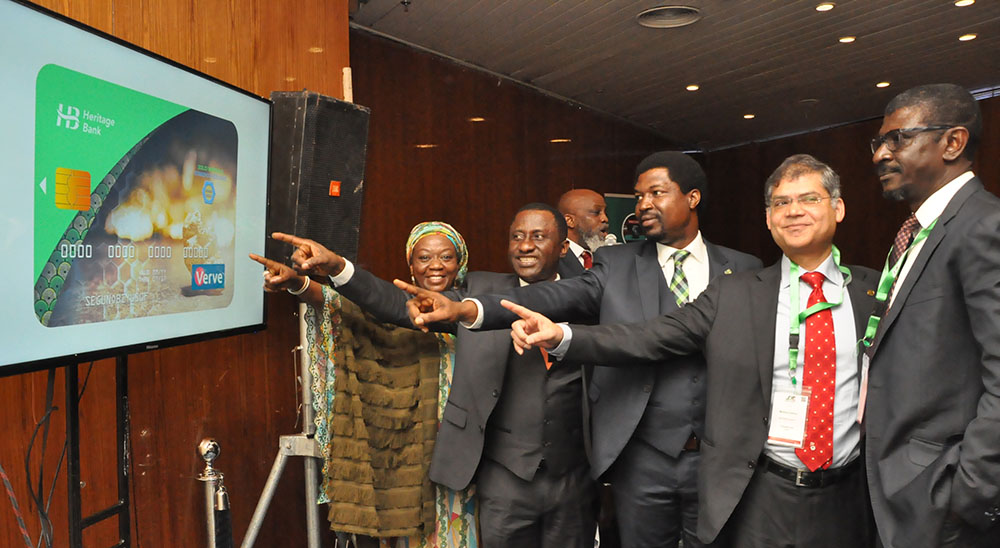
Heritage Bank Explores Nigeria’s £4bn Gold Market
By Modupe Gbadeyanka
A deal has been struck between Heritage Bank and Dukia Gold to facilitate access to local miners and artisans to get value for their commodity at international market price after being registered with the firm.
Managing Director of Heritage Bank, Mr Ifie Sekibo, while speaking recently at the Nigeria-Canada Investment Summit in Abuja, said the gold market in Nigeria worth £4 billion with high prospects of profitability for all players in the subsector.
He said based on this, the Nigeria’s most innovative banking service provider decided delve into the mining sector despite enormous risks.
Mr Sekibo, who was represented by the Team Lead, Agric Finance and Export, Adelana Ogunjirin, explained that prior to now, local miners of gold found it difficult to trade their commodities favourably, but with the involvement of Dukia and its partner, Heritage Bank, a Quality-and-Quantity test will be conducted based on the arrangement they made with Dukia Gold and that will lead to additional value to the small holder miners. He explained that this will leverage the small miners the opportunity to also trade their commodities at international market price.
He further stated that a metric tonne of Gold is currently valued at $30million adding that it is worth investing in the industry, especially as gold is a kind of commodity that does not easily lose its value.
“Mining sector is an area which has not been fully tapped in terms of the potentials around it, as there are quite a lot of opportunities around that sector. Recently we secured $1 billion funding line with our funding partner AfreximBank, which also is to support areas like solid minerals.
“Now with respect to this we have looked at the value chain of this space and we have looked at the opportunities that are there. A lot of fund providers have not really delved into this and it is because of the lack of understanding of the market,” he said.
“In terms of value, gold is an area where you can enhance the value. You hardly see Gold losing value and you see that in different exchanges you even trade those commodities.
“Looking at it in terms of trend, you see that gold is something that will appreciate definitely. So in terms of the profitability of this business, we have looked at it, the crunch, the numbers we see that is a space that the bank will definitely earn a lot of income,” he added.
The bank chief also expressed optimism that other banks would like to come into the Nigerian mining sector, but may be studying to understand the sector properly.
“Definitely other banks will come into the sector. For us we are leading, but the truth is they need to play in an area and space that they understand, as not everybody would be able to play in that space.
“Heritage Bank has already carved a niche for itself in agribusiness space, just like the Gold commodity, this would be exported. So, in terms of export proceeds too, there are opportunities to be explored. Generally, looking at the Nigerian outlook, on the long run, this will also enhance the country’s external reserves. There are multiplier effects of what we are doing today and that is why we are also moving in this direction,” the MD noted.
Also speaking, Managing Director, Nigeria Export-Import Bank, NEXIM, Mr Abba Bello, revealed that the bank had gone into high level discussions with heavy equipment manufacturers and suppliers that would lease equipment to miners for exploration and processing, adding that this was expected to make the equipment accessible and affordable.
“For equipment supplier or outright purchase of equipment, we have gone into discussions with Bluecare and now Mantrac for the supply of heavy equipment for gold processing or exploration on lease basis and, it is something that does not exist currently within the industry.
“Barrick Gold and Bullion Mart is something that happen in the mining world. You don’t have to own the equipment, but there are vendors who supply the equipment for explorers to hire.
“Discussions have gone very far with the equipment suppliers and very soon we will announce the programme,” Mr Bello said.
Meanwhile, the Country Manager, ITM, Nigeria, Ms Habibah Waziri, raised concerns on human resources development that would sustain the sector.
Ms Waziri also said there is need to formalize the sector and also invest in human capital in the sector for growth and development.
Banking
Coronation Merchant Bank Targets Top-Tier African Status in Next Growth Phase
By Adedapo Adesanya
Coronation Merchant Bank has set its sights on attaining top-tier status among African banks, leveraging a decade of operations and Nigeria’s ongoing economic reforms to drive its next phase of growth across key sectors.
Speaking at the Chairman’s Dinner held to commemorate the bank’s 10th anniversary in Lagos, the chief executive of the lender, Mr Paul Abiagam, said the institution had successfully carved out a distinct niche in Nigeria’s highly competitive financial services market despite a decade defined by economic volatility, policy shifts and macroeconomic uncertainty.
“Over the last 10 years, we have found our own space in a very tight market and built credible footprints in the specific markets we chose to serve,” Mr Abiagam said.
Describing the bank’s journey as “valiant” amid the changing economic landscape, he said the anniversary represents both a moment of gratitude to the bank’s founder, shareholders, board and partners, and a recommitment to scale new heights in the decade ahead.
Mr Abiagam attributed the bank’s resilience and steady growth to strong shareholder and board support, as well as a clear and disciplined corporate strategy.
He noted that Coronation Merchant Bank’s focus on defined target markets had enabled it to expand its footprint across key sectors of the economy while maintaining operational clarity.
Looking ahead, the CEO said ongoing reforms and the Federal Government’s ambition to build a $1 trillion economy present significant opportunities for financial institutions with the right expertise and positioning.
He identified infrastructure, construction, real estate, oil and gas, and manufacturing as priority sectors where the bank is already aligning its strategy.
“Volatility often comes with opportunity, What we see clearly is opportunity, and our strategy is to ensure we are well positioned to take advantage of it.” Mr Abiagam said.
Among the bank’s notable milestones, Mr Abiagam highlighted its international credit ratings, placing Coronation among a small group of internationally rated merchant banks in Nigeria.
He also pointed to human capital as a core strength, describing the bank’s people and talent as its greatest asset.
In his remarks, the Chairman of Coronation Merchant Bank, Mr Babatunde Folawiyo, reflected on the challenges of operating in Nigeria’s banking sector over the past decade, noting that the true measure of success lies in an institution’s ability to grow through uncertainty and emerge stronger.
“Anyone who has operated in Nigeria’s banking space over the last 10 years knows how challenging it has been,” Mr Folawiyo said, citing policy changes, macroeconomic shifts and leadership transitions. “The real test is whether you can grow through those challenges—and we have.”
Mr Folawiyo said recent reforms have introduced greater certainty into the economy, particularly in the foreign exchange market, which is critical for business planning and sustainable growth. While acknowledging that the adjustment period has been difficult, he stressed that predictability, even at higher exchange rates, is far more beneficial than extreme volatility.
“No business thrives without some level of stability. What hurts the economy most is wild and sudden swings. Predictability allows businesses to plan, adjust and grow,” he said.
On the outlook for the sector, Mr Folawiyo said Nigeria remains significantly underbanked, creating room for diverse players within the financial system. While technology and fintechs are expanding access to financial services, he emphasized the enduring role of specialized institutions such as merchant banks in serving corporate and structured finance needs.
“A corporate client structuring commercial papers or complex funding solutions needs more than a fintech app. It needs a bespoke, one-stop financial partner. That is where merchant banks like ours play a critical role,” the Chairman said.
He added that Coronation Merchant Bank’s strategy is anchored on long-term economic fundamentals rather than political cycles, noting that the current policy direction of the Central Bank and the Federal Government, though initially painful, aligns with sound economic principles.
“These are textbook reforms. There is no gain without pain, and we are already beginning to see the gains, not just in the financial sector but across the broader economy,” he added.
Banking
S&P Forecasts 25% Credit Growth for Nigerian Banks in 2026
By Adedapo Adesanya
Nigerian banks are expected to post stronger credit growth of up to 25 per cent in 2026 while retaining positive profitability, according to a new outlook by S&P Global Ratings.
In its Nigerian Banking Outlook 2026, S&P said improved lending to key sectors of the economy alongside resilient non-interest income would help banks absorb the impact of regulatory headwinds and easing interest rates.
The ratings agency projected credit growth of between 20 and 25 per cent in 2026, driven largely by increased investments in oil and gas, agriculture and manufacturing.
It added that the outlook for lending was supported by expectations of moderating inflation and gradual monetary easing, following recent interest rate cuts by the Central Bank of Nigeria (CBN).
“We expect credit growth of about 20-25 per cent supported by investments in the oil and gas, agriculture, and manufacturing sectors. Although interest rates have started to decrease, profitability should stay resilient in 2026, supported by growth in non-interest income (NII) and lower provisions.
“We expect Nigerian banks to prove resilient and capable of preserving their profitability in 2026,” S&P said, noting that earnings would be supported by transaction driven fees, commissions and a still elevated cost of risk, even as margins come under pressure.
The ratings agency noted further that it expects nominal lending growth to remain high at about 25 per cent, supported largely by investments in the oil and gas sector, agriculture and manufacturing.
S&P said Nigerian banks would continue to benefit from rates that remain high relative to peers, supporting net interest margins while interest rates are expected to decline further in 2026.
“Although interest rates have started to decline, we expect rates to remain high relative to peers, which will continue to support banks’ net interest margins through 2026.
“We forecast the average return on equity (ROE) will normalise at 20-23 per cent in 2026 compared to 25 per cent estimated for 2025, while return on assets will decline marginally to 3.0-3.1 per cent from an estimated 3.3 per cent in 2025. Profitability will be supported by still high interest margins, growing NII, and slightly lower provisions, while capital issuance will increase the equity base leading to a lower ROE.
“Although interest rates have started to decline, we expect rates to be high relative to peers, which will continue to support the banks’ net interest margins through 2026. We forecast an average margin drop of about 50bps to 100bps in 2026, as banks’ margins will continue to benefit from higher yields on government securities and large recourse to low-cost customer deposits.”
Banking
CBN Targets Reforms to Ease Compliance Burdens on Fintech Firms
By Aduragbemi Omiyale
To ease regulatory compliance burdens on financial technology (fintech) companies, the Central Bank of Nigeria (CBN) is considering some strategic reforms through a policy known as the Single Regulatory Window.
In its 2025 Fintech Report, the central bank said this scheme will significantly reduce time-to-market for new digital financial products by streamlining licensing and supervisory processes across multiple agencies.
The CBN said there would be a shared regulatory infrastructure in form of a Compliance-as-a-Service model to cut down duplicative reporting, ease the burden on regulated fintechs, and enhance supervisory visibility.
The apex bank said it came up with this idea after being aware of some challenges stakeholders, especially operators, go through in the ecosystem.
The bank said fintech firms remain a critical leg in its financial inclusion drive in Nigeria and must be supported to expand their operations to achieve the goal.
The CBN report showed that 62.5 per cent of fintech firms lamented how regulatory timelines materially affect product rollouts, while over one-third noted that it takes more than 12 months to bring a new product to market, largely due to compliance bottlenecks.
“Stakeholders cited delays in approvals and ambiguity in regulatory guidelines as their most pressing concerns,” a part of the report disclosed.
The report recommended “exploring models for a Single Regulatory Window to simplify multi-agency compliance processes and reduce time-to-market.”
It was also suggested that to address the issues, the bank must review “approval timelines and operational guidelines.”
In addition, the central bank was advised to either review the PSB framework or introduce a dedicated digital banking licence that would enable inclusive lending under stronger prudential oversight.
“A dedicated digital bank licence may be a more effective pathway for inclusive lending than expanding the PSB mandate,” the respondents suggested.
As for digital assets, the CBN signalled a shift towards a more nuanced regulatory framework for cryptocurrency, balancing innovation with financial integrity rather than imposing blanket restrictions, as fintechs acknowledged crypto’s potential to drive cost-effective cross-border transactions and strengthen remittance channels, while also warning of risks linked to illicit flows and consumer protection.
“There was broad agreement on the need for a risk-based, activity-focused regulatory framework,” the report stated, adding that regulators must avoid equating all crypto activity with criminality, especially as many scams originate offshore.
-
Feature/OPED6 years agoDavos was Different this year
-
Travel/Tourism9 years ago
Lagos Seals Western Lodge Hotel In Ikorodu
-
Showbiz3 years agoEstranged Lover Releases Videos of Empress Njamah Bathing
-
Banking8 years agoSort Codes of GTBank Branches in Nigeria
-
Economy3 years agoSubsidy Removal: CNG at N130 Per Litre Cheaper Than Petrol—IPMAN
-
Banking3 years agoSort Codes of UBA Branches in Nigeria
-
Banking3 years agoFirst Bank Announces Planned Downtime
-
Sports3 years agoHighest Paid Nigerian Footballer – How Much Do Nigerian Footballers Earn