Economy
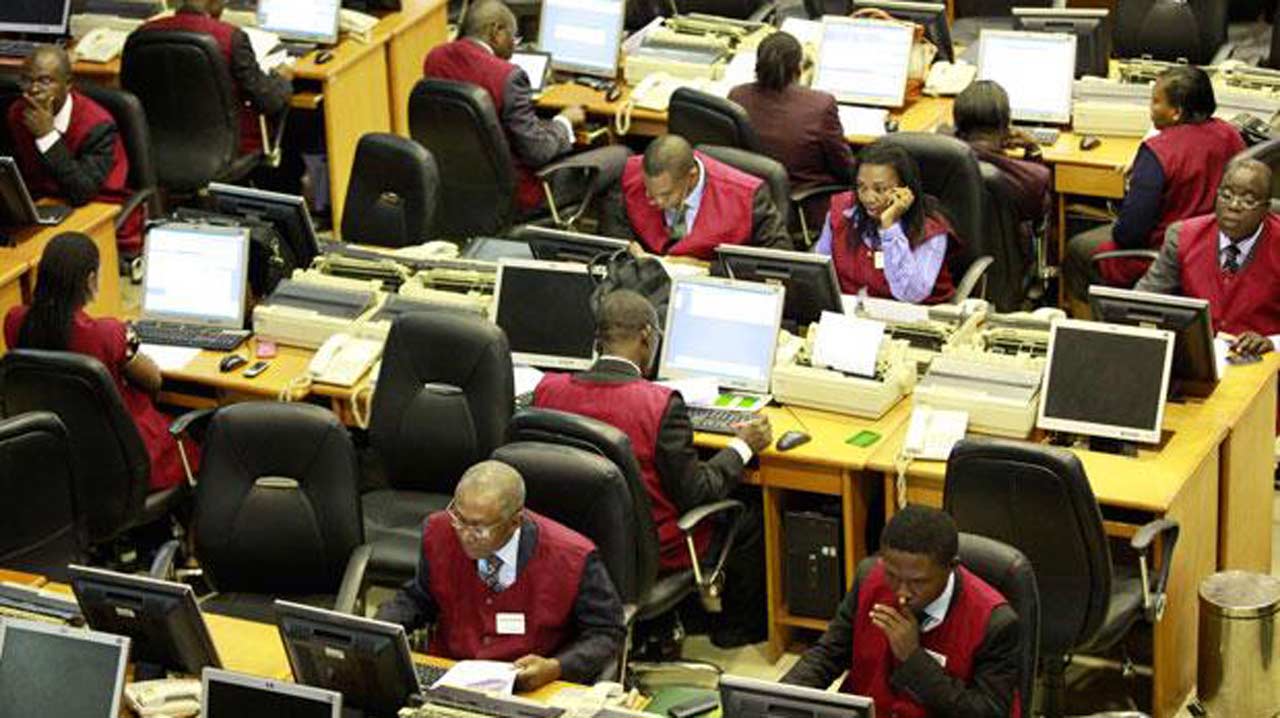
NSE Benchmark Indices Drop 0.23% on Selloffs
By Dipo Olowookere
The benchmark indicators of the Nigerian Stock Exchange (NSE), All-Share Index (ASI) and market capitalisation, depreciated on Monday by 0.23 percent.
The negative performance of the bourse was mainly impacted by selloffs in the banking sector as the Central Bank of Nigeria (CBN) raised the cash reserve ratio (CRR) for the sector to 27.50 percent from 22.5 percent for the first time since March 2016.
At the close of transactions yesterday, the sector was the lone decliner, going down by 1.19 percent, while the energy index closed flat. The insurance sector appreciated by 0.51 percent, consumer goods rose by 0.21 percent, while the industrial index increased by 0.07 percent.
Business Post reports that while the main index depreciated on Monday by 75.85 points to settle at 29,552.99 points, the total value of listed stocks decreased by N39.1 billion to finish at N15.223 trillion.
It was observed that the market punished Unilever Nigeria for its poor fourth quarter performance. The company topped the losers’ chart on Monday, losing N1.75 to end at N15.80 per share.
Julius Berger declined by N1.35 to close at N20.15 per unit, Zenith Bank fell by 50 kobo to trade at N21.45 per share, Eterna went down by 30 kobo to sell at N2.85 per unit, while FBN Holdings depreciated by 30 kobo to quote at N7 per share.
On the other hand, Okomu led the risers’ chart, appreciating by N2 to finish at N68 per share, while Nigerian Breweries also gained N2 to close at N54 per unit.
Vitafoam improved by 30 kobo to settle at N5.30 per share, NAHCO added 24 kobo to its share price to sell at N2.69 per unit, while NPF Microfinance Bank appreciated by 11 kobo to trade at N1.24 per share.
The activity level was mixed during the session as the volume of trades rose by 135.78 percent, while the value dropped by 9.95 percent. A total of 435.2 million shares worth N3.2 billion were transacted yesterday compared with the 184.6 million equities worth N3.5 billion traded the previous session.
The busiest stock on Monday was Veritas Kapital, exchanging 226.6 million units worth N45.3 million, while Zenith Bank followed with 45.5 million units traded for N989.0 million.
GTBank exchanged 26.7 million equities valued at N856.2 million, UBA sold 17.4 million stocks for N146.5 million, while FCMB transacted 16.9 million units worth N33.0 million.
Economy
LIRS Shifts Deadline for Annual Returns Filing to February 7
By Aduragbemi Omiyale
The deadline for filing of employers’ annual tax returns in Lagos State has been extended by one week from February 1 to 7, 2026.
This information was revealed in a statement signed by the Head of Corporate Communications of the Lagos State Internal Revenue Service (LIRS), Mrs Monsurat Amasa-Oyelude.
In the statement issued over the weekend, the chairman of the tax collecting organisation, Mr Ayodele Subair, explained that the statutory deadline for filing of employers’ annual tax returns is January 31, every year, noting that the extension is intended to provide employers with additional time to complete and submit accurate tax returns.
According to him, employers must give priority to the timely filing of their annual returns, noting that compliance should be embedded as a routine business practice.
He also reiterated that electronic filing through the LIRS eTax platform remains the only approved method for submitting annual returns, as manual filings have been completely phased out. Employers are therefore required to file their returns exclusively through the LIRS eTax portal: https://etax.lirs.net.
Describing the platform as secure, user-friendly, and accessible 24/7, Mr Subair advised employers to ensure that the Tax ID (Tax Identification Number) of all employees is correctly captured in their submissions.
Economy
Airtel on Track to List Mobile Money Unit in First Half of 2026—Taldar
By Adedapo Adesanya
The chief executive of Airtel Africa Plc, Mr Sunil Kumar Taldar, has disclosed that the company is still on track to list its mobile money business, Airtel Money, before the end of June 2026.
Recall that Business Post reported in March 2024 that the mobile network operator was considering selling the shares of Airtel Money to the public through the IPO vehicle in a transaction expected to raise about $4 billion.
The firm had been in talks with possible advisors for a planned listing of the shares from the initial public offer on a stock exchange with some options including London, the United Arab Emirates (UAE), or Europe.
However, so far no final decisions have been made regarding the timing, location, or scale of the IPO.
In September 2025, the telco reportedly picked Citigroup Incorporated as advisors for the planned IPO which will see Airtel Money become a standalone entity before it can attain the prestige of trading on a stock exchange.
Mr Taldar, noted that metrics continued to show improvements ahead of the listing with its customer base hitting 52 million, compared to around 44.6 million users it had as of June 2025.
He added that the subsidiary processed over $210 billion in a year, according to the company’s nine-month financial results released on Friday.
“Our push to enhance financial inclusion across the continent continues to gain momentum with our Mobile Money customer base expanding to 52 million, surpassing the 50 million milestone. Annualised total processed value of over $210 billion in Q3’26 underscores the depth of our merchants, agents, and partner ecosystem and remains a key player in driving improved access to financial services across Africa.
“We remain on track for the listing of Airtel Money in the first half of 2026,” Mr Taldar said.
Estimating Airtel Money at $4 billion is higher than its valuation of $2.65 billion in 2021. In 2021, Airtel Money received significant investments, including $200 million from TPG Incorporated at a valuation of $2.65 billion and $100 million from Mastercard. Later that same year, an affiliate of Qatar’s sovereign wealth fund also acquired an undisclosed stake in the unit.
The mobile money sector in Africa is expanding rapidly, driven by a young population increasingly adopting technology for financial services, making the continent a key market for fintech companies.
Economy
Crypto Investor Bamu Gift Wandji of Polyfarm in EFCC Custody
By Dipo Olowookere
A cryptocurrency investor and owner of Polyfarm, Mr Bamu Gift Wandji, is currently cooling off in the custody of the Economic and Financial Crimes Commission (EFCC).
He was handed over to the anti-money laundering agency by the Nigerian Security and Civil Defence Corps (NSCDC) on Friday, January 30, 2026, after his arrest on Monday, January 12, 2026.
A statement from the EFCC yesterday disclosed that the suspect was apprehended by the NSCDC in Gwagwalada, Abuja for running an investment scheme without the authorisation of the Securities and Exchange Commission (SEC), which is the apex capital market regulator in Nigeria.
It was claimed that Mr Wandji created a fraudulent crypto investment platform called Polyfarm, where he allegedly lured innocent Nigerians to invest in Polygon, a crypto token that attracts high returns.
Investigation further revealed that he also deceived the public that his project, Polyfarm, has its native token called “polyfarm coin” which he sold to the public.
In his bid to promote the scheme, the suspect posted about this on social media platforms, including WhatsApp, X (formally Twitter) and Telegram. He also conducted seminars in some major cities in Nigeria including Kaduna, Lagos, Port Harcourt and Abuja where he described the scheme as a life-changing programme.
Further investigation revealed that in October, 2025, subscribers who could not access their funds were informed by the suspect that the site was attacked by Lazarus group, a cyber attacking group linked to North Korea.
Further investigations showed that Polyfarm is not registered and not licensed with SEC to carry out crypto transactions in Nigeria. Also, no investment happened with subscribers’ funds and that the suspect used funds paid by subscribers to pay others in the name of profit.
Investigation also revealed that native coin, polyfarm coin was never listed on coin market cap and that the suspect sold worthless coins to the general public.
Contrary to the claim of the suspect that his platform was attacked, EFCC’s investigations revealed that the platform was never attacked or hacked by anyone and that the suspect withdrew investors’ funds and utilized the same for his personal gains.
The EFCC, in the statement, disclosed that Mr Wandji would be charged to court upon conclusion of investigations.
-
Feature/OPED6 years agoDavos was Different this year
-
Travel/Tourism9 years ago
Lagos Seals Western Lodge Hotel In Ikorodu
-
Showbiz3 years agoEstranged Lover Releases Videos of Empress Njamah Bathing
-
Banking8 years agoSort Codes of GTBank Branches in Nigeria
-
Economy3 years agoSubsidy Removal: CNG at N130 Per Litre Cheaper Than Petrol—IPMAN
-
Banking3 years agoSort Codes of UBA Branches in Nigeria
-
Banking3 years agoFirst Bank Announces Planned Downtime
-
Sports3 years agoHighest Paid Nigerian Footballer – How Much Do Nigerian Footballers Earn