Connect with us

Brands/Products

A New Book Prescribes Solutions to Africa’s Problems

Published

on

Making Africa World’s Largest Economy

By Kester Kenn Klomegah

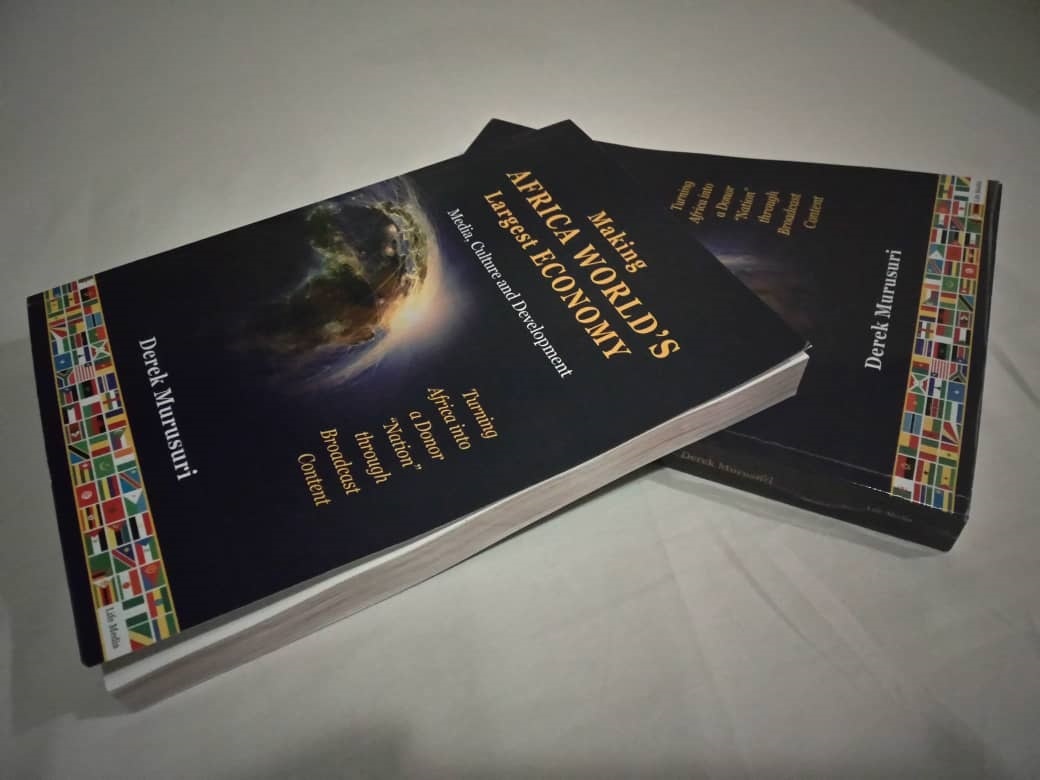
A new book titled Making Africa World’s Largest Economy that inspires Africa to think of implementing generational reforms to becoming world’s largest economy is expected to hit African bookstores from January 2020.

Derek Murusuri, author of the much-awaited book scheduled for a grand launch in Dar es Salaam, capital of Tanzania located in East Africa, said his 21-year researched book, would definitely be a game changer for Africa’s future.

“This book is for Africa. It brings back to African minds, the forgotten concept of political and economic liberation. It breaths a fresh air in the struggle for Africa’s economic liberation in the World’s richest continent yet poor, a paradox indeed,” the author explained.

“The young men and women of Africa must now rise to the new helm, as the roads rise to meet them, to rejuvenate the possibilities embalmed in their dreams which will raise new values, norms and beliefs to lead the continent to economic triumphs,” he added.

As a well-known fact, Africa’s economic development has sparked debates. The AfDB, the WB and the IMF as well as many other national and international agencies have identified key pitfalls in overall Africa’s development, leaving millions of population in abject poverty, economy under-developed and worsening economy.

The African Economic Outlook from the African Development Bank (AfDB) shows that the continent’s general economic performance continues to improve. Africa’s GDP growth was projected to accelerate to 4.0 percent in 2019 and to increase only slightly to 4.1 percent in 2020.

But even that growth is not fast enough to address persistent fiscal and current account deficits and unsustainable debt. Indeed, countries have to move to a higher growth path and increase the efficiency of growth in generating decent jobs.

In addition, Africa’s working-age population is projected to increase from 705 million in 2018 to almost 1 billion by 2030. Economic unification was to be the solution to Africa’s development dilemma. It also requires political stability in many African countries. But, most leaders in Africa were reluctant to encourage observing limits to their political administration.

The International Monetary Fund (IMF) World Bank’s (WB) sub-Saharan Africa economic outlook for 2019, for example, pointed to the political uncertainty and a concurrent weakening of economic reforms could continue to weigh on the economic outlook in many countries.

Derek Murusuri, who lived and worked previously in the UK, said his book assures Africans to know and believe that they were never created to be followers, neither were they predestined underdogs.

Murusuri said he shares the ideas on solutions to end Africa’s centuries of economic bondage and hopelessness, sufferings of millions of impoverished population. The post-independence African leaders who came to power in recent years, exhibit the zeal to transform and change the continent, making it increasingly competitive. But these efforts have remained invisible and with little impact in large parts of the continent.

What the book says and whether the continent will truly gamble to skip the hurdles and navigate through becoming the world’s leading economy, is a matter for political scientists, academicians, politicians and other analysts who will scan the book, review and implement the author’s ideas. The book Making Africa World’s Largest Economy is available from January 2020.


Dipo Olowookere is a journalist based in Nigeria that has passion for reporting business news stories. At his leisure time, he watches football and supports 3SC of Ibadan. Mr Olowookere can be reached via [email protected]

Click to comment

Leave a Reply

Your email address will not be published. Required fields are marked *

Brands/Products

Connect Nigeria Introduces Quote Request Platform

Published

on

Connect Nigeria Quote Request

By Modupe Gbadeyanka

To make finding the right service provider or reaching the right customer seamless, popular local information portal, Connect Nigeria, has introduced a Quote Request platform.

Connect Nigeria described the new system as “a digital solution designed to make connecting with service providers faster, easier, and more reliable.”

It said the Quote Request was built for consumers who need services quickly and want trusted options without the stress of searching endlessly; and service providers and businesses looking for real, high-intent customers without spending heavily on marketing.

“Whether you need a caterer for an event, a plumber for your home, or a designer for your brand, the platform is designed to connect you with the right people,” Connect Nigeria added.

“By connecting demand directly with supply, the platform creates a more structured and dependable marketplace,” it further stated.

At its core, the Quote Request simplifies the entire process of finding and offering services.

To use the service, users have to submit a request describing the service or product needed, which is then sent to verified vendors on the platform. Interested providers respond within 1–2 days, and users compare offers and choose what works best for their needs and budget.

“Instead of searching for vendors, the vendors come to you, with relevant, tailored responses,” Connect Nigeria explained.

The company expects this new platform to eliminate the stress of endless online searches, delayed or vague responses, and uncertainty about service quality.

As for businesses, it solves poor visibility, inconsistent customer flow, and lost opportunities due to slow response times.

Connect Nigeria Quote Request mobile app is now available on the Google Play Store and Apple App Store.

Continue Reading

Brands/Products

Mathesis Analytics to Scale AI-Powered Credit Infrastructure Across Nigeria

Published

on

Mathesis Analytics Winston Osuchukwu

By Aduragbemi Omiyale

An institutional investor, First Ally Capital, has strengthened a leading Nigerian financial technology company, Mathesis Analytics, to scale its proprietary credit decisioning infrastructure.

It made this possible by injecting fresh capital into the firm, which specialises in AI-powered credit decisioning infrastructure, an action that will directly support the growth and scaling of Mathesis’ core mission of providing the intelligence and infrastructure needed to bridge the credit gap for millions of unscored or underscored individuals across Nigeria.

With this investment, Mathesis will enable financial institutions to confidently assess and extend credit to borrowers who lack a formal credit history by leveraging an expanded pool of alternative behavioural and transactional data.

To date, Mathesis’ systems have supported more than 8 million loans for over 2 million unique borrowers in Nigeria, and the company is actively deploying its infrastructure to establish a growing pan-African footprint.

With the investment from First Ally Capital, Mathesis is well positioned to transform how the credit ecosystem operates, driving financial inclusion in partnership with lenders across the continent.

A significant barrier to credit access in Nigeria, which prides itself on being Africa’s largest economy, is data fragmentation. Borrowers frequently build positive financial behaviours across multiple digital platforms by repaying microfinance loans, saving through fintech wallets, or servicing Buy Now, Pay Later (BNPL) facilities.

However, under traditional credit infrastructure, these achievements remain invisible to new lenders.

Mathesis addresses this challenge through the concept of Personal Equity—the quantified expression of an individual’s financial behaviour aggregated across every institution with which they have transacted.

By translating these disparate signals into a precise, portable measure of creditworthiness, Mathesis creates a comprehensive credit identity that reflects the full breadth of a person’s financial life.

“True financial inclusion cannot be achieved in a vacuum; it requires structural collaboration in which lenders and fintech companies work as partners within the ecosystem.

“This investment from First Ally Capital validates our approach to reshaping credit infrastructure. By quantifying Personal Equity, we empower lenders to safely look beyond the constraints of formal credit histories and recognise a borrower’s true creditworthiness. This capital enables us to accelerate our pan-African expansion while maintaining the robust, institutional-grade infrastructure our partners rely on,” the chief executive of Mathesis Analytics, Winston Osuchukwu, stated.

On his part, the chief executive of First Ally Capital, Mr Ebenezer Olufowose, said, “At First Ally Capital, we pride ourselves on being a one-stop destination for financial solutions, offering a diverse portfolio of services ranging from investment banking and asset management to trusteeship, inclusive banking, and real estate.

“Our investment in Mathesis Analytics reflects our strong belief in the company’s vision and our commitment to supporting forward-thinking enterprises that deliver excellence.”

Continue Reading

Brands/Products

MultiChoice Now Full Subsidiary of Canal+—CEO

Published

on

CANAL+ MultiChoice

By Aduragbemi Omiyale

The chief executive of Canal+ Africa, Mr David Mignot, has disclosed that MultiChoice is now fully integrated into the media group.

Mr Mignot disclosed this via a statement issued on Thursday, noting that this development marks a new phase in the evolution of one of Africa’s leading pay television operators.

He noted that the integration positions MultiChoice within a global media organisation with an extensive international footprint.

“MultiChoice is now a full subsidiary of a truly international media group operating in 70 countries. The group was founded in France, is listed in London and Johannesburg, and has a strong African presence with operations in more than 45 countries,” Mr Mignot said.

The statement underscores the scale of the combined business, highlighting Canal+’s global reach alongside its significant investments across Africa.

The completion of the transaction is expected to strengthen MultiChoice’s position in the African media and entertainment market by giving it access to the broader resources, expertise and international capabilities of the Canal+ Group, while reinforcing the group’s commitment to the continent.

MultiChoice operates across sub-Saharan Africa through platforms including DStv and GOtv, serving millions of subscribers with entertainment, sports and news content.

Continue Reading