General
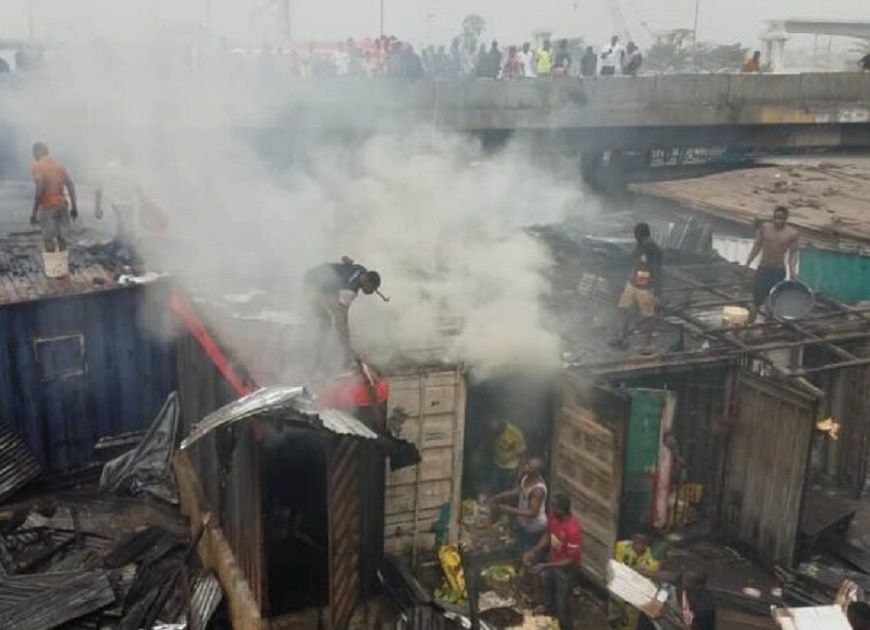
Fire Razes Food Stores at Apongbon Market in Lagos
By Modupe Gbadeyanka
About eight food stores were brought down by fire on Sunday evening at the popular Apongbon market in Lagos Island.
According to a statement signed by the Director General/Chief Executive Officer of the Lagos State Emergency Management Authority (LASEMA), Mr Olufemi Oke-Osanyintolu, the inferno was triggered by a power surge in one of the affected shops at the market.
He said, “Upon arrival of the Sharks Squad from the Lagos Central Zone of the agency, it was discovered that the fire started from one of the shops’ roof top as a result of power surge, today, Sunday, February 16, 2020.
“The inferno spread across eight containerized shops before it could be curtailed from spreading to other nearby shops.”
However, he said his men were able to bring the situation under control and confirmed that no life was lost to the fire, adding that properties worth a fortune were destroyed in the incident.
“The fire has been put out successfully by the aid of the Federal Fire men and Lagos State fire men. Eight shops were affected in the inferno. The shops were stored with food items but no casualties were recorded. However, properties worth fortune were destroyed by the fire,” the statement said.
Mr Oke-Osanyintolu called on Lagosians to desist from indulging in illegal installation of electrical appliances both at home and in the shop so as to avoid unnecessary loss of lives and properties.
The LASEMA boss affirmed that the administration of Governor Babajide Sanwo-Olu of Lagos State was committed to saving of lives and properties of all resident and doing business in Lagos.
General
Dangote Fuels Succession Talks as Daughters Occupy Strategic Positions
By Adedapo Adesanya
Nigerian billionaire businessman, Mr Aliko Dangote, has given his three daughters new positions in his multi-sector conglomerate, in what is speculated as part of his succession plans.
Mr Dangote’s business interests are primarily concentrated through the Dangote Group, a diversified conglomerate focused on manufacturing, agriculture, and infrastructure. His interests in these sectors cover sugar, salt, fertiliser, oil, and cement.
The 68-year-old billionaire has three daughters – Mariya, Halima, and Fatima – and according to Bloomberg, each has been given a core role in their father’s enterprises.
The eldest daughter, Mariya Dangote, was appointed to the board of the cement unit when her father retired in July 2025, and has now been tipped to lead the commercial strategy for that business as well as the group’s food operations across all markets.
Ms Halima Dangote, the middle daughter, already runs the family office in Dubai, and will use her experience to consolidate the company’s London operations and support the company’s international activities.
Ms Fatima Dangote, his youngest child, will assume a commercial leadership role at the energy business, which includes the 650,000-barrels per day Lagos refinery, while continuing to oversee Dangote Group’s corporate communications and administration.
The changes will “empower a new generation to take on expanded responsibilities in shaping our future,” the publication cited a verified staff memo.
The decision made by the entrepreneur accelerates the handoff of operational power to the next generation at one of Africa’s biggest industrial conglomerates, marking a significant milestone in Dangote’s succession strategy.
Handing over businesses to children is a common practice all over the world, as well as in Nigeria. One of such popular cases is Mr Pascal Dozie, who founded the defunct Diamond Bank, of which he was CEO between 1991 and 2006, handing over to his son, Mr Uzoma Dozie, after the current Governor of Anambra State, Mr Alex Otti, headed the lender before veering into politics.
This development for Mr Dangote comes as he plans to list the fertiliser and oil refinery subsidiaries on the Nigerian Exchange (NGX) Limited this year and is seeking to expand his cement operations, which currently manufacture in 10 African countries.
He is also planning to expand capacity to 1.4 million barrels a day by 2028, which would make it one of the world’s largest crude-processing plants.
General
NERC Unveils 3-Step Guide for Resolving Electricity Complaints
By Adedapo Adesanya
The Nigerian Electricity Regulatory Commission (NERC) has introduced a streamlined three-step process to help electricity consumers address common issues like power outages, estimated billing, faulty meters, and voltage fluctuations.
In a public advisory shared on its X handle on Tuesday, the electricity sector regulator emphasised that customers should begin by contacting their respective electricity Distribution Companies (DisCos), which serve as the primary point of contact for technical and billing problems.
Consumers are urged to secure a complaint reference number and maintain records of all interactions for efficient follow-up.
The advisory outlines the process as follows: “Contact your DisCo’s customer care – This is the first step for all technical or billing issues;
“Escalate to State Electricity Regulator (SER) – If unresolved, and the consumer is in a state that has transitioned to an SER;
“Reach NERC Call Centre – For consumers in non-transitioned states or needing further assistance. Contact options include 0201 344 4331, 0908 899 9244, or co********@******ov.ng,” it said.
“We’re here to make sure your complaint is heard and addressed,” the advisory concluded, aiming to empower consumers amid ongoing challenges in Nigeria’s power sector.
This guidance comes as electricity consumers continue to grapple with service disruptions and billing disputes, highlighting NERC’s efforts to improve accountability across DisCos and state regulators.
General
Senate Passes Electoral Act Amendment Bill After Mild Row
By Adedapo Adesanya
The Senate passed the Electoral Act, 2022 (Repeal and Re-Enactment) Bill 2026 on Tuesday after overcoming a rowdy session that saw lawmakers at loggerheads.
The issue in the upper chamber stemmed from a division over Clause 60 raised by Mr Enyinnaya Abaribe, a member of the opposition party, African Democratic Congress (ADC), from Abia South.
The Senate President, Mr Godswill Akpabio, stated that he believed the demand had previously been withdrawn, but several opposition senators immediately objected to that claim.
Citing Order 52(6), the Deputy Senate President, Mr Barau Jibrin, argued that it would be out of order to revisit any provision on which the Senate President had already ruled.
This submission sparked another uproar in the chamber, during which Mr Sunday Karimi had a brief face-off with Mr Abaribe.
The Senate Leader, Mr Opeyemi Bamidele, then reminded lawmakers that he had sponsored the motion for rescission, underscoring that decisions previously taken by the Senate are no longer valid, maintaining that, consistent with his motion, Mr Abaribe’s demand was in line.
Mr Akpabio further suggested that the call for division was merely an attempt by Mr Abaribe to publicly demonstrate his stance to Nigerians. He sustained the point of order, after which the Abian lawmaker rose in protest and was urged to formally move his motion.
Rising under Order 72(1), Mr Abaribe called for a division on Clause 60(3), specifically concerning the provision that if electronic transmission of results fails, Form EC8A should not serve as the sole basis, calling for the removal of the proviso that allows for manual transmission of results in the event of network failure.
During the division, Mr Akpabio directed senators who supported the caveat to stand. He then asked those opposed to the caveat to rise, to which 15 opposition senators stood.
However, when the votes were counted, the Senate President announced that 15 senators did not support the proviso, while 55 senators voted in support.
Earlier, proceedings in the Senate were momentarily stalled as lawmakers began clause-by-clause consideration of the Electoral Act, 2022 (Repeal and Re-Enactment) Bill 2026, following a motion to rescind the earlier amendment.
The motion to rescind the bill was formally seconded on Tuesday, paving the way for the upper chamber to dissolve into the committee of the whole for detailed reconsideration and reenactment of the proposed legislation.
During the session, the Senate President, Godswill Akpabio, reeled out the clauses one after the other for deliberation.
However, the process stalled when at clause 60, Mr Abaribe raised a point of order, drawing immediate attention on the floor.
This soon caused the session to move into a closed-door session.
Before rescinding the Electoral Act, the red chamber raised concerns over the timing of the 2027 general elections and technical inconsistencies in the legislation.
Rising under Order 52(6) of the Senate Standing Orders, the Senate leader, Opeyemi Bamidele, moved the motion to reverse the earlier passage of the bill and return it to the Committee of the Whole for fresh deliberations.
He explained that the development follows the announcement by the Independent National Electoral Commission (INEC) of a timetable fixing the 2027 general elections for February 2027, after consultations with the leadership of the National Assembly.
He stated that stakeholders had raised concerns that the proposed date conflicts with the provisions of the amended law, particularly the requirement that elections be scheduled not later than 360 days before the expiration of tenure.
He further noted that upon critical review of the passed bill, the 360-day notice requirement prescribed in Clause 28 could result in the scheduling of the 2027 Presidential and National Assembly elections during the Ramadan period.
According to him, holding elections during Ramadan could negatively affect voter turnout, logistical coordination, stakeholder participation, and the overall inclusiveness and credibility of the electoral process.
The motion also highlighted discrepancies discovered in the Long Title and several clauses of the bill, including Clauses 6, 9, 10, 22, 23, 28, 29, 32, 42, 47, 51, 60, 62, 64, 65, 73, 77, 86, 87, 89, 93, and 143. The identified issues reportedly affected cross-referencing, serial numbering, and internal consistency within the legislation.
-
Feature/OPED6 years agoDavos was Different this year
-
Travel/Tourism10 years ago
Lagos Seals Western Lodge Hotel In Ikorodu
-
Showbiz3 years agoEstranged Lover Releases Videos of Empress Njamah Bathing
-
Banking8 years agoSort Codes of GTBank Branches in Nigeria
-
Economy3 years agoSubsidy Removal: CNG at N130 Per Litre Cheaper Than Petrol—IPMAN
-
Banking3 years agoSort Codes of UBA Branches in Nigeria
-
Banking3 years agoFirst Bank Announces Planned Downtime
-
Sports3 years agoHighest Paid Nigerian Footballer – How Much Do Nigerian Footballers Earn