Economy
BDC Operators Trade Naira at N358 Per Dollar Monday
By Adedapo Adesanya
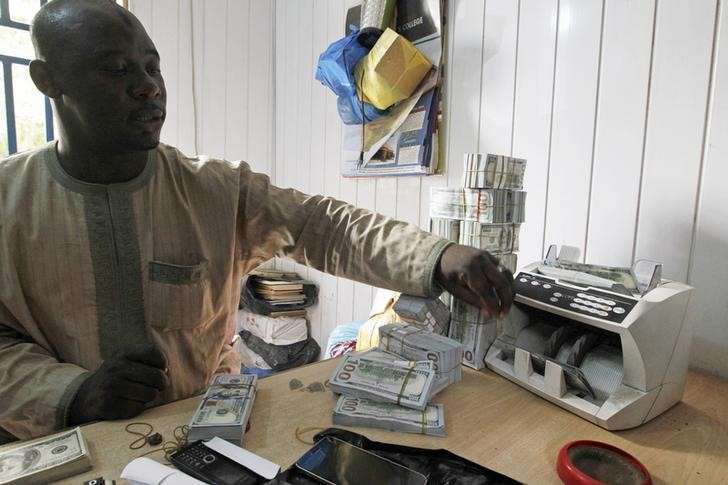
The value of the local currency to its American counterpart hovered around N358/$1 at the various locations of the Bureaux De Change (BDCs) segment of the foreign exchange market on Monday, February 17, 2020.
For example in Lagos, the Naira depreciated against the dollar by 20 kobo to close at N358.20/$1 in contrast to N358/$1 it traded last Friday, while it appreciated by N3 against the Pound to close at N472/£1 from N475/£1 and gained N1 against the Euro to trade at N393/€1 compared with its previous N394/€1.
At the Kano BDC market, the Nigerian Naira remained unchanged against the Dollar N358/$1, same way it traded flat against the Pound and the Euro during the session at N472/£1 and N395/€1 respectively.
In the capital city of Abuja, the domestic currency depreciated by 20 kobo against the greenback to trade at N358.20/$1 in contrast to N358/$1 it was transacted at the previous session.
However, it gained N1 on the Pound to sell at N473/£1 compared with N474/£1 it recorded at the preceding session, while it depreciated against the Euro by 50 kobo to sell at N394.50/€1 in contrast to N394/€1 it traded last Friday.
In Port Harcourt, BDC operators traded the Naira at N358/$1 yesterday, the same rate it was at the previous session. In the same vein, the value of the Euro and the Pound Sterling to the local currency remained stable at N397/€1 and N475/£1 respectively.
At the Investors and Exporters (I&E) segment, the local currency saw a 0.05 percent or 19 kobo drop against the greenback, selling at N364.95/$1 against N364.76/$1 it went for the previous trading day.
At the same market segment, the value of transactions went down by 82 percent or $231.49 million to $50.84 million from $282.33 million exchanged at the previous session.
At the interbank segment of the foreign exchange market, the Naira maintained stability at N306.95/$1, while at the parallel market, he domestic currency stayed at N360/$1.
It also remained unchanged at N394/€1, while it depreciated against the British currency by N1 to sell at N474/£1 compared with N473/£1 it went for at the previous session.
Economy
Brent Nears $80 on Fresh Doubt About US-Iran Ceasefire
By Adedapo Adesanya
Oil prices rose on Thursday after American Vice President JD Vance warned Israel against further attacks on Iran-backed Hezbollah in Lebanon, raising doubts about the durability of the US-Iran ceasefire agreement.
Brent crude futures settled at $79.85 a barrel after chalking up 30 cents or 0.38 per cent, while the US West Texas Intermediate (WTI) crude futures gained 19 cents or 0.25 per cent to finish at $76.60 a barrel.
US Vice President JD Vance on Thursday issued an extraordinary rebuke to Israeli critics of the Iran deal, warning them not to alienate their “only powerful ally” left in the world.
The deal gives negotiators 60 days to reach an agreement on the status of Iran’s nuclear programme and set up a $300 billion reconstruction fund for Iran and other financial incentives.
Mr Vance told members of Israeli Prime Minister Benjamin Netanyahu’s cabinet to “wake up and smell the reality,” amid growing tensions between Netanyahu and US President Donald Trump.
Market analysts noted that the statements about Israel may have put things back on edge, as the two countries jointly launched the war on Iran on February 28.
Ultimately, oil markets will be focused on what happens in the Strait of Hormuz, through which 20 per cent of the world’s oil flowed before the start of the war.
Analysts expect a gradual recovery in flows through the Strait of Hormuz, while industry experts have cautioned that prices may not plummet as demand recovers and inventories are refilled.
Investment bank Goldman Sachs expects Gulf exports to normalise to pre-war levels by the end of July, with crude production recovering by October. The bank estimates that a normalisation in exports to pre-war levels might be achieved with a 13 million barrel-per-day increase in Hormuz flows from current levels to around 70 per cent of pre-war levels.
Markets will be watching closely in the coming week to see exactly how much oil begins to flow, especially Iranian oil, which will no longer be sanctioned thanks to the latest ceasefire agreement.
China, the world’s second-largest oil consumer, is forecast to consume 753 million metric tons of petrol in 2026, down 4.9 per cent from 2025 amid a pivot to new energy and high oil prices.
Economy
FG Releases Transition Guidelines for Tax Acts 2025
By Modupe Gbadeyanka
The transition guidelines on the Tax Acts 2025 to provide direction to taxpayers, tax practitioners, revenue authorities and other stakeholders on how to address various issues arising from the old regime to the new framework have been released by the federal government.
The framework was issued on Thursday via a statement signed by the Director of Press Relations in the Federal Ministry of Finance, Efe Ovuakporie.
The guidelines set out the process for transition from the repealed tax laws to the new tax framework effective January 1, 2026.
Under the guidelines, the Tax Acts 2025, comprising the Nigeria Revenue Service (Establishment) Act, the Nigeria Tax Act, the Nigeria Tax Administration Act, and the Joint Revenue Board (Establishment) Act, apply from the respective commencement dates as enacted in each law. In particular, January 1, 2026, for the Nigeria Tax Act, 2025.
Tax liabilities, assessments, audits, investigations, disputes and enforcement actions relating to periods before that date will be treated under the repealed tax laws, the notice stated.
Tax returns relating to accounting periods ending before January 1, 2026, will be filed under the previous tax laws, while returns relating to accounting periods ending from January 1, 2026, onward will be administered under the new tax framework.
The document also covers the treatment of income taxes, transaction taxes, development levies, tax incentives, exemptions, record-keeping obligations and transactions that span both the old and new tax regimes.
Existing tax incentives and exemptions granted under the repealed laws will remain in place until their expiration dates. New applications and pending requests, however, will be considered under the provisions of the Tax Acts 2025.
The Minister of Finance and Coordinating Minister of the Economy, Mr Taiwo Oyedele, described the Tax Acts 2025 as a significant milestone in Nigeria’s tax reform programme, noting that the Guidelines set out how existing obligations, ongoing matters and future transactions will be treated under the new regime.
According to the Minister, the guidelines are anchored on three key principles – clarity, fairness and administrative certainty, adding that they are intended to promote uniform implementation and support effective administration across the Nigeria Revenue Service, State Internal Revenue Services, the FCT Internal Revenue Service, Local Government Revenue Committees, tax practitioners and taxpayers nationwide.
Economy
Federal, State, LG Councils Share N2.3trn FAAC Allocation
By Adedapo Adesanya
The Federation Account Allocation Committee (FAAC) has shared a total of N2.300 trillion among the federal government, state governments, and Local Government Councils from the revenue generated in May 2026.
The amount is slightly higher than the N2.257 trillion distributed last month, according to a statement issued by the Head of Information at the Federal Ministry of Finance, Mrs Efe Ovuakporie.
The FAAC allocation was confirmed at its June 2026 meeting following consideration of revenue receipts for the month of May.
The total distributable revenue of N2.300 trillion comprised N1.611 trillion from statutory revenue and N688.785 billion from Value Added Tax (VAT).
From the distributable amount, the federal government received N818.680 billion, while state governments got N759.141 billion. Local Government Councils were given N534.277 billion, and oil-producing states received N188.132 billion as 13 per cent derivation revenue.
The gross statutory revenue for the month stood at N2.652 trillion, representing an increase of N273.623 billion compared to the N2.378 trillion recorded in April 2026.
FAAC reported significant increases in collections from Companies Income Tax (CIT), Capital Gains Tax (CGT), Stamp Duties, Petroleum Profit Tax (PPT), Hydrocarbon Tax (HT), and oil royalties during the period under review.
However, collections from Import Duty, Value Added Tax (VAT), Excise Duty, and Common External Tariff (CET) levies recorded declines compared to the previous month.
Gross VAT revenue for May 2026 stood at N743.668 billion, lower than the N806.617 billion collected in April 2026.
The committee noted that despite the decline in VAT collections, overall revenue performance for the month was strengthened by improved receipts from petroleum-related taxes and Companies Income Tax.
-
Feature/OPED6 years agoDavos was Different this year
-
Travel/Tourism10 years ago
Lagos Seals Western Lodge Hotel In Ikorodu
-
Showbiz3 years agoEstranged Lover Releases Videos of Empress Njamah Bathing
-
Banking8 years agoSort Codes of GTBank Branches in Nigeria
-
Economy3 years agoSubsidy Removal: CNG at N130 Per Litre Cheaper Than Petrol—IPMAN
-
Banking3 years agoSort Codes of UBA Branches in Nigeria
-
Banking3 years agoFirst Bank Announces Planned Downtime
-
Sports3 years agoHighest Paid Nigerian Footballer – How Much Do Nigerian Footballers Earn