Connect with us

General

Alleged N8.5bn Fraud: Witness Explains How Atewe Bought 30,000 Shares from MTN Links

Published

on

Atewe shares

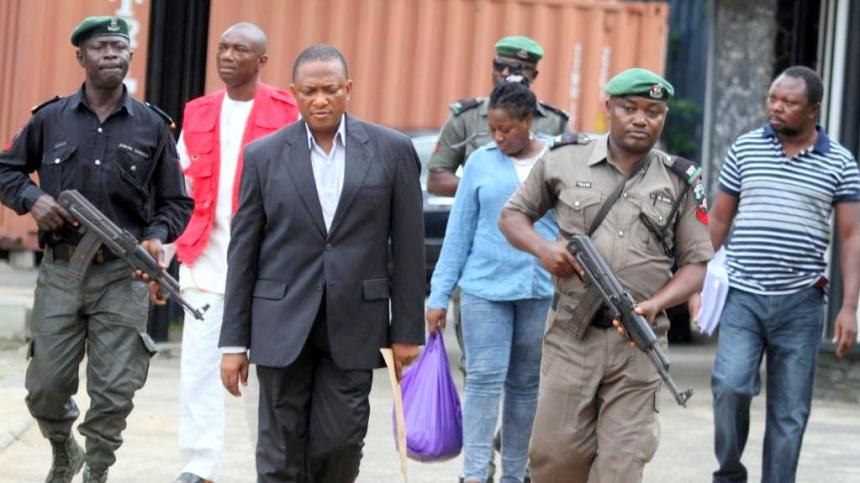
A prosecution witness, Mr Howard Edafe, in the ongoing N8.5 billion fraud case involving a former Joint Military Task Force Commander, Mr Emmanuel Atewe, on March 12, 2020 told Justice Ayokunle Faji of the Federal High Court sitting in Ikoyi, Lagos how the retired Major-General bought 30,000 units of shares from MTN Links for N170.4 million between 2014 and 2015.

A statement issued by the Media and Publicity Department of the agency said Mr Edafe, who is currently an Internal Auditor with Stanbic IBTC bank, while being led-in-evidence by counsel for the EFCC, Mr Rotimi Oyedepo, testified as the fourth prosecution witness, PW4.

Mr Atewe is standing trial alongside Patrick Akpobolokemi, a former Director-General of Nigerian Maritime Administration and Safety Agency (NIMASA), Kime Enzogu and Josephine Otuaga on a 22-count charge of conspiracy, stealing and money laundering.

Mr Edafe was quoted in the statement as saying that, “Sometime between 2014 and 2015, Atewe expressed interest in buying 30,000 units of shares from MTN Links through his Stanbic IBTC stockbroker.

“Following the notification, various documents were completed and made available regarding the transaction and Atewe made transfers to his Stanbic IBTC Bank account for the transaction.

“Although Atewe is a client to Stanbic IBTC Asset Management Limited, which is domiciled with Stanbic IBTC bank, Stanbic IBTC Asset Management Limited and Stanbic IBTC Bank are both subsidiaries of Stanbic IBTC Holdings.

“After Mr Atewe showed interest in buying 30,000 units of shares, we valued it and documents were prepared.

“Documents that were prepared for the transaction are: Purchase Order Form, which reflected that a unit was purchased for $27; Share Transfer Form; Utility Bill; Application Form; Means of Identification, which was the client’s international passport; three copies of Confidentiality and non-disclosure agreement.

“Evidence of transfer of money, which was provided by Mr. Atewe; a letter from Atewe authorizing remit of proceeds to Standard Chartered Bank in favour of Mr. Atewe; and a letter informing Stanbic IBTC the intention of Mr Atewe to purchase 30,000 units of shares.”

Mr Edafe also confirmed that the 30,000 units of shares were bought for N170,350,000 and paid for in four tranches; two payments of N40 million and N10.4 million received from Lord Firm Engineering, and N70 million from INP Limited, while N50 million was received from Ocean Gas Limited.

Under cross-examination by the defence, Mr Edafe told the court that he never came across Mr Akpobolokemi’s name during the transaction and that he was not a beneficiary of the transaction.

Earlier in the course of proceedings, the third prosecution witness, Mr Gideon Dachung, a Forensic Analyst and Document Examiner with the EFCC was cross-examined by the defence.

He was shown Exhibit C24, Exhibit G9 and Exhibit G17, and asked if he could establish, by merely looking at the exhibits, that the signatures on them have pictorial resemblance or not.

When the witness compared Exhibit C24 to Exhibit G9 and Exhibit C24 to Exhibit G17, he told the court that the signatures on the documents had a similar pictorial resemblance.

He, however, told the court that the two signatures on Exhibit C24 did not have any pictorial resemblance.

The trial continues on March 25, 2020.

Dipo Olowookere is a journalist based in Nigeria that has passion for reporting business news stories. At his leisure time, he watches football and supports 3SC of Ibadan. Mr Olowookere can be reached via [email protected]

Click to comment

Leave a Reply

Your email address will not be published. Required fields are marked *

General

Nigeria Cancels $717.7m in Undisbursed Electricity Intervention Loans from World Bank

Published

on

Nigeria Electricity Act 2023

By Adedapo Adesanya

Nigeria has cancelled $717.7 million in undisbursed World Bank intervention financing designed to revive Nigeria’s struggling electricity sector.

The cancellation followed a formal request by the federal government and a joint decision by both parties to discontinue financing under the Power Sector Recovery Performance-Based Operation due to evolving sector realities and the inability to achieve key reform milestones.

According to documents obtained from the World Bank, the development effectively terminates the remaining portion of a $1.52 billion power sector recovery programme.

The cancelled amount represents the entire undisbursed balance remaining under the programme.

“The restructuring will result in the cancellation of the entire undisbursed balance in the amount of $717.7 million equivalent, and no further disbursements will be made under the Program following approval of this restructuring,” the bank stated.

The federal government developed the Power Sector Recovery Programme as a framework to restore the sector’s financial viability and reduce its fiscal burden on public finances.

The programme included plans to progressively eliminate tariff shortfalls, improve operational performance among power sector institutions, and strengthen regulatory oversight and accountability mechanisms.

The loan was approved on June 23, 2020, with financing of about $752.5 million equivalent. The programme was structured to improve electricity supply reliability, strengthen the sector’s financial and fiscal sustainability, and enhance accountability among key institutions in the electricity value chain.

Following initial progress recorded under the programme, the World Bank approved an Additional Financing package of approximately $763.5 million equivalent on June 9, 2023, to consolidate earlier gains and support a new phase of reforms. The financing became effective on June 19, 2024, and extended the project’s closing date to June 30, 2027.

Together, the original financing and the additional facility amounted to about $1.52 billion.

However, while the additional financing struggled to meet critical reform conditions, resulting in limited disbursements and eventual cancellation of the remaining funds, the parent programme achieved substantial results and largely disbursed its resources.

According to the bank, high technical, commercial, and collection losses across the distribution segment, combined with inadequate cost recovery, have created a recurring mismatch between revenues generated by the sector and its actual operating costs.

The World Bank noted that Nigeria’s electricity sector continues to face deep-rooted structural challenges despite years of reforms and significant financial support.

The report stated that the sector still suffers from weak distribution performance, transmission bottlenecks, underutilisation of available generation capacity, and persistent financial imbalances.

“These constraints have created recurrent financing gaps, most notably in the form of tariff shortfalls, which generate liquidity pressures across the value chain and weaken the operational and financial performance of sector institutions,” the report said.

According to the World Bank, implementation of the original operation delivered notable results. The report stated that tariff shortfalls fell by 71 per cent between 2019 and 2022, declining from N581 billion to N166 billion.

During the same period, regulatory cost recovery improved significantly from 56 per cent to 94 per cent, while annual electricity supplied to the distribution grid increased by 13 per cent between 2018 and 2021.

The bank said all standard disbursement-linked indicators and global indicators attached to the original programme were fully achieved. “Implementation of the parent operation was satisfactory, brought substantial results, and fully disbursed the PforR component as all DLRs were achieved,” the report stated.

Encouraged by those gains, the World Bank approved the additional financing package to address remaining structural weaknesses and deepen reforms under the Power Sector Recovery Programme.

The new facility was expected to support the development of a sustainable financing framework for the sector, improve operational performance through implementation of performance improvement plans, and strengthen governance arrangements among electricity institutions.

However, the anticipated reforms failed to materialise within the expected timeframe. The World Bank attributed much of the setback to major macroeconomic developments that dramatically altered the operating environment.

Continue Reading

General

Tinubu Assures Nigerians of Economic Stability After Tough Reforms

Published

on

tinubu problem with nigeria

By Adedapo Adesanya

President Bola Tinubu says Nigeria is gradually emerging as a preferred destination for investment, saying the economic reforms introduced by his administration are beginning to yield positive results capable of driving job creation and economic growth.

He stated this in his 2026 Eid-el-Kabir message to Muslims in Nigeria and across the world, contained in a statement issued by the State House on Tuesday.

The President said the country had passed through difficult economic conditions but is now witnessing signs of stability and recovery following reforms implemented by his administration over the last three years.

“As a nation, we are on a journey of reconstruction and renewal. The reforms we have undertaken are challenging but necessary to build a stronger and more prosperous Nigeria for future generations,” Mr Tinubu stated.

“Just as sacrifice brings reward, I am happy that the sacrifices and efforts we have made over the past three years have yielded a more stable economy, making our country a preferred investment destination that will drive job creation and economic growth. The walk through the dark tunnel is over, and the light is here.”

The President described Eid-el-Kabir as a season that symbolises sacrifice, obedience, compassion and faith, urging Nigerians to embrace unity, tolerance and selflessness for national development.

Mr Tinubu also expressed confidence that ongoing reforms would continue to improve security and expand opportunities for citizens across the country.

“I am confident that, by the Grace of God, the reforms we have diligently pursued will continue to yield improved security and greater opportunities for all,” he said.

While acknowledging continued attacks by terrorists and bandits in parts of the country, the President assured affected communities that the Federal Government remained committed to restoring peace and defeating criminal elements.

“I am aware that, despite the best efforts of our security and intelligence agencies—including the recent elimination of a wanted ISIS leader—heartless terrorists and bandits still attack some communities. I assure you: you are neither abandoned nor forgotten. We will ultimately defeat all the forces of evil,” Tinubu stated.

He further urged Muslim faithful to use the Eid celebration to pray for national peace, unity and wisdom for leaders at all levels.

The President also called on Nigerians to extend support to vulnerable citizens and strengthen the spirit of brotherhood, irrespective of ethnic or religious differences.

He reaffirmed his administration’s commitment to investments in security, infrastructure, agriculture and human capital development as part of efforts to build a peaceful and prosperous nation.

Continue Reading

General

Court Throws Out Suit to Stop Jonathan From 2027 Presidential Race

Published

on

Googluck Jonathan

By Adedapo Adesanya

Nigeria’s former president, Mr Goodluck Jonathan, may contest the 2027 presidential election if he wishes, as a Federal High Court in Abuja on Tuesday dismissed a suit filed by a lawyer, Mr Johnmary Jideobi, seeking to stop him from contesting.

Justice Peter Lifu flung the suit and also awarded a N20 million fine against Mr Jideobi and in favour of the ex-president. He equally awarded a N1 million fine against the plaintiff and in favour of the Attorney-General of the Federation (AGF).

The judge held that Mr Jideobi lacked the legal right to have instituted the suit, having not suffered any loss from his perceived Mr Jonathan’s intention to vie for next year’s poll.

The judge, who said that a Federal High Court in Yenagoa and an Appeal Court had already held that Mr Jonathan was eligible to run, said he was bound by the decision of the appellate court. He described the lawyer’s suit as “an abuse of court process”.

Justice Lifu also dismissed Mr Jideobi’s motion seeking the judge’s withdrawal from the case for being frivolous.

Mr Jideobi had sued Mr Jonathan, the Independent National Electoral Commission (INEC), and AGF as the 1st to 3rd defendants, respectively.

Mr Jonathan is a former president of Nigeria. He first assumed power in 2010 after the death of ex-President Musa Yar’Adua. The Bayelsa-born politician served as vice president under Mr Yar’Adua and took over when the late president first fell sick.

A year later, he contested and won the 2011 presidential election. But in 2015, Mr Muhammadu Buhari of the All Progressives Congress (APC) defeated him, the first time an incumbent had lost a presidential election since the return of democracy in 1999.

Upon his exit from office, he has taken on a more diplomatic role despite calls for him to run in recent elections.

However, the 2027 polls have seen increased support for the former Nigerian leader, who has actively moved away from partisan politics since 2015.

Recently, Mr Jonathan told some youths under the Coalition for Goodluck Jonathan that he would consult before deciding on the matter.

“Yes, you are asking me to come and contest the next elections,” the former president told the group when members visited him in Abuja.

“The presidential race is not a computer game, but I’ve heard you, and I’ll consult widely,” he added.

Continue Reading

Trending