Economy
FMDQ Announces Phased Re-Opening
By Dipo Olowookere
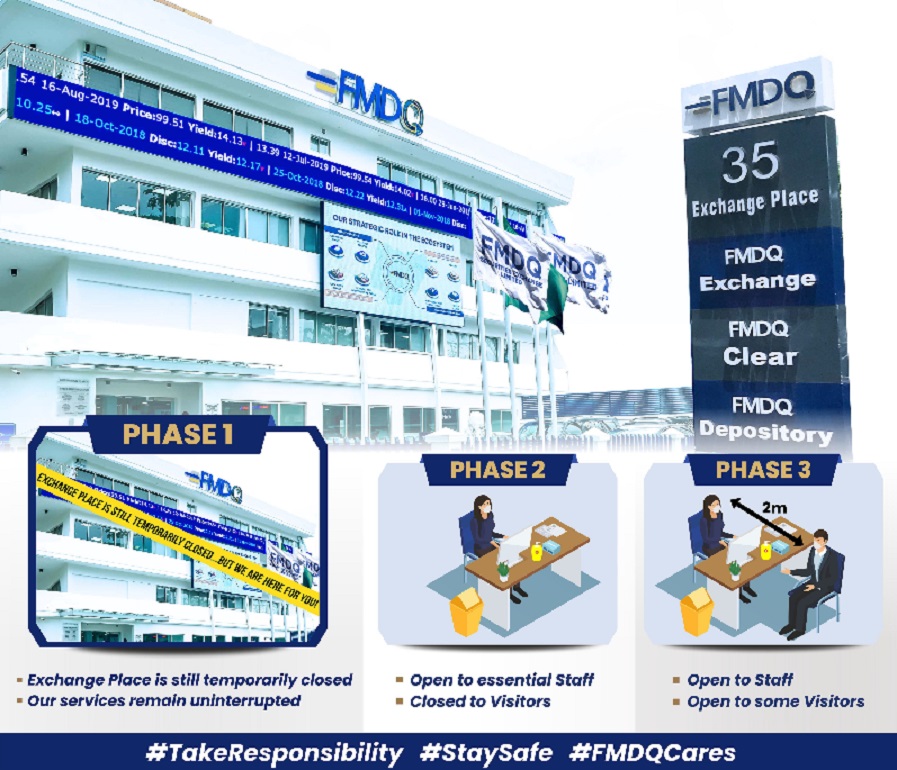
The management of FMDQ Holdings Plc has announced its intention to re-open its head office in Lagos called Exchange Place in phases.
A notice this week from the organisation disclosed that its head office would be reopened in three different phases.
In the first phase, the Exchange Place would remain temporarily closed with services still uninterrupted. During this period, investors would still continue to enjoy the numerous services rendered by the FMDQ like trading of Naira contract futures, bonds and other investment tools being traded on the platform.
For the second stage of the reopening, essential staff of the organisation would be allowed to resumed, while the offices remained shut to visitors. During this time, the necessary safety equipment and tools would be put in place, including hand sanitizers and others.
In the notice obtained by Business Post, it was stated that for the third and final phase, the Exchange Place will allow other members of staff to resume, while some visitors would be allowed to come in, but under strict adherence to guidelines of government concerning the coronavirus. This include the use of hand sanitizers, observing social distancing and others.
The FMDQ is involved in various activities like trading in equities, derivatives, currencies and the fixed income instruments like bonds, treasury bills and others.
The firm is Africa’s first vertically integrated financial market infrastructure (FMI) group, strategically positioned to provide seamless execution, clearing and settlement of financial market transactions, as well as data and information services, across the debt capital, foreign exchange, derivatives and equity markets, through its wholly owned subsidiaries – FMDQ Securities Exchange Limited, FMDQ Clear Limited, FMDQ Depository Limited, FMDQ Private Markets Limited and iQx Consult Limited – towards transforming the Nigerian financial markets through its “GOLD” (Global Competitiveness, Operational Excellence, Liquidity and Diversity) Agenda.
Economy
Nigerian Exchange Recovers 1.39% on Bargain-hunting
By Dipo Olowookere
The hunt for dividend-paying stocks rebounded the Nigerian Exchange (NGX) Limited by 1.39 per cent on Monday after a spate of sell-offs last week.
According to data, energy equities were the toast of investors yesterday, with the sector closing higher by 4.68 per cent when the closing gong was struck at 2:30 pm on the stock exchange.
Further, the industrial goods space appreciated by 2.49 per cent, the consumer goods index improved by 0.36 per cent, and the banking segment appreciated by 0.26 per cent, while the insurance counter lost 1.49 per cent to profit-taking.
As a result, the All-Share Index (ASI) gained 2,687.46 points to finish at 195,514.23 points compared with the 192,826.77 points it ended last Friday, and the market capitalisation grew by N1.725 trillion to N125.488 trillion from N123.763 trillion.
NGX Group, which announced a final dividend of N2 and a bonus share of 1-for-3 last Friday, was the best-performing equity on Monday after it gained 10.00 per cent to trade at N136.40.
In addition, Aradel Holdings appreciated by 9.99 per cent to N1,192.30, Union Homes REIT grew by 9.96 per cent to N76.15, Sovereign Trust Insurance advanced by 9.95 per cent to N2.43, and PZ Cussons rose 9.72 per cent to N79.00.
On the flip side, Custodian Investment ended as the worst-performing equity with a 10.00 per cent loss to settle at N61.20, McNichols shed 9.92 per cent to N7.63, Africa Prudential depleted by 9.75 per cent to N16.20, Chams crashed by 9.11 per cent to N4.09, and Neimeth depreciated by 8.23 per cent to N10.60.
The most active stock for the session was Fortis Global Insurance with 109.1 million units sold for N109.2 million, Japaul traded 54.7 million units valued at N218.9 million, UBA transacted 43.0 million units worth N2.1 billion, Access Holdings exchanged 30.7 million units for N799.4 million, and Oando sold 28.5 million units worth N1.3 billion.
In all, market participants bought and sold 789.9 million shares valued at N35.1 billion in 84,259 deals yesterday compared with the 823.8 million shares worth N34.8 million traded in 63,759 deals in the preceding session, indicating a decline in the trading volume by 4.16 per cent, and growth in the trading value and number of deals by 0.86 per cent, and 32.15 per cent apiece.
Economy
Naira Crashes to N1,378/$1 as FX Demand Outpaces Supply
By Adedapo Adesanya
The gradual fall of the Naira against the United States Dollar continued on Monday after it further lost N14.63 or 1.07 per cent to close at N1,378.02/$1 compared with the N1,363.39/$1 it was traded at last Friday at the Nigerian Autonomous Foreign Exchange Market (NAFEX). This was due to an insufficient supply of FX to meet the demand of customers at the currency market.
The Nigerian currency also depreciated against the Pound Sterling in the same market segment during the session by N9.65 to trade at N1,846.14/£1 compared with the previous trading day’s rate of N1,836.49/£1, and declined against the Euro by N3.76 to settle at N1,612.98/€1 versus the preceding session’s N1,609.22/€1.
In the same vein, the Nigerian Naira tumbled against the greenback in the black market yesterday by N5 to quote at N1,375/$1, in contrast to the previous value of N1,370/$1, as forex demand pressure gradually mounts.
The Central Bank of Nigeria (CBN) sold $200 million to boost the supply side and moderate demand pressures. For February, the CBN operated on both sides of the market, selling $225 million and purchasing $261.80 million. However, as FX demand continued to outpace available supply, pressure mounted further in the market.
Meanwhile, the research subsidiary of Coronation Merchant Bank said FX liquidity improved significantly last week. Total FX inflows into the official window rose to $1.07 billion from $648.20 million in the prior week.
Analysts maintain that the exchange rate is still trading within its projected N1,350 to N1,450 per Dollar band, dismissing panic concerns.
Meanwhile, the cryptocurrency market was bullish on Monday after macro shocks triggered repositioning across markets, and digital currencies benefited as some investors rotated back into risk.
After weeks of US military buildup and deadlocked nuclear diplomacy, the war with Iran increases the danger of a wider regional confrontation in a strategically vital economic corridor, adding to the risk gains for the market.
Ethereum (ETH) gained 5.5 per cent to trade at $2,050.07, Solana (SOL) appreciated by 5.2 per cent to $87.76, Bitcoin (BTC) added 4.9 per cent to sell for $69,322.35, Binance Coin (BNB) rose 3.2 per cent to $637.94, and Litecoin (LTC) expanded by 3.0 per cent to $52.39.
Further, Ripple (XRP) jumped 2.9 per cent to $1.40, Cardano (ADA) improved by 2.1 per cent to $0.2801, and Dogecoin (DOGE) increased by 1.9 per cent to $0.0946, while the US Dollar Tether (USDT) and the US Dollar Coin (USDC) remained unchanged at $1.00 apiece.
Economy
Oil Prices Surge as Strait of Hormuz Traffic Freezes Amid Iran-Israel Row
By Adedapo Adesanya
Oil prices surged 8 per cent on Monday as Israel and US strikes on Iran and retaliation by the Islamic Republic forced shutdowns of oil and gas facilities across the Middle East and disrupted shipping in the crucial Strait of Hormuz.
Brent crude rose 8.7 per cent or $6.36 to trade at $79.23 per barrel, while the US West Texas Intermediate (WTI) crude expanded by $7.8 per cent or 5.27 per cent to $72.29 per barrel.
Oil’s surge on the restart of trading after the weekend, however, was smaller than expected. On Sunday, some analysts had predicted oil would open above $90 a barrel and closer to $100.
The widening Iranian conflict is disrupting oil flows to several Asian countries as vessels are bottled up within the Middle East Gulf, and crude and transport costs are rising.
US President Donald Trump signalled the US-Israel military assault could continue for weeks, which could mean a prolonged disruption of traffic through the Strait of Hormuz, through which around 20 per cent of global oil output and a similar share of liquefied natural gas transits via ships from Middle East producers.
On Monday, Saudi Arabia shut its biggest domestic oil refinery after a drone strike. Qatar halted production of liquefied natural gas, and state-owned QatarEnergy was set to declare force majeure on LNG shipments.
The widening Iran conflict also left 150 ships stranded at anchor around the Strait of Hormuz after a seafarer was killed and at least three tankers were damaged.
The disruptions highlight the risks to Asia, the world’s biggest oil-consuming region, which sources 60 per cent of its oil from Middle Eastern producers. For instance, an extended disruption of the Strait would push oil prices higher and could cause supply shortages to China and India, the world’s biggest and third-biggest oil importers, forcing countries to tap stockpiles and reducing refinery operations.
In the view of the International Energy Agency (IEA) and other analysts, the oil market is well supplied with additions to supply from producers such as the United States, Guyana and the Organisation of the Petroleum Exporting Countries and its allies (OPEC+) expected to outpace global demand this year.
Eight members of OPEC+ agreed on Sunday to raise oil output by 206,000 barrels per day in April.
-
Feature/OPED6 years agoDavos was Different this year
-
Travel/Tourism10 years ago
Lagos Seals Western Lodge Hotel In Ikorodu
-
Showbiz3 years agoEstranged Lover Releases Videos of Empress Njamah Bathing
-
Banking8 years agoSort Codes of GTBank Branches in Nigeria
-
Economy3 years agoSubsidy Removal: CNG at N130 Per Litre Cheaper Than Petrol—IPMAN
-
Banking3 years agoSort Codes of UBA Branches in Nigeria
-
Banking3 years agoFirst Bank Announces Planned Downtime
-
Sports3 years agoHighest Paid Nigerian Footballer – How Much Do Nigerian Footballers Earn