Connect with us

Economy

Flour Mills to Expand Edible Oil Refinery, Raise Funds

Published

on

flour mills oil

By Dipo Olowookere

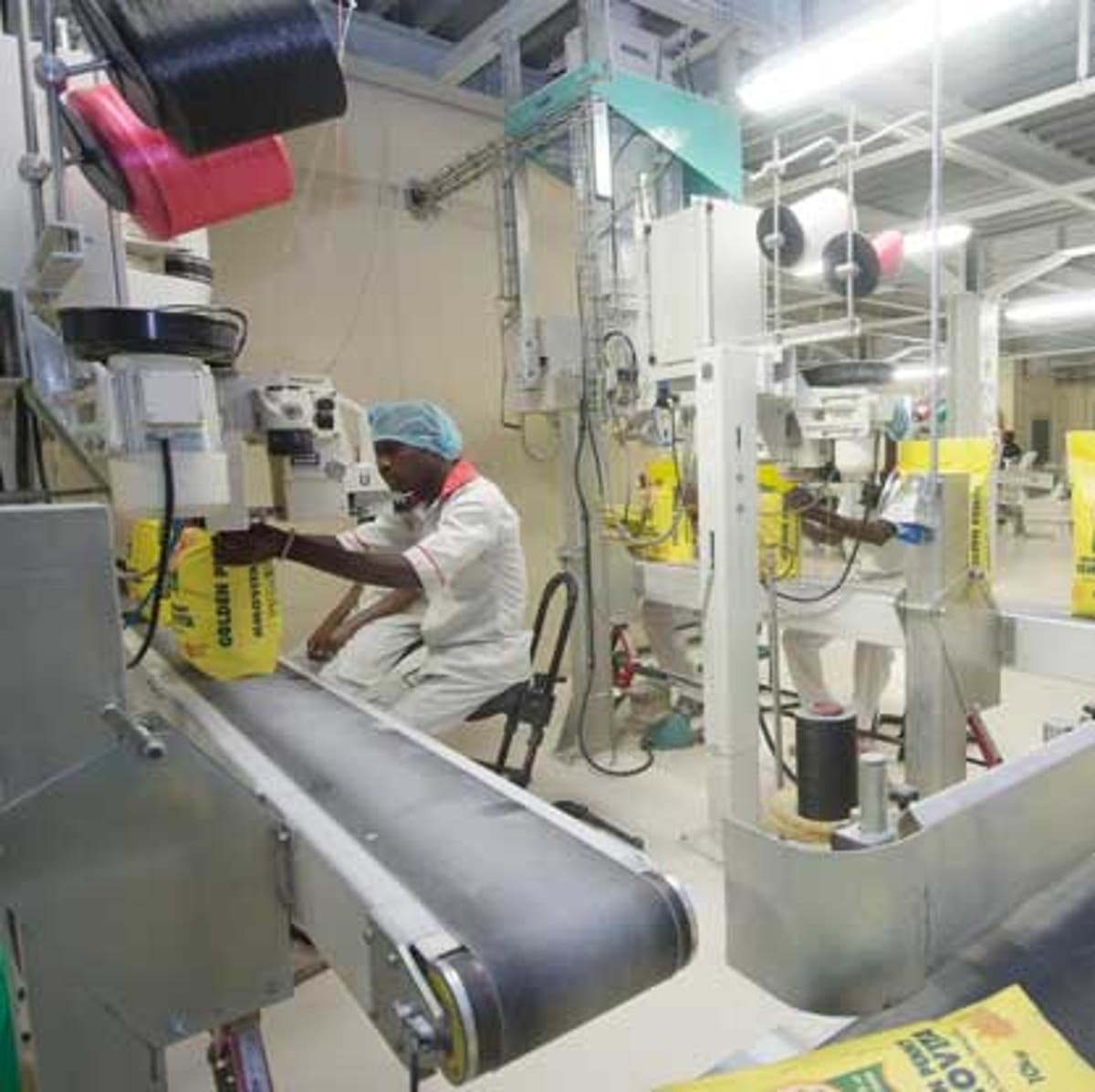
Plans are underway to expand the edible oil refinery of Flour Mills of Nigeria Plc, Premium Edible Oil Products Limited (PEOPL), the management has said.

The arm of the business used to be known as Rom Oil Mills Limited until it was changed to PEOPL recently by the company.

Business Post recalls that in 2014, Flour Mills commissioned a-400 metric tonnes per day universal refinery in Ibadan, Oyo State.

The factory was built to refine crude palm kernel oil, crude palm oil and crude soybean oil into refined oil and distilled fatty acids.

Flour Mills, which released its first-quarter results yesterday, grew its revenue to N154.6 billion from N134.8 billion in the same period of 2019, representing an improvement by 14.7 per cent.

The improvement in the turnover for the period was because of the continued contribution of its key business lines as the food segment accounted for N91.0 billion versus N81.6 billion in Q1’19, Agro-Allied arm contributed N33.1 billion versus N25.6 billion in Q1 2019, while the sugar business accounted for N27.0 billion versus N24.1 billion in Q1’19.

At an analyst’s call on Monday, the pasta and flour maker said it’s planning to expand its edible oil refinery and grow the reach of its animal feed products.

This, according to the flour miller, is to enable the company to achieve the organic growth strategy of the management.

Also at the call, the Group Chief Finance Officer of Flour Mills, Mr Anders Kristiansson, informed participants that the firm will approach the debt market to raise fresh capital.

He explained that the reason for the move is because it is now cheaper to borrow from the local debt market, where the interest rates for bonds are at a single digit.

According to him, the organisation will issue bonds under its N70 billion debt programme in the next two months, with proceeds to be mainly used to refinance existing debt.

“We have a N70 billion bond programme. We are looking to tap into the market again given the low-interest-rate environment,” Mr Kristiansson said, adding that, “We anticipate coming to the market to refinance some of our existing debt by bringing a bond to the market. We anticipate doing that in the next two months.”

Recall that in April 2020, Flour Mills issued commercial papers worth N30 billion to investors.

On Tuesday, at the Nigerian Stock Exchange (NSE), shares of the company appreciated by 20 kobo or 1.09 per cent to N18.50 per unit.


Dipo Olowookere is a journalist based in Nigeria that has passion for reporting business news stories. At his leisure time, he watches football and supports 3SC of Ibadan. Mr Olowookere can be reached via [email protected]

Advertisement
Click to comment

Leave a Reply

Your email address will not be published. Required fields are marked *

Economy

Six Price Gainers Rally OTC Securities Exchange by 2.09%

Published

on

NASD OTC securities exchange

By Adedapo Adesanya

Six price gainers lifted the NASD Over-the-Counter (OTC) Securities Exchange by 2.09 per cent on Monday, February 9, amid a surge in activity level.

According to data, the volume of securities significantly increased by 3,499.1 per cent to 13.3 million units from the 384,784 units recorded in the preceding trading session, as the value of securities soared by 518.0 per cent to N99.3 million from N16.1 million, and the number of deals moved up by 95.8 per cent to 47 deals from the preceding session’s 24 deals.

Central Securities Clearing System (CSCS) Plc ended the day as the most active stock by value on a year-to-date basis with 16.9 million units exchanged for N699.9 million, followed by Geo-Fluids Plc with 23.2 million units valued at N123.6 million, and FrieslandCampina Wamco Nigeria Plc with 1.8 million units traded for N118.5 million.

However, Geo-Fluids Plc became the most traded stock by volume on a year-to-date basis, with 23.2 million units worth N123.6 million, as CSCS Plc was pushed down the pecking order as second with 16.9 million units transacted for N699.9 million, while Mass Telecom Innovation Plc sold 15.1 million units for N6.1 million.

The price gainers were led yesterday by Okitipupa Plc after it gained N17.00 to trade at N237.00 per share versus the previous price of N220.00 per share, FrieslandCampina Wamco Nigeria Plc added N6.00 to sell at N66.00 per unit versus N60.00 per unit, and CSCS Plc grew by N5.35 to N58.85 per share from N53.50 per share.

Further, IPWA Plc appreciated by 23 Kobo to N2.59 per unit from N2.36 per unit, UBN Property Plc increased its value by 19 Kobo to N2.19 per share from N2.00 per share, and Industrial and General Insurance (IGI) Plc advanced by 5 Kobo to 59 Kobo per unit from 54 Kobo per unit.

However, Nipco Plc lost N9.00 on Monday to close at N250.00 per share versus last Friday’s price of N259.00 per share, and Geo-Fluids Plc dipped by 22 Kobo to N4.08 per unit from N4.30 per unit.

At the close of business, the market capitalisation of the bourse was up by N46.2 billion to N2.253 trillion from N2.207 trillion, and the NASD Unlisted Security Index (NSI) jumped 77.22 points to 3,766.94 points from 3,689.72 points.

Continue Reading

Economy

Naira Trades N1,354 Per Dollar at NAFEX

Published

on

ATMs

By Adedapo Adesanya

The first trading of the week at the Nigerian Autonomous Foreign Exchange Market (NAFEX) ended bullish for the Naira as it gained N11.93 or 0.87 per cent against the US Dollar on Monday, February 9, to trade at N1,354.26/$1 compared with the previous day’s N1,366.19/$1.

It also appreciated against the Pound Sterling in the official market during the session by N12.03 to settle at N1,845.72/£1 versus last Friday’s closing price of N1,857.75/£1, but depreciated against the Euro by 69 Kobo to quote at N1,613.19/€1, in contrast to the N1,612.52/€1 it was exchanged last Friday.

At the GTBank forex desk, the Nigerian Naira appreciated against the Dollar yesterday by N4 to close at N1,379/$1 versus the previous rate of N1,383/$1, and at the parallel market, it was flat at N1,450/$1.

The fortification of the Nigerian currency in the currency market on Monday was driven by forex liquidity, strong oil receipts, and flows from foreign investors attracted by the high yields on the country’s debt market.

Speaking at a forum on Monday, the Governor of the Central Bank of Nigeria (CBN), Mr Yemi Cardoso, declared that the bank’s reforms have established economic stability, evidenced by a significant reduction in inflation and growing external reserves, which he stated stood at $49 billion as of February 5, 2026.

He also highlighted the stability of the FX market, noting that the CBN is now accumulating foreign exchange from the market to enhance sustainability.

“By that, I mean that we now allow the market to generally find its level; many times, the Central Bank itself goes in to buy foreign exchange. The premium between the official and parallel market rates has collapsed to under 2 per cent,” Mr Cardoso stated.

The CBN chief said the reforms of the monetary authority—anchored on disinflation, FX market normalisation, and financial-system resilience—are already strengthening real-sector confidence.

As for the cryptocurrency market, it was in a recovery mode as investors took advantage of the drop in prices to add to their portfolios.

The pullback followed a turbulent few days in which Bitcoin (BTC) plunged to as low as $60,000 before rebounding. It rose 0.5 per cent on Monday to $70,415.57, as Ethereum (ETH) gained 0.9 per cent to trade at $2,116.42.

Further, Ripple (XRP) improved by 1.4 per cent to $1.44, Litecoin (LTC) expanded by 0.8 per cent to $54.66, Solana (SOL) grew by 0.5 per cent to $87.11, and Cardano (ADA) added 0.2 per cent to settle at $0.2704.

On the flip side, Binance Coin (BNB) slumped 0.6 per cent to $638.34, and Dogecoin (DOGE) weakened by 0.3 per cent to $0.0963, while the US Dollar Tether (USDT) and the US Dollar Coin (USDC) remained unchanged at $1.00 apiece.

Continue Reading

Economy

Crude Oil Soars as US Cautions Vessels Near Iran

Published

on

Crude Oil Production

By Adedapo Adesanya

Crude oil gained more than 1 per cent on Monday after the United States issued an advisory to US-flagged vessels to stay as far as possible from Iranian territory while passing through the Strait of Hormuz and Gulf of Oman.

The price of Brent crude was up 99 cents or 1.5 per cent during the session to $69.04 a barrel, while the US West Texas Intermediate (WTI) crude rose 81 cents or 1.3 per cent to settle at $64.36 per barrel.

The US Department of Transportation (DOT) Maritime Administration yesterday noted that vessels going through the Strait of Hormuz and Gulf of Oman have historically faced the risk of being boarded by Iranian forces, including as recently as February 3.
The agency advised U.S.-flagged ships to stay close to Oman while eastbound in the Strait of Hormuz.

The move renewed concerns that tensions between the US and Iran could lead to oil supply disruptions. About a fifth of the oil consumed globally passes through the Strait of Hormuz between Oman and Iran.

US President Donald Trump has threatened to attack, citing possible executions of protesters, and saying “help is on its way.” He ordered the USS Abraham Lincoln aircraft carrier and a flotilla of accompanying ships to the region.

In June, the US attacked Iranian nuclear facilities at the end of a 12-day Israeli bombing campaign.

Iran’s foreign minister said on Saturday the country will strike US bases in the Middle East if attacked by American forces, which have built up their naval presence in the region.

Investors were also monitoring efforts by Western governments to curb Russia’s income from oil exports that support its war in Ukraine.

The European Commission has proposed a sweeping ban on any services that support Russia’s seaborne crude oil exports, in fresh efforts to reduce revenues that help Russia’s war against Ukraine.

Refiners in India, once the biggest buyer of Russian crude, are avoiding purchases for delivery in April. Market analysts noted that if India fully stopped purchasing this crude, it would boost oil prices.

Meanwhile, Tengiz oilfield in Kazakhstan has returned 60 per cent of its peak production and was pumping at a rate of 550,000 barrels per day as of Sunday, following a forced shutdown for half of January due to a fire.

Tengiz, which is operated by a consortium led by US supermajor Chevron, is expected to reach peak levels of oil output of about 950,000 barrels per day by February 23.

Continue Reading

Trending