Connect with us

Technology

Western Digital, Dropbox Deploy Leading-Edge Cloud Infrastructure

Published

on

Ultrastar-DC-HC650 Hard Drive

By Modupe Gbadeyanka

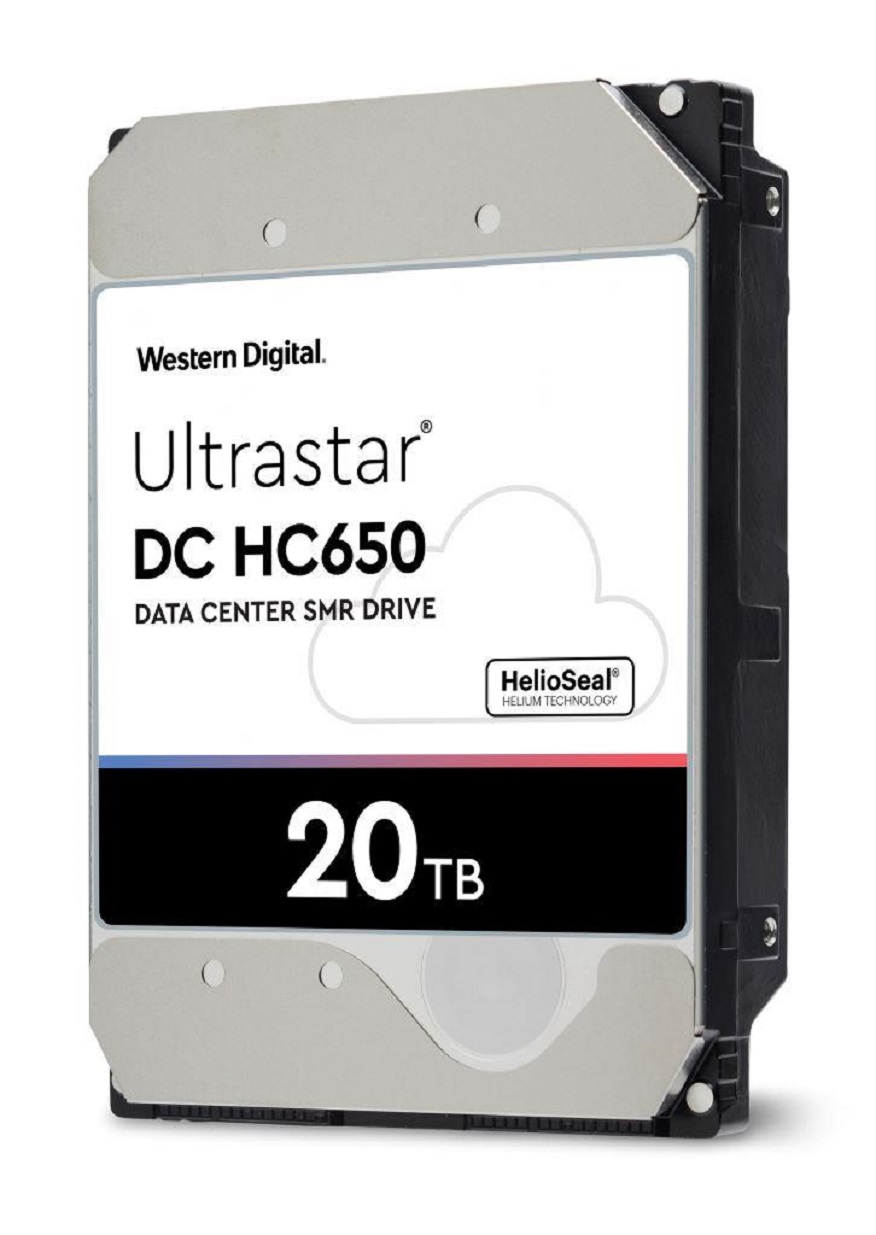
A leading global collaboration platform, Dropbox, has become one of the first firms to qualify for the Ultrastarâ DC HC650 20TB, host-managed, shingled magnetic recording (SMR) hard disk drives (HDD) designed by the world’s most essential data infrastructures, Western Digital.

This has placed Dropbox at the forefront of leveraging data centre capacity, efficiency and scalability for meeting the increasing demands of cloud storage and services by businesses, teams and individuals around the world.

With Western Digital SMR HDDs serving as the storage foundation for its custom-built, multi-exabyte storage platforms, Dropbox continues its strategic path, taking advantage of the highest storage densities with the lowest TCO without sacrificing data durability and availability for its 600 million+ online customers.

As the industry’s first 20TB HDDs, the Ultrastar DC HC650 delivers unmatched TCO for scale-out enterprise and cloud data centres through increased storage density and improved power efficiency.

Featuring the highest capacity in the industry, cloud and enterprise customers recognize the benefits of SMR HDDs and are adopting the technology to contend with the massive growth in data.

When considering exabyte-scale needs, and associated capital and operating cost of the data centre, the long-term value in terms of lower cost-per-TB, higher density, low power and high reliability can help benefit the bottom line.

Several complementary technology innovations are featured in the Ultrastar DC HC650, including the industry’s first energy-assisted magnetic recording (EAMR) implementation, the industry’s first triple-stage actuator and the fifth generation of HelioSeal® technology.

Commenting on the latest development, the vice president of engineering at Dropbox, Mr Andrew Fong, stated that, “We’ve been working with Western Digital for many years and throughout several phases of our storage platform development.”

“Online tools and services are more important than ever before, so we need to be able to quickly innovate, expand functionality and scale to help stay competitive.

“We look forward to deploying these higher-capacity 20TB SMR hard drives to further our cost savings and to provide our customers with even more value. Western Digital is an important strategic partner and we look forward to continuously pushing cloud infrastructure boundaries together,” he added.

On his part, the vice president of enterprise hard drives at Western Digital, Mr Andrew Dorian, noted that “Dropbox was a pioneer in adopting SMR at scale, and their commitment has definitely paid off, giving them an early mover advantage by enabling rapid development of the highest capacity HDDs in the industry into their cloud infrastructure.”

“We are pleased to continue our long-term partnership with Dropbox to help them scale and capitalize on the growing customer demand for cloud services, online storage and remote collaboration tools,” he further said.


Modupe Gbadeyanka is a fast-rising journalist with Business Post Nigeria. Her passion for journalism is amazing. She is willing to learn more with a view to becoming one of the best pen-pushers in Nigeria. Her role models are the duo of CNN's Richard Quest and Christiane Amanpour.

Advertisement
Click to comment

Leave a Reply

Your email address will not be published. Required fields are marked *

Technology

AI Legal Tech Firm Ivo Gets $55m for Contract Intelligence

Published

on

AI legal tech Ivo

By Dipo Olowookere

The sum of $55 million has been injected into an Artificial Intelligence (AI)-powered contract intelligence platform, Ivo, to support product development and scaling as the company deepens its reach across the hundreds of organizations that already rely on its product, including Uber, Shopify, Atlassian, Reddit, and Canva.

The Series B funding round comes after a year of substantial growth in product performance, customer adoption, and market traction to accelerate its mission of making contract intelligence available to every business.

Since its last funding round, Ivo has grown annual recurring revenue by 500 per cent, increased total customers by 134 per cent, and expanded adoption within the Fortune 500 by 250 per cent.

Business Post gathered that the latest funding support came from Blackbird, Costanoa Ventures, Uncork Capital, Fika Ventures, GD1 and Icehouse Ventures.

Ivo is purpose-built for in-house teams that need both reviews with surgical accuracy as well as visibility into their complete contract library.

The company’s AI-powered contract review solution, Ivo Review, allows users to complete reviews in a fraction of the time; customers report saving up to 75 per cent of the time that manual review would demand.

The product standardizes a company’s positions and precedents using playbooks built and implemented by lawyers. This means that every contract is reviewed accurately, consistently, and efficiently, critical for large and globally distributed teams.

“Our goal has always been to make interacting with contracts fast, accurate, and enjoyable. Every key relationship in a business is defined by an agreement, yet most organizations struggle to extract the insights inside them.

“Our focus is to give in-house teams a trustworthy solution that helps them work faster and gives them visibility into their contracts that was previously impossible,” the chief executive and co-founder of Ivo, Min-Kyu Jung, stated.

Also commenting, a Principal at Blackbird, Mr James Palmer, said, “In-house legal teams demand products that are deeply accurate and aligned to how they work. The most sophisticated teams are incredibly selective about the tools they trust.

“Ivo’s traction with some of the world’s best companies shows it consistently exceeds that bar. With exceptional product execution and an uncompromising quality bar, we believe Ivo is defining and leading the category.”

The Senior Manager for Contract Operations at Uber, Ms Kate Gardner, said, “Uber selected Ivo because it was intuitive to use, demonstrated a high level of accuracy, could work in multiple languages, and met its confidentiality requirements. Furthermore, the Ivo team was highly responsive to Uber’s needs.”

Continue Reading

Technology

Nigeria Leads in AI for Learning, Entrepreneurship—Google

Published

on

AI for Learning Nigeria

By Modupe Gbadeyanka

A new report released by global tech giant, Google, in collaboration with Ipsos, has revealed that Nigeria is writing the playbook on Artificial Intelligence (AI) as it leads in AI for learning and entrepreneurship.

In the study titled Our Life with AI: Helpfulness in the hands of more people, it was shown that Nigerians are using AI tools for everything from education to entrepreneurship at a remarkable rate, showing immense optimism for the technology’s future.

It was disclosed that about 88 per cent of Nigerian adults have used an AI chatbot, a huge 18-point jump from 2024, placing the West African country well ahead of the global average of 62 per cent.

It was also found out that while the top use for AI globally has shifted to learning, Nigerians are taking it a step further, using AI as a powerful tool for personal and professional development.

A staggering 93 per cent of Nigerians use AI to learn or understand complex topics, compared to 74 per cent globally, with 91 per cent using the tool to assist them with their work.

In addition, the research observed that 80 per cent of Nigerians are using AI to explore a new business or career change—nearly double the global average of 42 per cent.

Nigerians have overwhelmingly positive feelings about AI’s role in the classroom and beyond, seeing it as a game-changer for education, with 91 per cent feeling AI is having a positive impact on how we learn and access information versus 65 per cent globally.

The report showed that 95 per cent believe university students and educators are likely to benefit from AI, as 80 per cent of Nigerians are more excited about the possibilities of AI, versus just 20 per cent who are more concerned. Globally, the split is much closer at 53 per cent excited and 46 per cent concerned).

Commenting on the findings, the Communications and Public Affairs Manager for Google in West Africa, Taiwo Kola-Ogunlade, said, “It’s inspiring to see how Nigerians are creatively and purposefully using AI to unlock new opportunities for learning, growth, and economic empowerment.

“This report doesn’t just show high adoption rates; it tells the story of a nation that is actively shaping its future with technology, using AI as a tool to accelerate progress and achieve its ambitions. We’re committed to ensuring that AI remains a helpful and accessible tool for everyone.”

Business Post gathered that the research was conducted by Ipsos between September 22 and October 10, 2025, on behalf of Google.

For this survey, a sample of roughly 1,000 adults aged 18+ who are residents of Nigeria and were interviewed online, representing the country’s online population.

Continue Reading

Technology

NCC Grants Three Satellite Licences to Boost Broadband Services

Published

on

NCC

By Adedapo Adesanya

The Nigerian Communications Commission (NCC) has licensed three additional global internet service providers, Amazon’s Project Kuiper, BeetleSat-1, and and Germany-based Satelio IoT Services, as part of efforts to strengthen internet connectivity via satellite and to boost competition among existing internet service providers in the country.

Amazon Leo, formerly Project Kuiper, is Amazon’s Low Earth Orbit (LEO) satellite network, designed to provide fast, reliable internet to customers and communities beyond the reach of existing networks, while BeetleSat (formerly NSLComm) is an international company with strong ties to both Israel and Spain, and its corporate structure involves multiple countries, building a Low Earth Orbit (LEO) constellation of 250 satellites to provide high-throughput, low-latency, satellite internet, cellular backhaul, and mobility services globally, and Satelio IoT was approved for its planned 491-satellite IoT system, though only one satellite is currently in orbit.

NCC granted the global internet operators seven-year licences to each to operate in Nigeria from February 28, 2026, to February 28, 2033.

These operators were granted Ka-Band for their frequency band operations, and the licence is renewable after the seven years expiration, according to the regulator.

The NCC’s landing permit authorises Project Kuiper to operate its space segment in Nigeria as part of a global constellation of up to 3,236 satellites.

According to the NCC, the approval aligns with global best practices and reflects Nigeria’s willingness to open its satellite communications market to next-generation broadband providers.

The permit positions Project Kuiper to provide satellite internet services over Nigerian territory and sets the stage for intensified competition with Starlink, currently the most visible Low-Earth Orbit (LEO) satellite internet provider in the country.

The permit also gives Amazon LEO and BeetleSat-1, the legal certainty to invest in ground infrastructure, local partnerships, and enterprise contracts, while giving Nigeria a wider market opportunity to play in space internet service delivery, where Starlink currently operates.

Amazon’s Kuiper will offer three categories of satellite services in Nigeria: Fixed Satellite Service (FSS), Mobile Satellite Service (MSS), and Earth Stations at Sea (ESAS).

FSS enables broadband connectivity between satellites and fixed ground stations, such as homes, enterprises, telecom base stations, and government facilities. This is the core service behind satellite home internet and enterprise backhaul; MSS, by contrast, is designed for mobility and resilience; and ESIM extends high-speed satellite broadband to moving platforms, including aircraft, ships, trains, and vehicles.

These systems rely on sophisticated antennas that can track satellites in real time while in motion, making them critical for aviation and maritime connectivity as well as logistics and transport sectors.

BeetleSat was founded in Israel, where its groundbreaking antenna technology was developed and supported by the Israel Space Agency.

In 2021, it formed a strategic alliance with the Spanish technology group Arquimea, which is now BeetleSat’s largest shareholder and main industrial partner.

Continue Reading

Trending