Economy
Nigeria’s Manufacturing Index Contracts Sixth Month at 49.4 in October
By Adedapo Adesanya
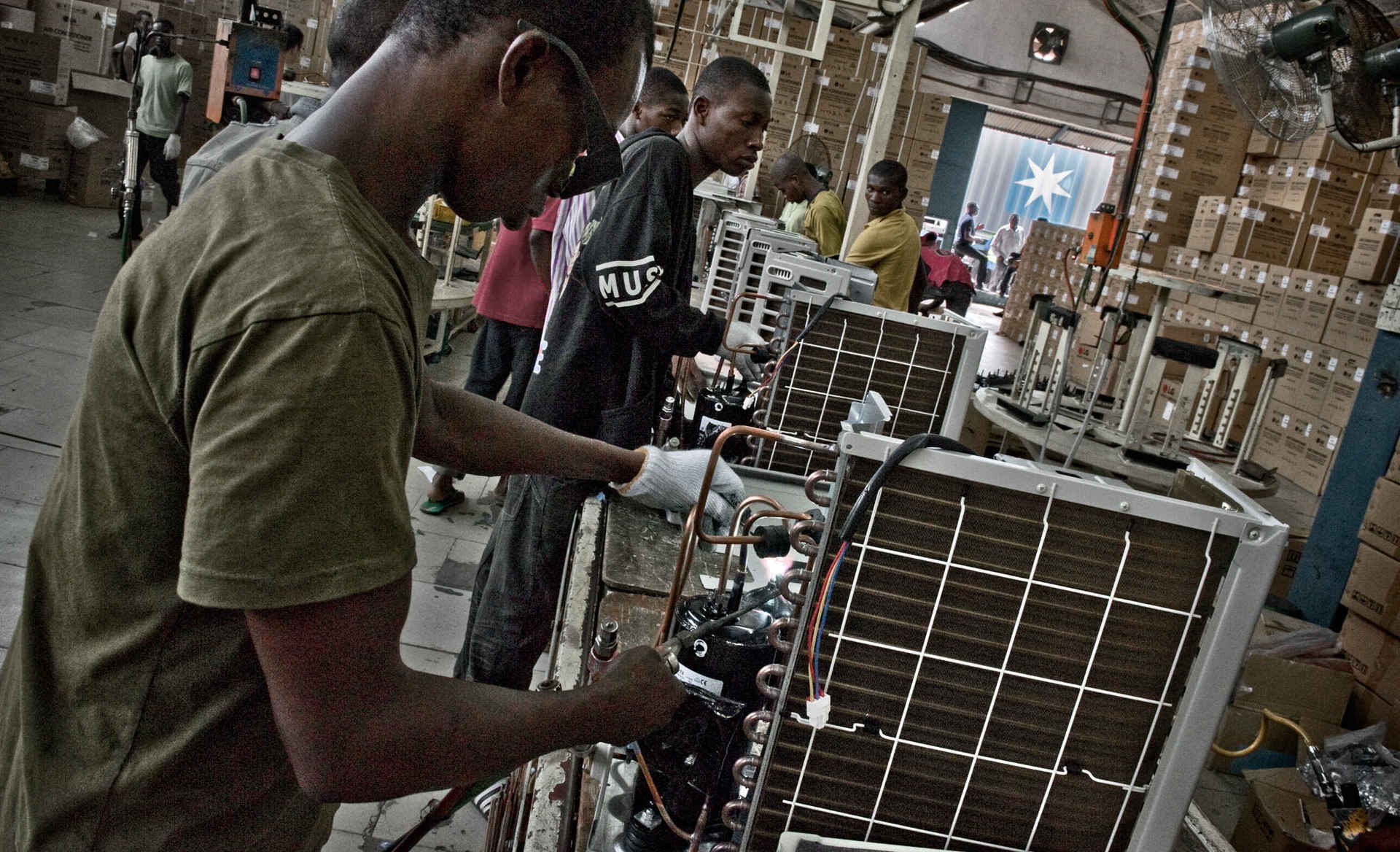
The Central Bank of Nigeria (CBN) has disclosed that the manufacturing Purchasing Managers’ Index (PMI) in October stood at 49.4 index points, indicating a contraction in Nigeria’s manufacturing sector for the sixth time this year.
This was disclosed in the October PMI report released on Wednesday by the apex bank.
According to the report, six out of the 14 sub-sectors surveyed reported expansion (above 50 per cent threshold) in October.
It listed the sub-sectors that expanded as: electrical equipment; transportation equipment; printing and related support activities; chemical and pharmaceutical products; textile; apparel; leather and footwear and cement.
It said the remaining eight sub-sectors reported contractions in the following order: primary metal, petroleum and coal products, paper products, fabricated metal products, furniture and related products, nonmetallic mineral products, plastics and rubber, products and food, and beverage and tobacco products.
The production level index stood at 50.0 per cent in October for the sector indicates a halt in the contraction which commenced in May.
Out of the 14 sub-sectors surveyed, seven sub-sectors recorded expansion in production level, one sub-sector maintained current level, while six sub-sectors recorded declines in production in October.
The new orders index expanded at 51.2 points from contraction in the previous month.
Four sub-sectors reported expansion in new orders, four sub-sectors were stationary, while the remaining six recorded contractions in the month under review.
In terms of supplier delivery time, the report also stated that the manufacturing supplier delivery time index stood at 51.8 points in October.
This indicates that supplier delivery time is faster for the sixth consecutive month. Six of the 14 sub-sectors recorded improved suppliers’ delivery time, five sub-sectors reported stationery level, while three sub-sectors recorded slowing delivery time.
The employment level index for October stood at 46.0 points, indicating contraction in employment level for the seventh consecutive month.
Of the 14 sub-sectors, three sub-sectors recorded growth in employment level in the review month; two sub-sectors recorded stationary level of employment, while the remaining nine sub-sectors recorded lower employment levels in the review month.
In terms of raw material Inventories, the month stood at 46.2 index points, indicating that the manufacturing sector inventories contracted for the seventh time in October.
Two of the 14 sub-sectors recorded growth in inventories, while the remaining 12 sub-sectors recorded lower raw material inventories in the review month.
Economy
NGX Diarrhoea Persists, Further Loses 1.57% Amid Panic Sell-Offs
By Dipo Olowookere
Panic sell-offs by investors have left the Nigerian Exchange (NGX) Limited losing weight very fast, as it further gave up 1.57 per cent on Monday.
Yesterday, only 17 equities ended on the advancers’ log, while 45 equities finished on the laggards’ chart, representing a negative market breadth index and weak investor sentiment.
All the major sectors of the bourse tasted defeat during the session, with the insurance counter down by 1.33 per cent. The banking space lost 1.22 per cent, the consumer goods index depreciated by 0.63 per cent, the industrial goods segment shed 0.39 per cent, and the energy sector tumbled by 0.06 per cent.
Consequently, the All-Share Index (ASI) stumbled by 3,682.70 points to 228,366.32 points from 232,049.02 points, and the market capitalisation slipped by N2.363 trillion to N146.542 trillion from N148.905 trillion.
Learn Africa lost 10.00 per cent to close at N9.00, MTN Nigeria also declined by 10.00 per cent to N747.00, Unilever Nigeria crashed by 10.00 per cent to N126.00, Austin Laz dropped 9.94 per cent to settle at N3.17, and Universal Insurance dipped by 9.90 per cent to quote at N28.12.
Conversely, Sovereign Trust Insurance gained 4.08 per cent to end at N2.04, Cornerstone Insurance chalked up 3.45 per cent to trade at N6.00, Neimeth appreciated by 3.03 per cent to N8.50, Livestock Feeds climbed by 1.92 per cent to N7.95, and C&I Leasing grew by 1.90 per cent to N5.35.
Business Post observed a surge in activity level on the first trading day of this week, with the trading volume, value, and number of deals up by 156.37 per cent, 137.50 per cent, and 38.50 per cent.
This was because market participants transacted 996.5 million stocks worth N43.7 billion in 61,813 deals on Monday compared with the 388.7 million stocks valued at N18.4 billion traded in 44,631 deals last Friday.
Ikeja Hotel exchanged 305.5 million shares for N13.2 billion, Access Holdings sold 289.9 million equities worth N6.6 billion, Dangote Sugar traded 29.4 million stocks valued at N1.9 billion, Chams transacted 22.0 million shares worth N87.9 million, and Zenith Bank traded 21.2 million equities for N2.4 billion.
Economy
Oil Prices Climb Over 1% as Fragile US-Iran Truce Faces New Concerns
By Adedapo Adesanya
Oil prices settled higher by more than 1 per cent on Monday after attacks by the United States and Iran underscored the fragility of their interim peace deal.
Brent crude futures gained $1.16 or 1.61 per cent to sell at $73.15 a barrel, while the US West Texas Intermediate (WTI) crude appreciated by $1.52 or 2.2 per cent to $70.75 per barrel.
The latest price movement appears to suggest that the market is concerned about a reduction in tanker traffic through the Strait of Hormuz following attacks on two commercial vessels on Thursday and Friday last week, and a further flare-up over the weekend.
The Thursday attack on the container ship Ever Lovely prompted some shipowners to pull back and wait for additional information about how safe transiting the Strait is. The US military on Friday carried out strikes on Iran in response to the attack on the vessel.
On Saturday, an Iranian attack on a Panama-flagged oil tanker, Kiku, while it was transiting the Strait of Hormuz, prompted additional strikes by the U.S. forces.
After the flare-up this weekend, the US and Iran appear to have agreed to cease attacks ahead of tentatively planned new talks this week.
Iranian and US technical teams working on the implementation of an interim peace deal are expected to meet in Doha in the coming days, even after both sides carried out strikes over the weekend that threatened to derail the accord.
Iranian Deputy Foreign Minister Kazem Gharibabadi said Iranian and Omani experts will start talks on redefining transit paths through the Strait of Hormuz in the coming days, adding that his country will try to obstruct vessels outside of defined paths.
Analysts cautioned that traffic through the strait is far from being fully recovered, helping keep prices somewhat elevated as outbound Persian Gulf crude exports are quickly rebounding to at least 75 per cent of pre-war levels.
Middle East producers are pushing ahead with loading oil and Liquefied Natural Gas (LNG) despite fresh ship attacks in the Strait of Hormuz and renewed strikes between the US and Iran in recent days.
Saudi oil giant Aramco resumed crude oil loadings on Friday at its Ras Tanura terminal, west of the Strait of Hormuz, after they were halted for nearly four months. Loadings continued even after a helicopter belonging to the company crashed on Sunday at Ras Tanura, killing 14 nationals. The cause of the crash was unknown.
Economy
Customs Steps up Push on Green Tax Awareness Ahead of July 1 Launch
By Adedapo Adesanya
The Nigeria Customs Service (NCS) has intensified its nationwide sensitisation campaign on the implementation of the Green Tax Surcharge and related fiscal adjustments ahead of the policy’s commencement on July 1, 2026.
The service disclosed this in a statement published on its official X handle on Monday, saying the initiative is aimed at promoting environmental sustainability, reducing carbon emissions and encouraging the importation of cleaner vehicles into the country in line with global environmental standards.
According to the statement, the latest sensitisation programme was held at the Apapa Area Command on Friday, June 26, 2026, under the theme, “Implementation of the Green Tax Surcharge and Related Fiscal Adjustments.”
The event brought together customs officers, licensed customs agents, freight forwarders, importers and other key stakeholders to familiarise them with the new policy ahead of its implementation.
Representing the Comptroller-General of Customs, Mr Adewale Adeniyi, the Zonal Coordinator for Zone A, Mr Mohammed Babadende, said the exercise was organised to ensure stakeholders fully understand the policy and its implementation framework before it takes effect.
“This sensitisation is designed to ensure that every stakeholder clearly understands the policy before implementation. Our objective is to eliminate uncertainty, promote voluntary compliance and guarantee uniform application of the Green Tax Surcharge across all commands,” Mr Adeniyi said.
He stressed that effective stakeholder engagement would help ensure a seamless rollout of the policy while improving compliance across the country’s ports and border stations.
Delivering a technical presentation, the Comptroller in charge of Tariff, System Audit and Coordination, Mr Murtala Muazu, explained that the Green Tax Surcharge differs from conventional fiscal measures and would therefore require a separate assessment process.
Mr Muazu disclosed that the agency has introduced a simplified implementation mechanism through the Harmonised System (HS) Code declaration platform to facilitate accurate assessment and ease compliance by importers and clearing agents.
He further revealed that the federal government has simultaneously reviewed existing import charges on vehicles to cushion the effect of the new environmental levy.
According to him, import levies on vehicles have been reduced from 20 per cent to 10 per cent, while duties on used vehicles have been cut from 15 per cent to five per cent.
The customs said the reductions are intended to offset the impact of the Green Tax Surcharge while supporting legitimate trade and ensuring businesses are not unduly burdened by the new policy.
Area Controllers who attended the sensitisation programme urged importers, licensed customs agents and members of the public to support the initiative, noting that the reduction in import levies would lower the cost of doing business, facilitate legitimate trade and ultimately contribute to reducing transportation costs across the country.
Stakeholders at the event welcomed the initiative but called for sustained public awareness campaigns to ensure broader understanding, minimise confusion and encourage voluntary compliance as the rollout date approaches.
The Green Tax Surcharge is scheduled to take effect on July 1, 2026, as part of the federal government’s broader efforts to promote environmentally friendly transportation and align Nigeria’s import policies with global climate and sustainability objectives.
-
Feature/OPED6 years agoDavos was Different this year
-
Travel/Tourism10 years ago
Lagos Seals Western Lodge Hotel In Ikorodu
-
Showbiz3 years agoEstranged Lover Releases Videos of Empress Njamah Bathing
-
Banking8 years agoSort Codes of GTBank Branches in Nigeria
-
Economy3 years agoSubsidy Removal: CNG at N130 Per Litre Cheaper Than Petrol—IPMAN
-
Banking3 years agoSort Codes of UBA Branches in Nigeria
-
Banking3 years agoFirst Bank Announces Planned Downtime
-
Sports3 years agoHighest Paid Nigerian Footballer – How Much Do Nigerian Footballers Earn