Connect with us

Banking

UBA Rakes N5.5bn from Funds Transfer Fee in Nine Months

Published

on

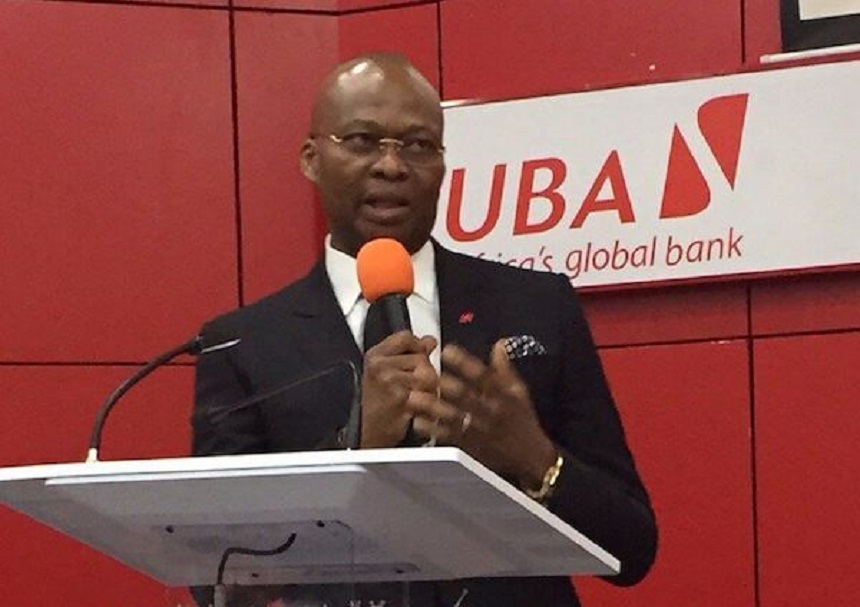
Kennedy Uzoka UBA Shareholders

By Dipo Olowookere

One of the foremost financial institutions in Nigeria, United Bank for Africa (UBA) Plc, raked N5.5 billion as funds transfer fee in the first nine months of 2020.

This information was revealed in the financial statements of the company released to the Nigerian Stock Exchange (NSE) on Friday.

In a brief analysis by Business Post, the amount generated by the lender in the period under review was lower than the corresponding period of 2019, which stood at N6.6 billion.

The funds transfer fee is the amount a bank charges its customers for transferring money from one account to another and in Nigeria, many users of financial services have complained bitterly about the high costs of such transactions, especially as the Central Bank of Nigeria (CBN) is discouraging the use of cash and preaching financial inclusion.

In the first nine months of this year, according to the results of UBA, it generated N6.9 billion from account maintenance, higher than N6.0 billion in the same period of last year, while the electronic banking income raked in N27.9 billion, higher than N26.7 billion in nine months of last year.

These and others left the fees and commission income of the bank in the period at N85.0 billion, lower than N86.5 billion in 2019, while the fees and commission expense rose to N28.8 billion from N23.2 billion.

According to the results, UBA closed September 30, 2020, with an interest income of N317.1 billion as against N297.9 billion recorded a year ago and the increment was largely due to the N137.5 billion generated from term loans to corporate organisations and investment in bonds. However, the interest expense reduced to N131.1 billion from N139.0 billion in 2019.

UBA stated that its profit before tax went down this year to N90.4 billion from N98.2 billion, while the profit after tax also fell to N77.1 billion from N81.6 billion and this can be attributed to the rise in the total operating expenses incurred by the bank in the period under review; N192.7 billion versus N161.6 billion a year ago.

On its balance sheet, there was a significant improvement as the total assets increased to N7.1 trillion year-to-date from N5.6 trillion, while the total liabilities went up to N6.4 trillion from N5.0 trillion, with deposits from customers at N5.2 trillion versus the N3.8 trillion in December 2019.


Dipo Olowookere is a journalist based in Nigeria that has passion for reporting business news stories. At his leisure time, he watches football and supports 3SC of Ibadan. Mr Olowookere can be reached via [email protected]

Click to comment

Leave a Reply

Your email address will not be published. Required fields are marked *

Banking

FairMoney Unveils Asset Financing Solution for Mobility Entrepreneurs

Published

on

FairMoney

By Aduragbemi Omiyale

A new product known as Asset Financing Solution, tailored for those in the Nigerian transportation and logistics sector, has been introduced by a technology-enabled financial institution, FairMoney Microfinance Bank.

This initiative marks a significant expansion of FairMoney’s product ecosystem, moving beyond personal and working capital loans into commercial asset financing. By helping entrepreneurs build a verifiable credit history through vehicle repayments, the company is supporting financial inclusion and participation within the formal economy.

Asset Financing Solution forms part of the lender’s broader commitment to responsible lending and structured financing for eligible operators, as it expands access to asset financing for mobility entrepreneurs across the country through an application process subject to credit assessment and eligibility requirements.

The sector continues to record sustained market activity with reported growth rates of approximately 9.87 per cent–10.1 per cent in late 2025.

As road freight and passenger transport remain the nation’s dominant modes of transit, FairMoney’s new initiative aims to improve access to structured asset financing for thousands of transporters and delivery merchants. By providing access to business-use transport assets, the product helps address limited access to structured financing for micro-SMEs and supports activities within Nigeria’s logistics and mobility sector.

Mobility entrepreneurs seeking to acquire vehicles can now access flexible repayment plans through an application process that is subject to credit assessment and eligibility requirements.

Leveraging its technology-enabled onboarding and risk assessment capabilities, applicants can move through a structured onboarding and evaluation process.

Repayment structures are specifically tailored to the daily and weekly cash-flow realities of mobility businesses, supporting operational continuity and business growth within structured repayment arrangements.

The programme is open to eligible applicants via the FairMoney Business platform and through designated partner hubs across major cities.

“Our mission has always been to increase financial inclusion and create income opportunities by supporting individuals and small business operators in growing their businesses.

“With this solution, we are focused on supporting small business operators and mobility entrepreneurs who contribute significantly to transportation and commercial activity. The solution is designed to provide structured asset financing for eligible operators,” the Managing Director of FairMoney MFB, Mr Henry Obiekea, stated.

Speaking further, he said, “The intra-state transportation sector in Nigeria is experiencing sustained demand and market activity, offering opportunities for mobility and transport operators. The Asset Financing Solution ensures that costs are spread into manageable instalments, thereby supporting small business operations and broader economic participation.”

Continue Reading

Banking

Court Convicts Ex-Access Bank Staff for Unauthorised Withdrawals on 305 Customers’ Account

Published

on

Obadofin Daniel Bamise Hadiza Oyiza Yakubu Access Bank Staff

By Modupe Gbadeyanka

Two former employees of Access Bank Plc, identified as Mr Obadofin Daniel Bamise and Ms Hadiza Oyiza Yakubu, have been convicted and sentenced by Justice A.A. Bello of the Kaduna State High Court for theft.

The convicts were found guilty of a separate one-count charge of theft against them by the Kaduna Zonal Directorate of the Economic and Financial Crimes Commission (EFCC).

They carried out unauthorised withdrawals on the accounts of 305 customers of Access Bank, who were beneficiaries of the federal government’s Palliative Scheme, totalling N7.8 million. They posted the unauthorised withdrawals to the Palliative Scheme’s coordinators’ accounts.

After pleading “guilty” to the charges against them, Justice Bello convicted and sentenced both of them to seven years imprisonment each, with an option of a N50,000 fine each.

According to a statement from the EFCC, the charge against Mr Bamise was, “That you, Obadofin Bamise Daniel sometime between the 5th of November, 2024 and 23rd of January, 2025 in Kaduna, within the jurisdiction of this Honourable Court, while being an employee of Access Bank Plc did in your capacity as an employee committed theft in the sum of N433.000 being property in possession of Access Bank Plc and you thereby committed an offence contrary to Section 274 of the Kaduna State Penal Code Law, 2017 and punishable under same Law.”

The charge against Ms Yakubu was, “That you, Hadiza Oyiza Yakubu sometimes between the 5th of November, 2024 and 23rd of January, 2025 in Kaduna, within the jurisdiction of this Honourable Court, while being an employee of Access Bank Plc did in your capacity as an employee committed theft in the sum of N806,000 being property in possession of Access Bank Plc and you thereby committed an offence contrary to Section 274 of the Kaduna State Penal Code Law, 2017 and punishable under same Law.”

Continue Reading

Banking

Paystack Integrates AI into Dashboard with New Command Centre

Published

on

Paystack

By Adedapo Adesanya

Leading payments technology company, Paystack, has tapped into the AI wave for businesses with the introduction of an AI-powered “Command Centre” that allows businesses to interact with their payment data using plain-language questions instead of manually navigating dashboards.

The redesigned launch marks a major evolution in how businesses interact with the company’s 10-year-old product, which has helped to monitor transactions, manage settlements, review disputes, and run day-to-day payment operations for thousands of merchants.

The revamped dashboard, built on Pax, Paystack’s internal design system, includes the AI-native Command Centre, which is embedded directly into the Dashboard, allowing businesses to ask questions in plain language and receive answers grounded in their own Paystack data, as text, tables, or charts.

The system combines GPT models, structured data retrieval, and visualisation tools to deliver responses in the most relevant format.

It also has a simpler product architecture, with navigation reorganised into two core sections: Payments and Products, making it easier for merchants to find what they need and scale as Paystack’s offerings grow.

In a statement, the company said it also has full mobile parity that makes every screen, feature, and action available on mobile as well as desktop. It also offers a dark mode feature, as well as stronger analytics and clearer navigation built into the foundation of the product

“Businesses don’t come to their dashboard because they want to click through pages. They come because they have questions,” said Ms Dara Assim-Ita, Senior Product Designer at Paystack, who led the rebuild.

“Over the last decade, we have seen firsthand how much time merchants lose navigating tools that were built to display data rather than deliver answers. With this rebuild, we have changed that. Merchants can now simply ask ‘What happened with this transaction?’ or ‘Why is revenue down this week?’ and get a direct answer. The goal is to make the Dashboard feel less like a static reporting tool and more like an intelligent command centre – one that helps merchants understand what’s happening, find what they need faster, and make better decisions.”

To support the experience, Paystack built a new service called Project Canvas API, which handles conversations, connects to model providers, and interfaces with existing Paystack systems.

As the Dashboard handles sensitive financial data, the system was built to ensure responses are grounded in real merchant data and screened against safety and compliance requirements before being returned.

The company also worked closely with its Data Protection and Privacy team, completed a Data Protection Impact Assessment, and ran extensive adversarial testing ahead of launch.

“We are at a point where artificial intelligence is rapidly becoming integral to how businesses operate, and Paystack is committed to being on that curve for our merchants. The most powerful application of AI disappears into the work people are already trying to do, and that was the design principle behind this,” Ms Assim-Ita added.

Continue Reading

Trending