Connect with us

Economy

Crude Oil Rises as Houthi Rebels Strike Aramco Oil Facilities

Published

on

crude oil price at market

By Adedapo Adesanya

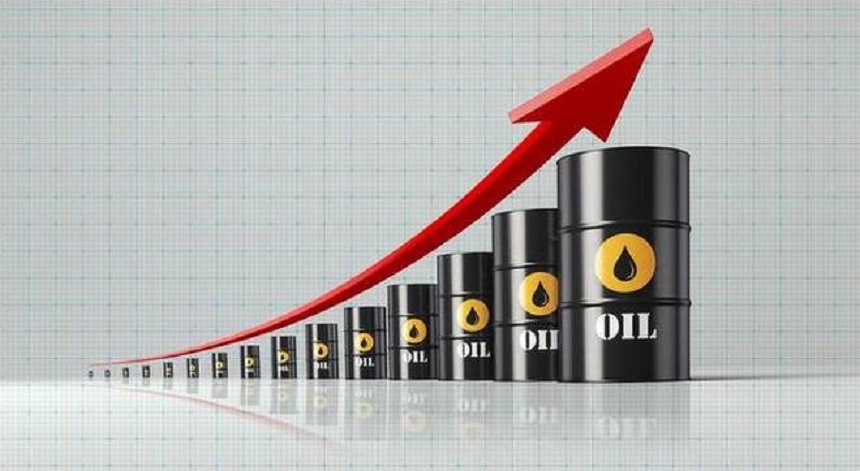
Crude oil prices opened the new week in the positives on Monday, spurred by another set of drone attacks against Saudi Arabian energy giant Aramco’s facilities by Houthi rebels.

The tension raised by this act pushed the price of the Brent higher by 0.38 per cent or 24 cents to $63.19 per barrel and lifted the West Texas Intermediate (WTI) higher by 39 cents or 0.64 per cent to $59.70 per barrel.

The Yemeni Houthis claimed responsibility for the attack on the oil facilities in Saudi Arabia, a reminder of political tensions in the Middle East.

The Houthis targeted Aramco refineries in the western Saudi city of Jeddah and in Jubail in the east, with 10 drones launched at dawn on Monday.

While such attacks have increased this year, they rarely claim lives or cause extensive damage. The attack on the oil facilities comes amid a surge in fighting between the rebels and forces loyal to the Saudi-backed government in Yemen.

The Kingdom condemned the attack against vital installations, noting that it does not only target the Kingdom, but also petroleum exports, the stability of energy supply to the world, freedom of world trade, as well as the global economy.

The Iran-aligned rebels have struck Aramco facilities in the past, targeting the vulnerability of Saudi Arabia’s expensive and strategically vital oil infrastructure.

Prices were also supported by the fall of the US Dollar. A weakened greenback makes commodities such as oil priced in the US currency more attractive.

There are already signs emerging of the potential impact of a steady reopening in the US on consumption. United Airlines Holdings said it saw an acceleration in customer demand in March, while American air passenger numbers remain near their highest level since March.

Despite these positives, the market still has to contend with rising coronavirus cases just as the Organisation of the Petroleum Exporting Countries and its allies (OPEC+) agreed to add more barrels from May.

Iran is also posing a serious threat to the stability of the market as the Middle East giant’s supply may return quicker than expected following advanced talks over sanctions.


Adedapo Adesanya is a journalist, polymath, and connoisseur of everything art. When he is not writing, he has his nose buried in one of the many books or articles he has bookmarked or simply listening to good music with a bottle of beer or wine. He supports the greatest club in the world, Manchester United F.C.

Economy

Police, Capital Market Regulators Partner for Nigeria’s Economic Growth

Published

on

IGP Egbetokun capital market regulators

By Aduragbemi Omiyale

The Nigeria Police Force (NPF) has promised to work with the Securities and Exchange Commission (SEC) and the Nigerian Exchange (NGX) Group Plc for the prevention of financial crime, and the reinforcement of trust and confidence in Nigeria’s capital market.

The Inspector General of Police, Mr Kayode Egbetokun, gave this assurance on Wednesday at the closing gong ceremony in his honour at the NGX in Lagos.

The police chief said, “A transparent and well-regulated capital market is vital to Nigeria’s economic growth. The Nigeria Police Force remains committed to working with regulators and market operators to prevent financial crime, protect investors, and uphold the integrity of our financial system.”

Earlier in his welcome address, the chairman of NGX Group, Mr Umaru Kwairanga, commended the leadership of the police in supporting market integrity.

“Market integrity is a shared responsibility. By honouring the Inspector-General of Police, we are reinforcing the importance of institutional alignment in protecting investors and preserving trust in our financial system.

“Strong collaboration between regulators, enforcement agencies, and market infrastructure institutions is essential to building a resilient and credible market that supports economic growth,” he stated.

The Director-General of SEC, Mr Emomotimi Agama, while speaking, emphasized the importance of coordinated enforcement, noting: “Investor protection is at the core of market regulation, and today’s engagement highlights how critical collaboration with law enforcement is to achieving that mandate. This partnership strengthens our enforcement capacity, enhances deterrence against illegal investment activities, and reinforces confidence in the Nigerian capital market.”

As for the chairman of NGX Limited, Mr Ahonsi Unuigbe, “A transparent and orderly market can only thrive where rules are respected and misconduct is addressed decisively. The presence of the Nigeria Police Force in this collective effort sends a strong signal that safeguarding the market is a national priority.”

Similarly, the chief executive of NGX Group, Mr Temi Popoola, stressed the importance of aligning innovation with oversight, pointing out that, “Technology and market growth must be supported by strong enforcement and investor protection frameworks. Our collaboration with the SEC and the Nigeria Police Force reflects a unified approach to preserving the credibility of Nigeria’s capital market.”

Continue Reading

Economy

NASD OTC Exchange Closes Green by 0.09%

Published

on

NASD OTC exchange

By Adedapo Adesanya

The NASD Over-the-Counter (OTC) Securities Exchange rallied by 0.09 per cent on Wednesday, February 4, amid renewed appetite for unlisted stocks.

This lifted the NASD Unlisted Security Index (NSI) by 3.18 points to 3,641.30 points from the previous session’s 3,641.30 points and raised the market capitalisation by N1.9 billion to N2.180 trillion from the N2.178 trillion quoted on Tuesday.

The bourse recorded three price gainers and four price losers at the midweek session.

The advancers were led by Air Liquide Plc, which went up by N2.04 rise to end at N22.53 per share versus the previous session’s N20.49 per share, Central Securities Clearing System (CSCS) added 97 Kobo to sell at N44.97 per unit versus N44.00 per unit, and Acorn Petroleum Plc appreciated by 2 Kobo to N1.37 per share from N1.35 per share.

On the flip side, Geo-Fluids Plc lost 55 Kobo to sell at N6.26 per unit versus N6.81 per unit, Nipco Plc depreciated by 48 Kobo to trade at N259.00 per share versus N259.48 per share, FrieslandCampina Wamco Nigeria Plc declined by 40 Kobo to N63.10 per unit from N63.50 per unit, and Industrial and General Insurance (IGI) depleted by 1 Kobo to 65 Kobo per share from 66 Kobo per share.

Yesterday, the volume of trades slid by 64.5 per cent to 2.5 million units from 7.0 million units, the value of transaction decreased by 53.2 per cent to N17.7 million from N37.9 million, and the number of deals went down by 47.1 per cent to 18 deals from 34 deals.

CSCS Plc remained the most traded stock by value on a year-to-date basis with 16.0 million units valued at N652.6 million, followed by FrieslandCampina Wamco Nigeria Plc with 1.7 million units exchanged for N111.2 million, and Geo-Fluids Plc with 11.7 million units traded for N76.1 million.

CSCS Plc was also the most active stock by volume on a year-to-date basis with 16.0 million units sold for N652.6 million, trailed by Mass Telecom Innovation Plc with 13.3 million units worth N5.3 million, and Geo-Fluids Plc with 11.7 million units valued at N76.1 million.

Continue Reading

Economy

Naira Rallies to N1,358/$1 at Official Market, N1,450/$1 at Parallel Market

Published

on

Naira parallel market

By Adedapo Adesanya

The Naira rallied at the different segments of the foreign exchange (FX) market on Wednesday as supply continues to outweigh demand, giving it an edge against the United States Dollar.

In the parallel market, the Nigerian Naira improved its value on the greenback yesterday by N5 to quote at N1,450/$1 compared with the previous day’s N1,455/$1, and at the GTBank FX desk, it gained N3 to trade at N1,383/$1, in contrast to Tuesday’s exchange rate of N1,386/$1.

In the the Nigerian Autonomous Foreign Exchange Market (NAFEX), which is also the official market, the Naira firmed up against the Dollar at midweek by N14.63 or 1.1 per cent to settle at N1,358.28/$1 versus the preceding session’s N1,372.91/$1.

Against the Pound Sterling, the domestic currency appreciated on Wednesday by N14.16 to N1,863.43/£1 from the previous day’s N1,877.59/£1, and gained N13.73 on the Euro to end at N1,606.03/€1 versus the N1,619.76/€1 it was exchanged a day earlier.

The strengthening of the Naira value has been driven by the injection of forex into the financial markets by foreign investors seeking attractive investments in the emerging markets, helping to boost Nigeria’s external reserves, which provide the Central Bank of Nigeria (CBN) with the capacity to support the local currency.

As of February 4, 2026, the reserves reached $46.59 billion.

The local currency has been able to find a solid path despite no indications of any intervention from the apex bank in recent week, strengthening the case of price discovery.

Policy moves by the CBN is also offering a backbone for the FX market as it considers some strategic reforms through a policy known as the Single Regulatory Window.

In its 2025 Fintech Report, the central bank said this scheme will significantly reduce time-to-market for new digital financial products by streamlining licensing and supervisory processes across multiple agencies.

Meanwhile, the cryptocurrency market was in red amid a broad sell-off in global technology stocks, with reports showing that liquidity was notably thin, amplifying price moves and contributing to forced liquidations. The decline followed a sharp sell-off in global technology stocks overnight, where concerns over the pace of artificial intelligence adoption and rising capital spending by major firms weighed heavily on valuations.

Bitcoin (BTC) lost 7.9 per cent to sell at $70,534.94, Ripple (XRP) declined by 11.2 per cent to $1.42, Binance Coin (BNB) slumped by 9.4 per cent to $689.70, Ethereum (ETH) crashed by 8.9 per cent to $2,072.46, and Solana (SOL) dipped by 8.7 per cent to $89.86.

In addition, Dogecoin (DOGE) depreciated by 6.9 per cent to $0.1008, Cardano (ADA) slipped by 6.8 per cent to $0.2792, Litecoin (LTC) dropped 5.1 per cent to trade at $57.56, and US Dollar Tether (USDT) went down by 0.1 per cent to $0.9980, while the US Dollar Coin (USDC) closed flat at $1.00.

Continue Reading

Trending