Connect with us

Economy

NGX: All-Share Index Slips Back to 38,000 Region After 1.66% Loss

Published

on

NSE All-Share Index

By Dipo Olowookere

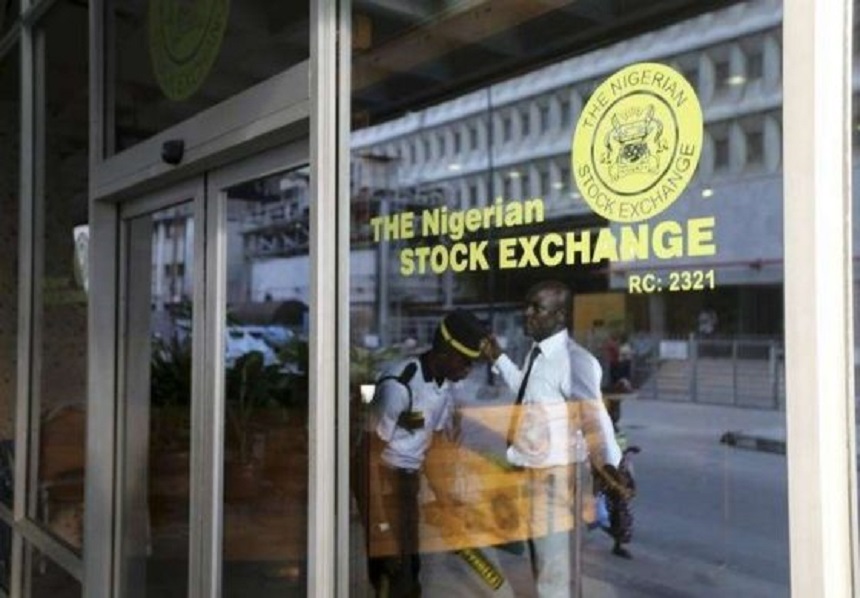
The first trading session on the floor of the Nigerian Exchange (NGX) Limited was bearish as the market went down by 1.66 per cent on Tuesday.

The stock market was shut down on Monday as a result of the Democracy Day public holiday declared by the federal government to celebrate June 12.

Investors returned yesterday to take profit from the gains posted in the previous trading sessions and this weakened the All-Share Index (ASI) by 648.99 points to 38,507.29 points from 39,156.28 points of the preceding session.

In the same vein, this selling pressure reduced the market capitalisation of the exchange by N340 billion to N20.069 trillion from N20.409 trillion it closed last Friday.

Business Post reports that the market breadth was negative as there were only 19 price gainers against the 26 price losers recorded at the close of transactions.

Airtel Africa was the heaviest price loser as its share price went down by 10.00 per cent to N753.30, followed by Okomu Oil, which dropped 9.44 per cent to N105.50.

Cornerstone Insurance depreciated by 9.09 per cent to 50 kobo, Learn Africa declined by 8.00 per cent to 92 kobo, while Livestock Feeds reduced by 4.74 per cent to N1.81.

On the flip side, CWG topped the gainers’ chart after its value went up yesterday by 9.73 per cent to N1.24. Berger Paints gained 6.72 per cent to sell for N7.15, Red Star Express rose by 4.19 per cent to N3.23, NEM Insurance appreciated by 3.89 per cent to N1.87, while Coronation Insurance gained 3.64 per cent to 57 kobo.

On the trading day, Access Bank was the most active stock. The tier-one banking institution traded 43.1 million units of its shares valued at N359.5 million.

Sterling Bank transacted 33.2 million units worth N52.1 million, Zenith Bank exchanged 25.9 million units valued at N602.2 million, UAC Nigeria transacted 22.9 million units worth N216.8 million, while Union Homes REIT sold 19.0 million units valued at N695.9 million.

At the close of business, a total of 297.3 million shares worth N3.7 billion were traded in 4,402 deals compared with the 289.1 million shares worth N3.6 billion transacted in 3,719 deals the preceding day. This indicated that the trading volume, value and number of deals increased by 2.86 per cent, 2.96 per cent and 18.37 per cent respectively.

In terms of the sectors’ performances, the consumer goods space declined by 0.18 per cent, while the industrial goods counter closed flat, with the insurance, banking and energy sectors closing higher by 0.41 per cent, 0.16 per cent and 0.13 per cent apiece.


Dipo Olowookere is a journalist based in Nigeria that has passion for reporting business news stories. At his leisure time, he watches football and supports 3SC of Ibadan. Mr Olowookere can be reached via [email protected]

Advertisement
Click to comment

Leave a Reply

Your email address will not be published. Required fields are marked *

Economy

NECA, CPPE Laud CBN’s 0.50% Interest Rate Cut

Published

on

CBN - Yemi Cardoso

By Adedapo Adesanya

The Nigeria Employers’ Consultative Association (NECA) and the Centre for the Promotion of Private Enterprise (CPPE) have separately commended the Central Bank of Nigeria (CBN) for reducing the Monetary Policy Rate (MPR) from 27.0 per cent to 26.5 per cent at its 304th Monetary Policy Committee (MPC) meeting.

In reaction, NECA Director-General, Mr Adewale-Smatt Oyerinde, praised the decision in a statement, noting that the 50 basis-point cut is “a cautious but noteworthy signal” that authorities were responding to sustained pressures on businesses.

He said the marginal reduction might not immediately lower lending rates, but reflected “a gradual shift toward supporting growth without undermining price stability”.

According to him, the overall stance remained tight, with the Cash Reserve Ratio retained at 45 per cent and the liquidity ratio at 30 per cent.

He added that the asymmetric corridor around the MPR was also maintained, reinforcing a cautious monetary approach.

“With a substantial portion of deposits still sterilised, banks’ capacity to expand credit to the real sector may remain constrained in the near term,” he said.

Mr Oyerinde described the move as “a careful balancing act” aimed at moderating inflation without worsening pressures on businesses.

He noted that firms continued to grapple with high operating costs, exchange rate volatility and weakened consumer demand.

“Inflation, particularly in food, energy and transportation, remains a significant challenge to employers and households,” he said.

He stressed that the modest easing must be supported by coordinated fiscal and structural reforms to address supply-side constraints.

Such reforms, he said, should improve infrastructure and enhance productivity across key sectors of the economy.

Mr Oyerinde urged financial institutions to ensure the MPR reduction was gradually reflected in lending conditions for manufacturers and SMEs.

He affirmed that although the MPC had not fully relaxed its tightening stance, the rate cut signalled cautious optimism.

“Sustained improvements in inflation, exchange rate stability and investor confidence will determine scope for further easing that supports growth and employment,” he said.

On its part, the CPPE said the decision reflected improving macroeconomic fundamentals and a cautious shift from aggressive tightening.

The organisation noted that sustained disinflation, stronger external reserves, an improved trade balance and relative exchange-rate stability had created room for monetary easing.

It said the rate cut could boost investor confidence and support private-sector growth, but cautioned that weak monetary transmission might limit its impact on lending rates.

The CPPE identified high cash reserve requirements, elevated lending rates, government borrowing and structural banking costs as major constraints to effective transmission.

The group also stressed the need for fiscal consolidation, citing high public debt, persistent deficits and rising debt-service obligations as risks to macroeconomic stability.

According to the chief executive of CPPE, Mr Muda Yusuf, effective policy coordination and stronger transmission mechanisms were critical to unlocking investment and sustaining growth, lauding the CBN for what he described as a measured and data-driven policy adjustment.

The CPPE boss noted that the easing reflected strengthening macroeconomic performance, declining inflation, growing reserves, improved trade balance and enhanced foreign exchange stability.

Mr Yusuf added that for the benefits of monetary easing to be fully realised, authorities must strengthen transmission to ensure lower lending rates for the real sector and advance credible fiscal consolidation to safeguard stability.

He said that if supported by structural reforms and disciplined fiscal management, the current policy direction could unlock a stronger investment cycle and more durable economic growth.

Continue Reading

Economy

NASD Index Falls 0.28% as Investors Lose N6.64bn

Published

on

NASD Unlisted Securities Index

By Adedapo Adesanya

The NASD Over-the-Counter (OTC) Securities Exchange extended the negative start to the week by 0.28 per cent on Tuesday, February 24, with the market capitalisation down by N6.64 billion to close at N2.378 trillion versus Monday’s N2.384 trillion, and the NASD Unlisted Security Index (NSI) falling by 11.1 points to 3,974.80 points from 3,985.90 points.

At the session, transaction value skyrocketed by 1,706.3 per cent to N1.2 billion from the previous day’s N61.8 million, as the transaction volume increased by 59.1 per cent to 11.6 million units from 7.3 million units, and the number of deals expanded by 23.1 per cent to 48 deals from the preceding session’s 39 deals.

Central Securities Clearing System (CSCS) Plc remained the most active stock by value on a year-to-date basis with 33.7 million units exchanged for N2.0 billion, Okitipupa Plc was next with 6.2 million units traded for N1.1 billion, and Geo-Fluids Plc occupied the third position with 121.0 million units valued at N474.9 million.

Resourcery Plc emerged as the most traded stock by volume on a year-to-date basis with 1.05 billion units worth N408.7 million, followed by Geo-Fluids Plc with the sale of 121.0 million units for N474.9 million, and CSCS Plc with 33.7 million units worth N2.0 billion.

Yesterday, the market breadth was flat after the bourse finished with three price gainers and three price losers led by MRS Oil Plc, which shed N14.50 to close at N200.00 per share versus the previous day’s N214.50 per share, CSCS Plc depleted by N1.39 to N65.82 per unit from N67.21 per unit, and Geo-Fluids Plc depreciated by 1 Kobo to close at N3.30 per share versus Monday’s N3.31 per share.

The price gainers were led by FrieslandCampina Wamco Nigeria Plc, which improved its value by N1.60 to close at N95.00 per unit compared with the preceding session’s N93.40 per unit, Afriland Property Plc gained 83 Kobo to sell at N18.00 per share versus N17.17 per share, and First Trust Mortgage Bank Plc advanced by 13 Kobo to N1.45 per unit from N1.32 per unit.

Continue Reading

Economy

Nigerian Exchange Sheds 0.92%

Published

on

Nigerian Exchange

By Dipo Olowookere

The Nigerian Exchange (NGX) Limited depreciated by 0.92 per cent on Tuesday after the Central Bank of Nigeria (CBN) slashed the benchmark interest rate by 0.5 per cent to 26.50 per cent at the end of its first Monetary Policy Committee (MPC) meeting for 2026.

Sell-offs mainly occurred in the consumer goods and insurance sectors, shedding 4.74 per cent and 1.31 per cent, respectively.

However, bargain-hunting remained in the others, with the industrial goods index gaining 1.92 per cent, the banking counter grew by 1.23 per cent, and the energy sector soared by 0.15 per cent.

When the bourse ended for the session, the All-Share Index (ASI) gave up 1,779.03 points to close at 194,484.52 points compared with the previous day’s 196,263.55 points, and the market capitalisation declined by N1.142 trillion to N124.827 trillion from N125.969 trillion.

DAAR Communications depreciated by 10.00 per cent to N2.25, Tantalizers also declined by 10.00 per cent to N4.86, BUA Foods shrank by 9.99 per cent to N760.60, Ellah Lakes slumped 9.96 per cent to N10.40, and Japaul lost 9.95 per cent to trade at N3.80.

Conversely, Jaiz Bank appreciated by 10.00 per cent to N12.76, Infinity Trust Mortgage Bank went up by 9.83 per cent to N19.00, FCMB gained 9.72 per cent to close at N13.55, Fortis Global Insurance chalked up 9.09 per cent to finish at 72 Kobo, and Sterling Holdco grew by 7.50 per cent to N8.60.

A total of 27 stocks ended on the gainers’ chart and 40 stocks finished on the losers’ table, indicating a negative market breadth index and weak investor sentiment.

Yesterday, investors bought and sold 1.1 billion equities worth N53.4 billion in 72,218 deals compared with the 1.3 billion equities valued at N31.5 billion in 95,091 deals recorded a day earlier.

This showed that the value of transactions went up by 69.52 per cent, the volume of trades declined by 15.39 per cent, and a slip in the number of deals by 24.05 per cent.

During the session, Japaul was the most active stock with 102.4 million units worth N399.8 million, Access Holdings exchanged 97.9 million units valued at N2.6 billion, Fortis Global Insurance traded 75.2 million units for N54.1 million, Zenith Bank sold 67.6 million units valued at N6.2 billion, and FCMB transacted 46.4 million units worth N612.2 million.

Continue Reading

Trending