Economy
FG Designs Online Portal to Monitor Agric Interventions to Farmers
By Modupe Gbadeyanka
An online portal aimed to ensure efficient and effective monitoring of federal government intervention in the agricultural sector has been designed by the federal government.
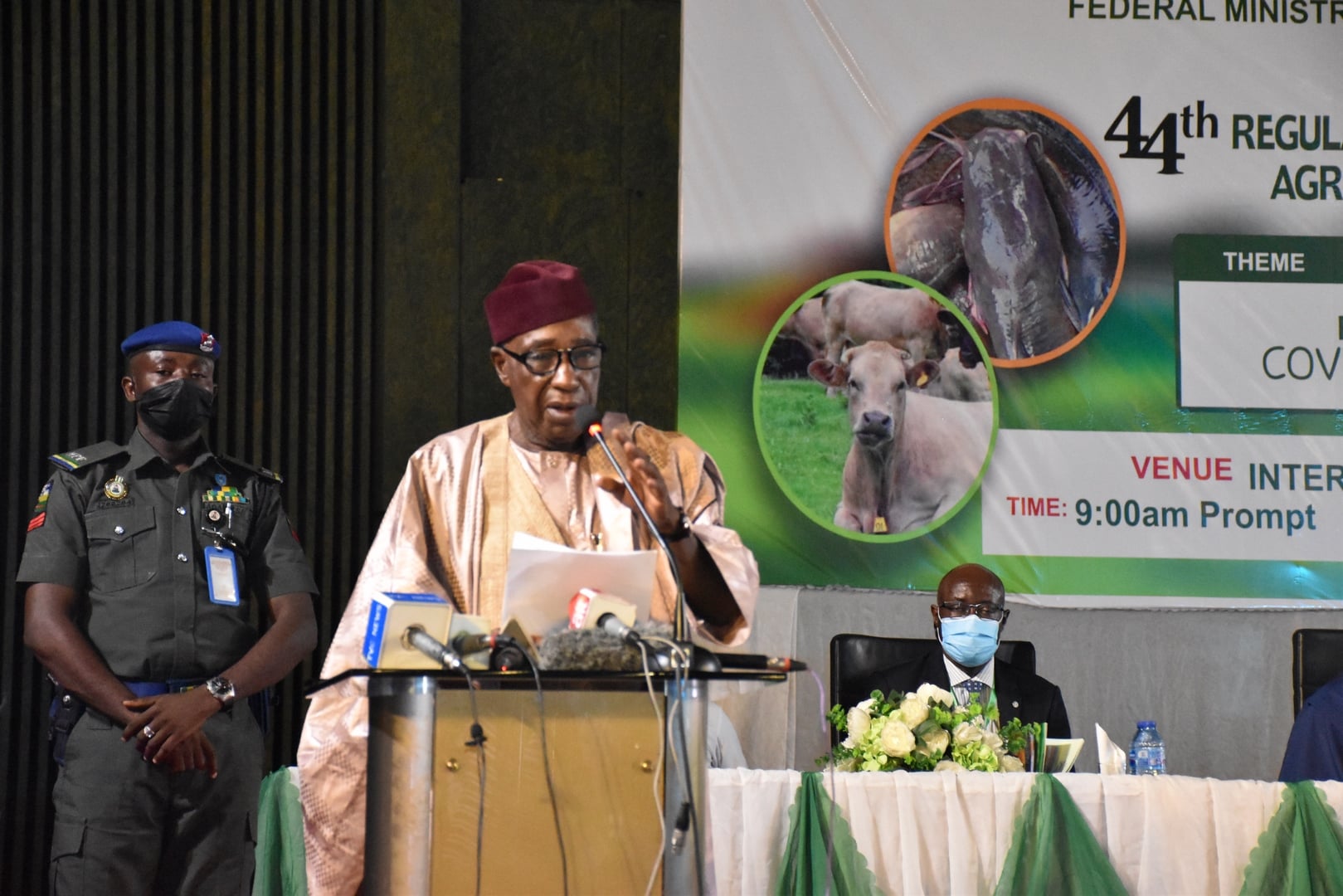
The Minister of Agriculture and Rural Development, Mr Muhammad Sabo Nanono, disclosed that the initiative will capture the biodata of about 10 million farmers and link it with geographical information of their farmed plots, crops and the volumes of production in the country.
Speaking during the opening ceremony of the 44th council meeting of the National Council on Agriculture and Rural Development (NCARD) held at the International Conference Centre, Abuja on Thursday, June 17, 2021, the Minister said the portal was initially designed to “capture the data of 2.4 million farmers across the country, the results from the exercise have encouraged the Economic Sustainability Plan team to expand the data capture to 10 million farmers.”
He stated that the database will be “a platform for the federal government interventions going forward, putting an end to ghost schemes and other unscrupulous practices in the agricultural industry.”
Mr Nanono noted that “a major hallmark of our agricultural interventions is inclusiveness. We have catered for the youths, women, and many demographic considerations in our implementation strategies.”
The Minister explained that “as a stop-gap intervention, we launched the Agric for Food and Jobs Program, originally conceived as an input loan for smallholder farmers across several commodities including maize, rice, cotton, groundnut, sorghum, cowpea, soybean, sesame, cassava and oil palm.”
“The scheme brought into a partnership with the Central Bank of Nigeria (CBN), Commodity Association and Agricultural Platform Companies for effective facilitation.
“This we believe will not only improve production significantly but also aid in the off–taking of produce while providing input at a reduced price due to economy of scale,” he said.
Mr Nanono noted that “the challenges brought by the emergence of the COVID–19 pandemic, floods and insecurity has galvanised the government into setting up a necessary structure to address the infrastructural deficiency, technology gaps, security challenges, and extension inadequacy.”
“This approach is believed to be the right one for achieving our desired economic diversification and national development,” the Minister added.
He noted that the NCARD would promote the existing policies, programmes, and projects at the national and sub-national levels for the purpose of entrenching synergy, best practices, entrepreneurship, livelihood, and growth in the sector.
Mr Nanono reemphasised that “agricultural productivity can only improve through the mechanization of production activities. In our effort to improve the agricultural production profile of the country, we have entered into a partnership with the government of Brazil through one of their foremost technology transfer, the Fundacao Getulio Vargas (FGV).”
He further said that “this partnership has yielded an agricultural mechanisation loan to the tune of €995 million. This shall be granted to Nigerian entrepreneurs to establish service centres across all the 774 Local Government of the country, selling services to all categories of farmers and thereby helping to improve their productivity.”
“The services centres shall be either a Type 1, supporting production activities or Type 2, supporting processing and packaging activities,” he explained.
The Minister informed that “the ministry in collaboration with the Nigerian Export Promotion Council (NEPC) has been working to exploit a strategic advantage in the production of commodities like sesame, hibiscus, cotton and sorghum to improve production protocols to conform with internationally acceptable standards, maintenance of an exporters’ directory and exporter certificate verification portal.”
He stressed that “the ministry has embarked on increasing the number of available extension workers in the different aspects of our operations. This year, about 1,200 extension workers have been trained.”
The Minister highlighted that “with the green imperative project launching soon, there is a component of it that will see the training of extension workers in agricultural mechanisation and other important aspects of crop and livestock operations.”
He pointed out that “the National Livestock Transformation Plan (NLTP), has been adjudged worldwide to be a well-conceived project which seeks to transform our livestock sector from the nomadic – dependent sector into an organised ranching one.”
“To this end, 22 states and Federal Capital Territory have registered with the NLTP Office. Seven of these 10 states have also earmarked about 19 grazing reserves for the implementation of the NLTP, with a total land size of approximately 400,000 hectares,” he said.
According to him, it is, therefore, safe to say, that NLTP, when fully implemented, will bring an end to the incessant clashes between the farmers and herdsmen at the same time introduce the herders to the modern way of raising cattle, with all added benefits of improved feeding, animal and human, genetic improvement, value addition and better socio-economic standing for all participants.
In his remarks, the Minister of Federal Capital Territory Administration (FCTA), Mr Mohammed Musa Bello, represented by the Special Assistant, Prof. Mohammed Usman, said that the theme of this year’s council meeting Agriculture and Food Security in the face of COVID-19, Floods and Insecurity is apt enough and a reminder to the effect that we are yet to win the fight on the pandemic.
He added there is a need for robust interaction and ideas among stakeholders on how to reposition the Agricultural sector.
In his welcome address, the Minister of State, Agriculture and Rural Development, Mr Mustapha Baba Shehuri, said that “Nigeria economy had its GDP contracted for two consecutive terms of the second and third quarter in 2020; leading to recession.
“It was in the fourth quarter of 2020 that the economy returned to positive growth with GDP expanding to 0.1 per cent from the contraction of 3.6 per cent (negative growth) experienced in the third quarter. The feat was achieved through the contribution mainly attributed to the performance of the agricultural sector.”
Mr Shehuri observed that “as a matter of fact, local production of maize, rice, cassava, potatoes, yam, and other staples steadily increased, it is also the same story in livestock, fisheries and dairy sector. The fact that we did not import food during the lockdown era was a testimony that we can grow what we eat and eat what we produce.”
In his goodwill message, the Chairman, House Committee on Agricultural Production and Services, Mr Muntari Mohammed Dandutse, stated the National Assembly would fast-track the bills being raised as an outcome or resolution of the NCARD towards achieving food security and job creation.
While giving a vote of thanks, the Permanent Secretary in the Ministry, Mr Ernest Umakhihe, thanked the stakeholders for their commitment and technical support during the 44th Regular Meeting of the National Council on Agriculture and Rural Development.
Economy
Adedeji Urges Nigeria to Add More Products to Export Basket
By Adedapo Adesanya
The chairman of the Nigeria Revenue Service (NRS), Mr Zacch Adedeji, has urged the country to broaden its export basket beyond raw materials by embracing ideas, innovation and the production of more value-added and complex products
Mr Adedeji said this during the maiden distinguished personality lecture of the Faculty of Administration, Obafemi Awolowo University (OAU), Ile-Ife, Osun State, on Thursday.
The NRS chairman, in the lecture entitled From Potential to Prosperity: Export-led Economy, revealed that Nigeria experienced stagnation in its export drive over three decades, from 1998 to 2023, and added only six new products to its export basket during that period.
He stressed the need to rethink growth through the lens of complexity by not just producing more of the same stuff, lamenting that Nigeria possesses a high-tech oil sector and a low-productivity informal sector, as well as lacking “the vibrant, labour-absorbing industrial base that serves as a bridge to higher complexity,” he said in a statement by his special adviser on Media, Dare Adekanmbi.
Mr Adedeji urged Nigeria to learn from the world by comparative studies of success and failure, such as Vietnam, Bangladesh, Indonesia, South Africa, and Brazil.
“We are not just looking at numbers in a vacuum; we are looking at the strategic choices made by nations like Vietnam, Indonesia, Bangladesh, Brazil, and South Africa over the same twenty-five-year period. While there are many ways to underperform, the path to success is remarkably consistent: it is defined by a clear strategy to build economic complexity.
“When we put these stories together, the divergence is clear. Vietnam used global trade to build a resilient, complex economy, while the others remained dependent on natural resources or a single low-tech niche.
“There are three big lessons here for us in Nigeria as we think about our roadmap. First, avoiding the resource curse is necessary, but it is not enough. You need a proactive strategy to build productive capabilities,” he stated, adding that for Nigeria, which is at an even earlier stage of development and even less diversified than these nations, the warning is stark.
“Relying solely on our natural endowments isn’t just a path to stagnation; it’s a path to regression. The global economy increasingly rewards knowledge and complexity, not just what you can dig out of the ground. If we want to move from potential to prosperity, we must stop being just a source of raw materials and start being a source of ideas, innovation, and complex products,” the taxman stated.
He added that President Bola Tinubu has already begun the difficult work of rebuilding the economy, building collective knowledge to innovate, produce, and build a resilient economy.
Economy
Nigeria Inaugurates Strategy to Tap into $7.7trn Global Halal Market
By Adedapo Adesanya
President Bola Tinubu on Thursday inaugurated Nigeria’s National Halal Economy Strategy to tap into the $7.7 trillion global halal market and diversify its economy.
President Tinubu, while inaugurating the strategy, called for disciplined, inclusive, and measurable action for the strategy to deliver jobs and shared prosperity across the country.
Represented by Vice-President Kashim Shettima, he described the unveiling of the strategy as a signal of Nigeria’s readiness to join the world in grabbing a huge chunk of the global halal economy already embraced by leading nations.
“As well as to clearly define the nation’s direction within the market, is expected to add an estimated $1.5 billion to the nation’s Gross Domestic Product (GDP) by 2027. It is with this sense of responsibility that I formally unveil the Nigeria National Halal Economy Strategy.
“This document is a declaration of our promise to meet global standards with Nigerian capacity and to convert opportunity into lasting economic value. What follows must be action that is disciplined, inclusive, and measurable, so that this Strategy delivers jobs, exports, and shared prosperity across our nation.
“It is going to be chaired by the supremely competent Minister of Industry, Trade and Investment.”
The president explained that the halal-compliant food exports, developing pharmaceutical and cosmetic value chains would position Nigeria as a halal-friendly tourism destination, and mobilising ethical finance at scale,” by 2030.
“The cumulative efforts “are projected to unlock over twelve billion dollars in economic value.
“While strengthening food security, deepening industrial capacity, and creating opportunities for small-and-medium-sized enterprises across our states,” he added.
Allaying concerns by those linking the halal with religious affiliation, President Tinubu pointed out that the global halal economy had since outgrown parochial interpretations.
“It is no longer defined solely by faith, but by trust, through systems that emphasise quality, traceability, safety, and ethical production. These principles resonate far beyond any single community.
“They speak to consumers, investors, and trading partners who increasingly demand certainty in how goods are produced, financed, and delivered. It is within this broader understanding that Nigeria now positions itself.”
Tinubu said many advanced Western economies had since “recognised the commercial and ethical appeal of the halal economy and have integrated it into their export and quality-assurance systems.”
President Tinubu listed developed countries, including the United Kingdom, France, Germany, the Netherlands, the United States, Canada, Australia, and New Zealand.
“They are currently among the “leading producers, certifiers, and exporters of halal food, pharmaceuticals, cosmetics, and financial products.”
He stated that what these developed nations had experienced is a confirmation of a simple truth, that “the halal economy is a global market framework rooted in standards, safety, and consumer trust, not geography or belief.”
The president explained that the Nigeria national halal economy strategy is the result of careful study and sober reflection.
He added that it was inspired by the commitment of his administration of “to diversify exports, attract foreign direct investment, and create sustainable jobs across the federation.
“It is also the product of deliberate partnership, developed with the Halal Products Development Company, a subsidiary of the Saudi Public Investment Fund.
“And Dar Al Halal Group Nigeria, with technical backing from institutions such as the Islamic Development Bank and the Arab Bank for Economic Development in Africa.”
The Minister of Industry, Trade and Investment, Mrs Jumoke Oduwole, said the inauguration of the strategy was a public-private collaboration that has involved extensive interaction with stakeholders.
Mrs Oduwole, who is the Chairperson, National Halal Strategy Committee, said that the private sector led the charge in ensuring that it is a whole-of-government and whole-of-country intervention.
The minister stressed that what the Halal strategy had done for Nigeria “is to position us among countries that export Halal-certified goods across the world.
The minister said, “We are going to leverage the African Continental Free Trade Area (AfCFTA) to ensure that we export our Halal-friendly goods to the rest of Africa and beyond to any willing markets; participation is voluntary. “
She assured that as the Chairperson, her ministry would deliver on the objectives of the strategy for the prosperity of the nation.
The Chairman of Dar Al-Halal Group Nigeria L.td, Mr Muhammadu Dikko-Ladan, explained that the Halal Product Development Company collaborated with the group in developing the strategy.
“In addition to the strategy, an export programme is underway involving the Ministry of Trade and Investment, through which Nigerian companies can be onboarded into the Saudi Arabian market and beyond.£
Mr Dikko-Ladan described the Strategy as a landmark opportunity for Nigeria, as it creates market access and attracts foreign direct investment.
Economy
UK, Canada, Others Back New Cashew Nut Processing Plant Construction in Ogun
By Adedapo Adesanya
GuarantCo, part of the Private Infrastructure Development Group (PIDG), has provided a 100 per cent guarantee to support a $75 million debt facility for Robust International Pte Ltd (Robust) to construct a new cashew nut processing plant in Ogun State, Nigeria.
GuarantCo, under the PIDG is funded by the United Kingdom, the Netherlands, Switzerland, Australia, Sweden and Canada, mobilises private sector local currency investment for infrastructure projects and supports the development of financial markets in lower-income countries across Africa and Asia.
Nigeria is one of Africa’s largest cashew producers of 300,000 tonnes of raw cashew nuts annually, yet currently less than 10 per cent are processed domestically. Most raw nuts are exported unprocessed to Asian and other countries, forfeiting up to 80 per cent of their potential export value and adding exposure to foreign exchange fluctuations.
According to GuarantCo, this additional plant will more than double Robust’s existing cashew processing capacity from 100 metric tonnes per day to 220 metric tonnes per day to help reduce this structural gap.
The new plant will be of extensive benefit to the local economy, with the procurement of cashew nuts from around 10,000 primarily low-income smallholder farmers.
There is an expected increase in export revenue of up to $335 million and procurement from the local supply chain over the lifetime of the guarantee.
Furthermore, the new plant will incorporate functionality to convert waste by-products into value-added biomass and biofuel inputs to enhance the environmental impact of the transaction.
It is anticipated that up to 900 jobs will be created, with as many as 78 per cent to be held by women. Robust also has a target to gradually increase the share of procurement from women farmers, from 15 per cent to 25 per cent by 2028, as it reaches new regions in Nigeria and extends its ongoing gender-responsive outreach programme for farmers.
Terms of the deal showed that the debt facility was provided by a Symbiotics-arranged bond platform, which in turn issued notes with the benefit of the GuarantCo guarantee. These notes have been subscribed to in full by M&G Investments. The transaction was executed in record time due to the successful replication of two recent transactions in Côte d’Ivoire and Senegal, again in collaboration with M&G Investments and Symbiotics.
Speaking on the development, the British Deputy High Commissioner, Mr Jonny Baxter, said: “The UK is proud to support innovative financing that mobilises private capital into Nigeria’s productive economy through UK-backed institutions such as PIDG. By backing investment into local processing and value addition, this transaction supports jobs, exports and more resilient agricultural supply chains. Complementing this, through the UK-Nigeria Enhanced Trade and Investment Partnerships and the Developing Countries Trading Scheme, the UK is supporting Nigerian businesses to scale exports to the UK and beyond, demonstrating how UK-backed partnerships help firms grow and compete internationally.”
Mr Dave Chalila, Head of Africa and Middle East Investments at GuarantCo, said: “This transaction marks GuarantCo’s third collaboration with M&G Investments and Symbiotics, emphasising our efforts to bring replicability to everything we do so that we accelerate socio-economic development where it matters most. The transaction is consistent with PIDG’s mandate to mobilise private capital into high-impact, underfinanced sectors. In this case, crowding in institutional investors in the African agri-processing value chain.
“As with the two recent similarly structured transactions, funding is channelled through the Symbiotics institutional investor platform, with the notes externally rated by Fitch and benefiting from a rating uplift due to the GuarantCo guarantee.”
Adding his input, Mr Vishanth Narayan, Group Executive Director at Robust International Group, said: “As a global leader in agricultural commodities, Robust International remains steadfast in its commitment to building resilient, ethical and value-adding supply chains across origin and destination markets. This transaction represents an important step in advancing our long-term strategy of strengthening processing capabilities, deepening engagement with farmers and enhancing local value addition in the regions where we operate. Through sustained investment, disciplined execution and decades of operating experience, we continue to focus on delivering reliable, high-quality products while fostering inclusive and sustainable economic growth.”
For Ms María Redondo, director at M&G Investments, “The guarantee gives us the assurance to invest in hard currency, emerging market debt, while supporting Robust’s new cashew processing plant in Nigeria. It’s a clear example of how smart credit enhancement can unlock institutional capital for high-impact development and manage currency and credit risks effectively. This is another strong step in channelling institutional capital into meaningful, on‑the‑ground growth.”
Also, Ms Valeria Berzunza, Structuring & Arranging at Symbiotics, said: “We are pleased to continue our collaboration with M&G Investments, GuarantCo, and now with Robust through a transaction with a strong social and gender focus, demonstrating that well-structured products can boost commercially attractive, viable, and impactful investments.”
-
Feature/OPED6 years agoDavos was Different this year
-
Travel/Tourism9 years ago
Lagos Seals Western Lodge Hotel In Ikorodu
-
Showbiz3 years agoEstranged Lover Releases Videos of Empress Njamah Bathing
-
Banking8 years agoSort Codes of GTBank Branches in Nigeria
-
Economy3 years agoSubsidy Removal: CNG at N130 Per Litre Cheaper Than Petrol—IPMAN
-
Banking3 years agoSort Codes of UBA Branches in Nigeria
-
Banking3 years agoFirst Bank Announces Planned Downtime
-
Sports3 years agoHighest Paid Nigerian Footballer – How Much Do Nigerian Footballers Earn