Connect with us

Economy

Nigeria Can Boost FX Earnings by 70% from Leather—Osinbajo

Published

on

FX Earnings leather

By Aduragbemi Omiyale

The decline in crude oil prices caused by the COVID-19 pandemic in 2020 put the Nigerian economy under pressure as foreign exchange earnings slumped significantly.

At a point last year, the price of the Brent crude, under which Nigeria’s crude oil is graded, was selling at $20 per barrel and this caused a plunge in revenue as most of the country’s earnings are from the sale of the commodity.

As a result, the nation slipped into another recession in the third quarter of 2021 after the gross domestic product (GDP) contracted by 3.62 per cent after a 6.10 per cent decline in the second quarter of the year.

It was the second time the economy was sliding into a recession in four years after it had one in 2016. However, unlike the previous one, last year’s recession was short-lived as the nation exited in the fourth quarter of the year after a 0.11 per cent GDP growth.

Despite the country out of recession, there is still an FX liquidity crisis in Nigeria and the Vice President, Mr Yemi Osinbajo, is of the view that the leather products value chain can be of great assistance if well harnessed.

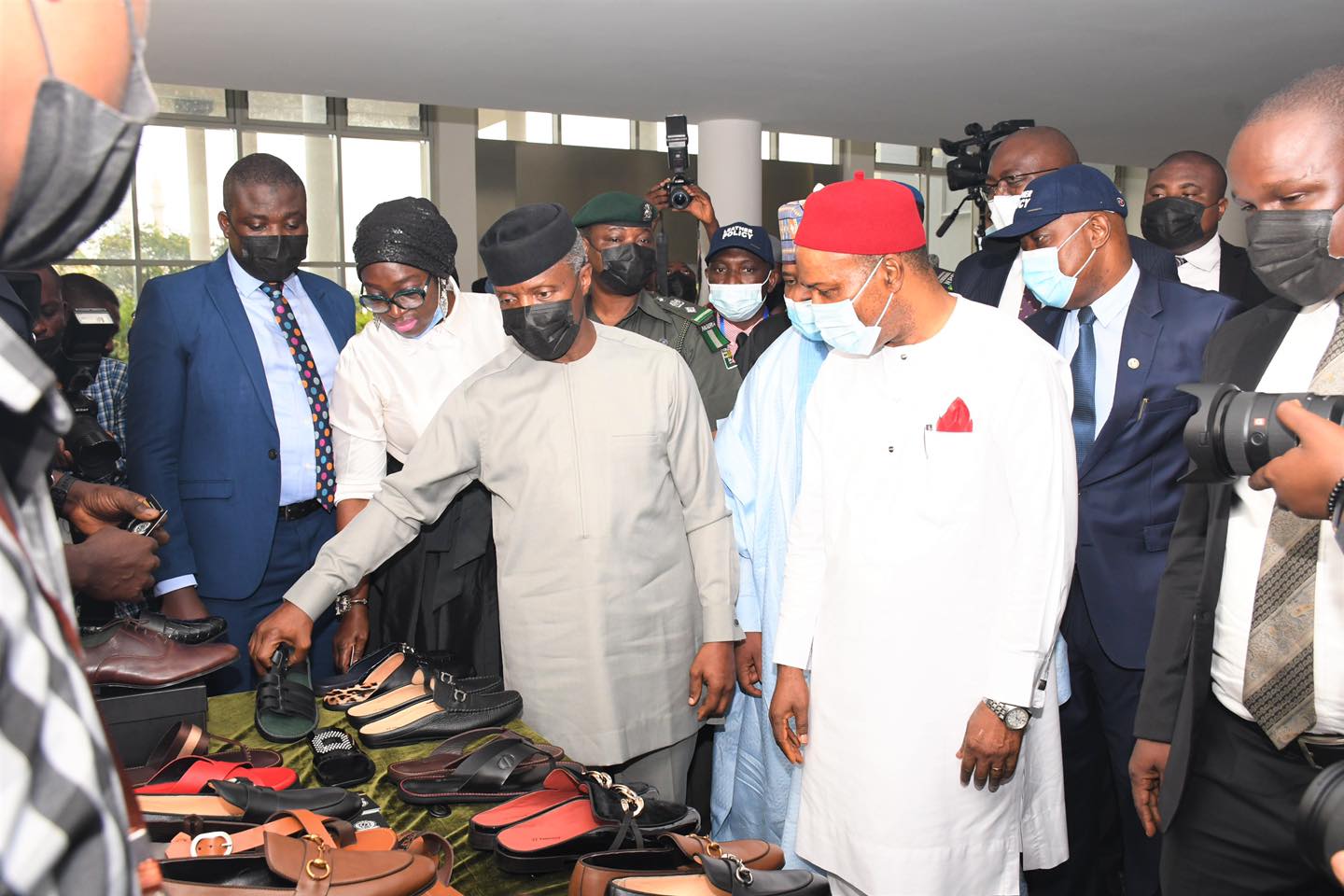
Speaking on Tuesday in Abuja at the formal launch and sensitisation workshop on the National Leather and Leather Products Policy Implementation Plan, he said the nation can boost its FX earnings from the sector by 70 per cent.

He noted that by 2025, the leather products industry will generate over $1 billion and create employment for over 700,000 people.

The Vice President, who described the implementation of the leather products policy as holistic, added that it will also provide a more sustainable infrastructure development plan and guaranteed access to credit facilities for business people.

According to him, countries like Spain, Italy, China and the West African sub-region are prime destinations for Nigerian leather products.

In his keynote address, Mr Ogbonnaya Onu the Minister of Science and Technology, hailed the leather products policy as the first strategic implementation plan for the leather and leather products policy in Nigeria.

“The Federal Ministry of Science and Technology is supporting this important initiative through offering leadership in the transformation of our economy from a resource-based to a knowledge and innovation-driven one,” he said.

The Minister further said the policy will help the effective and efficient exploitation of Nigeria’s natural resources, earn and conserve foreign exchange, create jobs and help promote the country’s drive for self-reliance.

He called on all relevant stakeholders to facilitate both foreign and domestic investments, saying, “We need to transform our plan into action, we need all stakeholders to work together, we need to involve the Organised Private Sector, we need to bring in more investment, both domestic and foreign into the leather industry.”

The Minister of State for Science and Technology, Mr Mohammed Abdullahi, said the implementation plan was delicate and vital to reposition Nigeria for socio-economic growth and development, saying that the implementation plan covers eight thematic areas which are; Research and Development, Governance, Intellectual property Rights, E-Leather, Compliance, Environment and social best practices, standards, marketing and patronage, Funding as well as fiscal measures and critical infrastructure.

He also noted that if the leather policy is fully implemented, it will create an enabling environment that will sustain all-inclusive growth for local and small enterprises as well attract and protect investments, improve production output and promote innovation in the country.


Aduragbemi Omiyale is a journalist with Business Post Nigeria, who has passion for news writing. In her leisure time, she loves to read.

Advertisement
Click to comment

Leave a Reply

Your email address will not be published. Required fields are marked *

Economy

NGX Index Crosses 170,000 Points as Investors Sustains Buying Pressure

Published

on

All-Share Index NGX

By Dipo Olowookere

The Nigerian Exchange (NGX) Limited recorded another milestone after it further closed higher by 1.18 per cent on Thursday amid renewed confidence in the market.

The All-Share Index (ASI) crossed the 170,000-point threshold during the session as it added 1,975.18 points to the preceding day’s 168,030.18 points to settle at 170,005.36 points.

Also yesterday, the market capitalisation of Customs Street was up by 1,268 trillion to N109.129 trillion from the N107.861 it ended a day earlier.

The growth recorded during the session was powered 55 equities, which outweighed the losses recorded by 19 other equities.

Guinea Insurance expanded by 10.00 per cent to N1.43, Seplat Energy grew by 10.00 per cent to N7,370.00, RT Briscoe increased by 9.95 per cent to N11.49, Neimeth chalked up 9.90 per cent to close at N11.10, and Zichis rose by 9.89 per cent to N6.11.

At the other side, Deap Capital lost 9.62 per cent to trade at N6.20, Universal Insurance slipped by 9.43 per cent to N1.44, Haldane McCall declined by 9.09 per cent to N4.00, Red Star Express went down by 9.04 per cent to N15.60, and UPDC depreciated by 7.02 per cent to N5.30.

Business Post reports that the energy index was up by 4.68 per cent, the industrial goods improved by 0.79 per cent, the banking space grew by 0.64 per cent, and the consumer goods sector soared by 0.11 per cent, while the insurance counter lost 0.31 per cent.

Yesterday, market participants traded 713.0 million stocks valued at N22.3 billion in 46,104 deals versus the 694.8 million stocks worth N20.6 billion transacted in 42,095 deals on Wednesday, showing a spike in the trading volume, value, and number of deals by 2.62 per cent, 8.25 per cent, and 9.52 per cent, respectively.

Access Holdings sold 106.6 million shares valued at N2.5 billion, Chams transacted 44.5 million equities worth N201.3 million, Champion Breweries traded 44.5 million stocks for N774.3 million, Universal Insurance exchanged 34.8 million shares worth N53.6 million, and Deap Capital sold 22.7 million equities valued at N141.9 million.

Continue Reading

Economy

Naira Depreciates to N1,366 Per Dollar at Official Market

Published

on

naira official market

By Adedapo Adesanya

The Naira weakened against the US Dollar in the Nigerian Autonomous Foreign Exchange Market (NAFEX) on Thursday, February 5, by N7.78 or 0.57 per cent to N1,366.06/$1 from the N1,358.28/$1 it was traded on Wednesday, according to data from the Central Bank of Nigeria (CBN).

The Nigerian currency also depreciated against the Euro in the same market segment yesterday by N5.92 to close at N1,611.95/€1 versus the preceding session’s closing price of N1,606.03/€1, but appreciated further against the Pound Sterling by N8.05 to N1,855.38/£1 from the previous day’s value of N1,863.43/£1.

The domestic currency’s exchange rate for international transactions on the GTBank Naira card was further strengthened after an N8 price appreciation on the greenback to settle at N1,375/$1 compared with the N1,383/$1 it was exchanged at midweek, and at the black market, it maintained stability at N1,450/$1.

The loss suffered by the Nigerian Naira in the official market appears to be an isolated event, as Nigeria’s gross external reserves rose to $46.80 billion as of February 4, 2026, from $46.70 billion a day earlier, underscoring improved capacity to meet foreign obligations and support market confidence.

The local currency has been able to find a solid path despite no indications of any intervention from the apex bank in recent week strengthening the case of price discovery.

As for the digital currency market, Bitcoin (BTC) tumbled more than 13 per cent over the past 24 hours, selling at $63,075.23, its steepest one-day decline since the FTX-driven crash in November 2022.

The sell-off extended beyond crypto, with silver plunging 15 per cent and gold sliding more than 2 per cent. US stocks also fell.

The latest downturn comes as investor confidence in crypto’s utility as a store of value, inflation hedge, and digital currency falters.

Ripple (XRP) plunged by 23.4 per cent to $1.15, Dogecoin (DOGE) went down by 14.2 per cent to $0.0879, Cardano (ADA) declined by 13.4 per cent to $0.2459, Binance Coin (BNB)  slumped by 13.2 per cent to $606.83, Solana (SOL) dipped by 13.1 per cent to $78.70, Ethereum (ETH) crashed by 13.0 per cent to $1,841.67, and Litecoin (LTC) lost 13.1 per cent to trade at $50.70, while the US Dollar Tether (USDT) and the US Dollar Coin (USDC) were at $1.00 each.

Continue Reading

Economy

Crude Oil Dips as Iran-US Talks in Oman Ease Pressure

Published

on

MT Kali Vessel crude oil

By Adedapo Adesanya

Crude oil was down by almost 3 per cent on Thursday in choppy trading, after the US and Iran agreed to hold talks in Oman on Friday.

Brent crude futures depleted by $1.91 or 2.75 per cent to trade at $67.55 per barrel, and the US West Texas Intermediate (WTI) crude futures slumped by $1.85 or 2.84 per cent to $63.29 per barrel.

The US and Iran are set to hold nuclear talks in Oman today after President Donald Trump warned the country’s supreme leader should be “very worried.”

The high-stakes talks are scheduled to take place on Friday in the Omani capital, Muscat, and will involve Iranian Foreign Minister Abbas Araghchi and President Trump’s special envoy, Mr Steve Witkoff.

Tensions between the two countries have escalated sharply in recent weeks following a deadly crackdown by Iranian security forces on nationwide anti-government protesters. The crackdown prompted Trump to send a US military “armada” to the region and threaten to launch strikes.

Now, market analysts noted that the talks are being given the benefit of the doubt, but noted scepticism that any reasonable deal could be made with Iran.

The discussions come as the US builds up forces in the Middle East, and regional players seek to avoid a military confrontation that many fear could escalate into a wider war and impact the Strait of Hormuz.

About a fifth of the world’s total oil consumption passes through the Strait of Hormuz between Oman and Iran. Other OPEC members, Saudi Arabia, the United Arab Emirates, Kuwait and Iraq, export most of their crude via the strait, as does Iran.

Strength in the US Dollar and volatility in precious metals also weighed on commodities and risk sentiment more broadly on Thursday. The greenback getting stronger makes oil expensive for holders of other currencies.

On the supply side, discounts on Russian oil exports to China widened to new records this week as sellers cut prices to attract demand from the world’s top crude importer and offset the likely loss of Indian sales. This week, a trade deal was announced between the US and India, which agreed to halt purchases of Russian crude.

Continue Reading

Trending