Economy
NIPOST Targets Courier, Financial Services
By Adedapo Adesanya
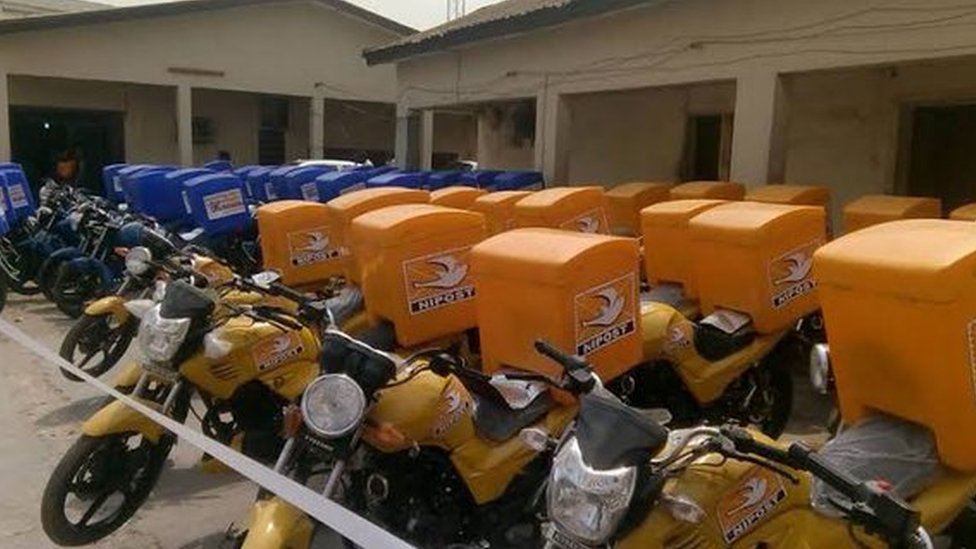
The federal government has disclosed plans to launch a set of policies to unbundle the Nigerian Postal Services (NIPOST) which would see it not just as a regulator but as a competitor in logistics, courier and even financial services.
This was disclosed by the Minister of Communications and Digital Economy, Mr Isa Pantami, on Tuesday, at the unveiling ceremony of the NIPOST N50 revenue stamp in Abuja.
Mr Pantami stated that the unbundling would transform its operations and make it innovative.
In his words, “We have so many policies of transforming NIPOST in the pipeline and part of it will unbundle NIPOST.
“We also have the Act of NIPOST going into an amendment.
“We have a plan with a property and development company, the firm will bring together all the properties of NIPOST, develop them and make sure that the government generates revenue from them.
“All generated revenue will go into developing sectors like health, education, agriculture, security and other social developments,” he said.
The Minister added that the NIPOST unbundling would see the restructuring of its NIPOST transport and logistics, courier services and microfinance bank.
Mr Pantami said he was hopeful of NIPOST becoming a world-class outfit and praised stakeholders for their unrelenting efforts in remodelling and recording modest achievements recently.
In his remarks, Mr Ismail Adewusi, Postmaster General and Chief Executive Officer of NIPOST, said that over the years, Nigeria’s history had been documented through stamps.
“Through stamps, NIPOST has documented Nigeria’s history, educating and preserving our national heritage among others,” he explained.
“Stamps have served as objects of visual communication and dependable recorder of events for prosperity,” Mr Adewusi said.
He urged members of the public to use the new revenue stamps for the authentication and validation of documents and denotation of fees.
“We have about 25 million copies of the stamp unveiled today for sale at the rate of N50 each and it is available for sale in all our postal outfits nationwide,” Mr Adewusi added.
“We are hopeful it will be sold out in the next two weeks and then we commence reproduction,” he further said.
Economy
Wale Edun’s Claims of 1.8mbpd Crude Output Contrast Official Data
By Adedapo Adesanya
The Minister of Finance, Mr Wale Edun, says Nigeria’s crude oil production has risen to 1.8 million barrels a day, contrasting with available production data.
Speaking in an interview with Reuters on Wednesday on the sidelines of the International Monetary Fund and World Bank Group spring meetings in Washington D.C., the Minister said the current oil output would generate fiscal breathing space that will allow the government to support vulnerable households as it ploughs ahead with reforms.
Nigeria, which is a member of the Organisation of the Petroleum Exporting Countries (OPEC), is Africa’s largest oil producer.
Mr Edun said rising crude production was positive for Nigeria’s revenue, foreign exchange and the country’s fiscal situation.
“It gives us that extra fiscal space within which to look at … helping the vulnerable households at this time,” he told the publication, noting that support would be targeted, adding “there is no thought of any return or retardation to broad untargeted subsidies.”
Mr Edun also said the Bola Tinubu-led administration was also committed to continuing its reform programme.
“Nigeria is in a position where the resilience that has been built in the economy is actually very obvious for all to see,” he said.
Despite the 1.8 million barrels per day figure claim, Business Post reports that production data for March 2026 from the Nigerian Upstream Petroleum Regulatory Commission (NUPRC) shows that Nigeria attained 1.546 million barrels per day, made up of 1.382 million barrels per day of crude, 42,809 barrels per day of blended condensate and 120,442 barrels per day of unblended condensate.
The average crude production represents 92 per cent of the OPEC quota, which is fixed at 1.5 million barrels per day.

Economy
SEC Opens Capital Market to Free Trade Zone Companies
By Adedapo Adesanya
The Securities and Exchange Commission Nigeria (SEC) has unveiled a new regulatory framework that would allow companies operating within free trade zones to raise capital from the Nigerian public, subject to strict eligibility and disclosure requirements.
The proposal, titled New Rules for Public Offering of Securities by a Free Trade Zone Entity, is anchored on provisions of the Investments and Securities Act (ISA) 2025 and is designed to integrate free trade zone enterprises into the domestic capital market while strengthening investor protection.
Under the proposed rules, only entities duly licensed by recognised free zone authorities, such as the Nigeria Export Processing Zones Authority and the Oil and Gas Free Zones Authority, will be eligible to issue shares to the public.
The commission clarified that the rules will apply strictly to free trade zone entities (FTZEs), excluding companies operating outside designated zones, even if licensed by zone authorities. It also emphasised that no FTZE will be permitted to offer securities to the public without prior approval from the Commission.
To qualify, an FTZE must demonstrate a minimum of three years’ operating track record immediately preceding its application, with at least two years of independent business activity within a free trade zone. Additionally, such entities are required to have competent senior management and a minimum paid-up share capital of not less than N7.5 billion.
The SEC said FTZEs seeking to access the capital market must subject themselves to Nigeria’s tax laws and comply fully with ongoing disclosure and reporting obligations applicable to publicly listed companies.
The proposed framework also outlines extensive registration requirements. Issuers will be required to submit evidence of licensing by a free zone authority, constitutional documents, and verified details of shareholding structure and board composition.
A “No Objection” letter from the relevant free zone authority will also be mandatory, alongside a commitment to list the offered shares on a registered securities exchange.
The SEC noted that the rules are intended to provide clarity on eligibility criteria and operational conditions for FTZEs seeking to conduct public offerings, thereby deepening the capital market and aligning free zone operations with national financial system standards.
Economy
Guinness Nigeria Shareholders to Pocket N4.38bn Interim Dividend for Q1’26
By Aduragbemi Omiyale
Shareholders of Guinness Nigeria Plc will share about N4.38 billion as an interim dividend for the first quarter of 2026, the board has disclosed.
This cash reward amounts to N2.00 per share, as the company has shares outstanding of 2,190,382,819 on the floor of the Nigerian Exchange (NGX) Limited.
The brewer stated that the interim dividend would be paid to investors whose names appear on the register of members as of the close of business on April 20, 2026.
The dividend payout is being proposed following the sustained profitability reflected in the unaudited financial results of the company in the first three months of this year and its “strong performance in FY 2025.”
It would be “paid from distributable profits in accordance with Sections 426–428 of the Companies and Allied Matters Act (CAMA) 2020.”
Analysis of the performance of the brewery giant between January and March 2026 showed that revenue grew by 4 per cent on a year-on-year basis to N122.77 billion from N118.34 billion in the same period of last year, while the gross profit contracted to N43.48 billion from N44.52 billion due to prevailing cost pressures within the operating environment.
The company’s operating profit also shrank to N17.18 billion from N18.00 billion in the first quarter of 2025 due to elevated marketing & distribution costs and administrative expenses.
However, the reduction in net finance costs to N1.43 billion from N7.72 billion in Q1 of 2025 helped the organisation to grow its post-tax profit to N10.39 billion in the period under review versus the N7.03 billion recorded in the corresponding period of last year.
-
Feature/OPED6 years agoDavos was Different this year
-
Travel/Tourism10 years ago
Lagos Seals Western Lodge Hotel In Ikorodu
-
Showbiz3 years agoEstranged Lover Releases Videos of Empress Njamah Bathing
-
Banking8 years agoSort Codes of GTBank Branches in Nigeria
-
Economy3 years agoSubsidy Removal: CNG at N130 Per Litre Cheaper Than Petrol—IPMAN
-
Banking3 years agoSort Codes of UBA Branches in Nigeria
-
Banking3 years agoFirst Bank Announces Planned Downtime
-
Sports3 years agoHighest Paid Nigerian Footballer – How Much Do Nigerian Footballers Earn