Economy
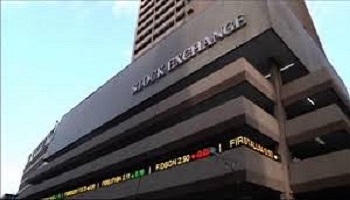
NSE Market Cap Loses N180b As Dangote Cement Sheds N8.42k

By Modupe Gbadeyanka
The Nigerian equity market recorded a further drop on Tuesday just like the previous day with the major market indicator falling by 1.95 percent.
The all-share index lost 523.27 points or 1.95% to finish at 26,364.27 points, while the market capitalisation shed N180.1 billion to close at N9.07 trillion.
Dangote Cement slumped by N8.42k at the market to lead the losers’ chart, closing at N164.1k per share while Forte Oil fell by N5.98k to close at N113.72k per share.
Also, Lafarge Africa lost N2.74k to finish at N52.14k per share, Okomu Oil shed N2.30k to end at N44.70k per share and UACN depreciated by 93k to finish at N17.67k per share.
Investors at the Nigerian Stock Exchange (NSE) market traded a total of 189 million shares in 3,434 deals valued at N1.6 billion on Tuesday. This showed an improvement from what was achieved on Monday, where 115.04 million shares worth N1.16 billion in 2,963 deals were exchanged.
Guinness went up by N2.50k at the market to close at N88.50k per share, while Nigerian Breweries appreciated by N2 to finish at N144 per share.
CAP Plc gained N1.62k to end at N34.2k per share, GlaxoSmithKline improved by 75k to finish at N15.75k per share, while Eterna Oil pushed up by 14k to close at N3.36k per share.
Economy
Reps Extol SEC on Fiscal Sustainability, Revenue Growth
By Aduragbemi Omiyale
The Securities and Exchange Commission (SEC) has been praised by the House of Representatives Committee on Finance for improving its fiscal sustainability through cost-cutting measures and enhanced revenue generation.
The Deputy Chairman of the panel, Mr Saeed Musa Abdullahi, speaking on Tuesday during the 2026 Revenue Monitoring Exercise with the commission in Abuja, however, challenged the organisation to exceed its 2026 revenue target.
He commended the regulator’s efforts to strengthen its finances and urged it to sustain the momentum.
“You have done significantly well. We have followed the progress of the SEC over the years and urge you to keep the flag flying. We will continue to celebrate you when you do well.
“This exercise is not to witch-hunt any agency; it is aimed at ensuring better performance, especially at a time when the country is facing serious fiscal challenges,” the lawmaker said.
“You have told us your revenue projection for 2026, but we believe you can do more. We urge you to surpass your projection by at least 20 per cent, or even more,” Mr Abdullahi stated.
Earlier, the Director-General of the SEC, Mr Emomotimi Agama, told the committee that, in line with the principles of the International Organisation of Securities Commissions (IOSCO), securities regulators are expected to operate independently, with governments providing financial support where necessary.
According to him, his organisation currently receives no budgetary allocation from the federal government, relying instead on income generated from the capital market while still remitting funds to the government.
“Going by IOSCO principles, the SEC is expected to be financially independent. The government is supposed to provide support for the running of the Commission.
“However, due to the paucity of funds, all the money used to fund the commission comes from the market. The SEC does not receive any funding from the government; rather, it pays money to the government,” he said.
The DG explained that once the commission’s revenues are paid into its account with the Central Bank of Nigeria (CBN), statutory deductions are made automatically before the SEC can access the funds.
“When these funds hit our account with the CBN, deductions are made directly by the government. We do not have access to the funds before the deductions are effected,” he added.
Mr Agama noted that as a regulator, the SEC is careful not to overburden market operators with additional charges to fund its operations. To ease financial pressure, he said the agency secured approval from the Minister of Finance for a waiver allowing it to retain 20 per cent of its income.
“We are regulators and are not expected to ask the market for money. With the kind permission of the Minister of Finance, we obtained a 20 per cent waiver on deductions to ensure our operations are not hindered,” he said.
The SEC boss also disclosed that the commission had secured a grant from the African Development Bank (AfDB) to acquire a modern market surveillance system, which is expected to be deployed this year to strengthen oversight of Nigeria’s capital market and align it with international standards.
Economy
S&P Global Buys Majority Stake in Agusto Rating Firm
By Adedapo Adesanya
S&P Global has agreed to acquire a majority stake in Agusto & Co., a leading Pan-African rating agency with operations in Nigeria, Kenya, Rwanda and Ghana.
The investment, a strategic step for both companies, will complement and support the growth strategy of the S&P Global Ratings division in Africa. The terms of the transaction were not disclosed.
The company said in a statement on Tuesday that by combining S&P Global’s international expertise and resources with Agusto & Co.’s strong Pan-African presence and reputation for excellence, the partnership aims to expand market insights, strengthen credit transparency, and support market participants across the region.
“We are delighted to partner with Agusto & Co. to strengthen our domestic ratings presence across Africa,” said Mr Yann Le Pallec, President, S&P Global Ratings. “This transaction underscores our commitment to supporting growth and transparency in local credit markets throughout the continent. Africa’s opportunity is extraordinary, and by combining our global expertise with Agusto & Co.’s deep local insights, together we can foster informed analysis, constructive market dialogue, and greater investor confidence both regionally and internationally.”
“This partnership is a transformational milestone for Agusto & Co. and African capital markets, fulfilling our late founder’s vision of affiliating with a leading global rating agency,” said Yinka Adelekan, Managing Director of Agusto & Co.
“For more than 30 years, we have built a trusted credit rating institution across Africa. By combining our deep Pan-African market knowledge and analytical independence with S&P Global Ratings’ global expertise, resources and affiliate network, we believe this partnership will create new opportunities, enhance value for market participants, and support the continued development of transparent and resilient credit markets across the continent.”
Agusto & Co. is a leading Pan-African credit rating agency with a strong presence in Nigeria and other key African markets, rating financial institutions, corporates and other entities. Following the transaction, Agusto & Co. will continue to operate as a separate ratings entity and issue its own credit ratings and methodologies in accordance with applicable regulatory requirements.
The transaction is subject to customary closing conditions, including receipt of required regulatory approvals.
Subject to obtaining all required regulatory approvals, the transaction is expected to close during the second half of 2026.
The transaction is not expected to have a material impact on the financial results of S&P Global or S&P Global Ratings, the agency said.
Agusto & Co. was founded in 1992 by the late Nigerian economist and chartered accountant, Mr Olabode (Bode) Agusto. It was established as the first credit rating agency in Nigeria.
Mr Agusto, who served as the firm’s first managing director for 11 years, died in October 2023.
Economy
LCCI Opposes Pension Contribution Hike, Cites Inflation, High Costs
By Adedapo Adesanya
The Lagos Chamber of Commerce and Industry (LCCI) has urged the federal government to suspend plans to increase Nigeria’s mandatory pension contribution rate.
The chamber’s Director General, Dr Chinyere Almona, warned that the move could worsen the challenges facing businesses, threaten jobs and discourage investment.
She noted that while improving retirement security is important, raising pension contributions at a time when businesses are grappling with soaring inflation, extremely high borrowing costs, exchange rate volatility, rising energy prices and multiple taxes would place an unbearable burden on employers.
According to the DG, Nigeria’s existing contribution rate is already comparable with global standards, noting that the country’s 18 per cent mandatory contribution is close to the OECD’s 18.8 per cent average and significantly higher than rates in countries such as the United Kingdom (8 per cent), the United States (12.4 per cent) and Kenya (12 per cent).
She warned that increasing payroll costs at this time would discourage recruitment, suppress wage growth, place disproportionate pressure on micro, small and medium-sized enterprises (MSMEs), reduce Nigeria’s attractiveness to investors and push more businesses into the informal sector.
The advocacy group called on the government to defer the proposal until a comprehensive Nigeria-specific actuarial and economic impact assessment is conducted and extensive consultations are held with the organised private sector and labour unions.
The group recommended that instead of increasing mandatory contributions, the National Pension Commission (PenCom) should focus on developing innovative investment instruments capable of delivering higher returns on existing pension assets, saying this would improve contributors’ retirement savings without imposing additional financial pressure on businesses.
PenCom had recently proposed an increase in mandatory pension contributions as well as a 3 per cent mandatory annual contribution equivalent to 3 per cent of the total wage bill.
According to the insurance regulator, the proposal forms part of broader pension sector reforms designed to strengthen the financial security of Nigerian workers in retirement.
LCCI’s opposition to this proposed policy comes after the Organised Private Sector of Nigeria expressed its disdain over the issue, also citing rising inflation and economic hardship for its rejection.